GIDEON blog

Free Demo ► Latest Updates ► Video Tutorials ►
Subscribe , j x

South Sudan: Unknown Hemorrhagic Illness

Regarding an ongoing outbreak of hemorrhagic illness in South Sudan, a differential diagnosis list generated by Gideon [Global Infectious Disease & Epidemiology Network]https://www.gideononline.com, includes 2 lesser-known pathogens which have been associated with single small clusters of hemorrhagic fever in Africa: Bas-Congo virus (rhabdovirus) and Lujo virus (arenavirus). In 2008, 4 of 5 patients died of Lujo virus infection in a South African hospital, following transfer of an index patient from Zambia. The following year, 2 of 3 villagers in DR Congo died in an outbreak of Bas Congo virus infection. If tests for other pathogens continue to be negative, these 2 agents might be considered.

Cited on ProMED

Measles in Cambodia

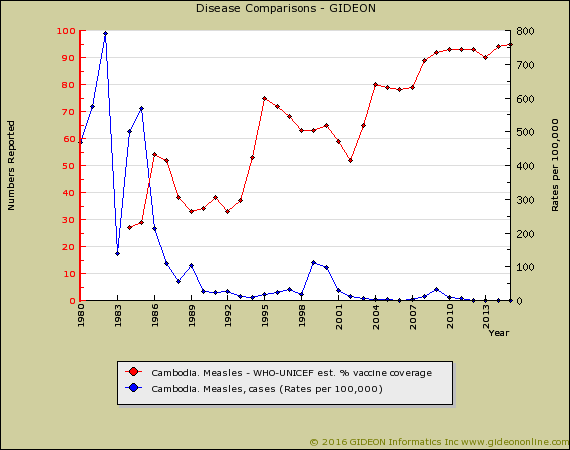
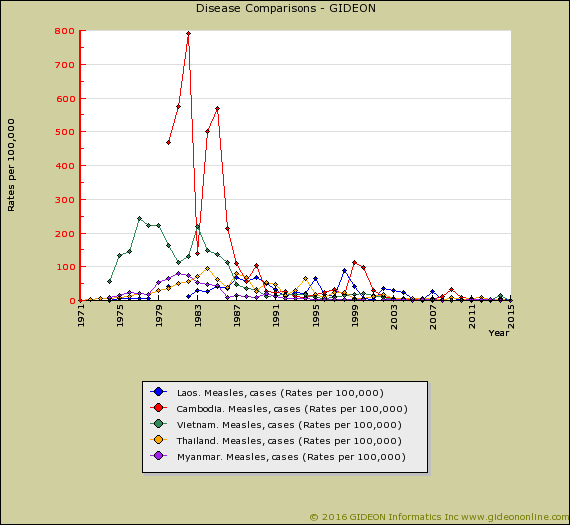
Major outbreaks of measles were reported in Cambodia during the 1980’s.  As vaccination uptake steadily increased to levels in excess of 90%, disease incidence in the country is currently similar to the low rates reported by neighboring countries [1,2]  See graphs [3]:

CambodiaMeasles


CambodiaVac.


References:

  1. Berger SA. Measles: Global Status, 2016. 429 pp, 537 graphs, 3,928 references. Gideon e-books, https://www.gideononline.com/ebooks/disease/measles-global-status/
  2. Berger SA. Infectious Diseases of Cambodia, 2016. 425 pp, 54 graphs, 2,029 references. Gideon e-books, https://www.gideononline.com/ebooks/country/infectious-diseases-of-cambodia/.
  3. Gideon Graphs Tool at: https://www.gideononline.com/wp-content/uploads/Gideon-Graphs.pps

Hand, Foot and Mouth Disease in Singapore

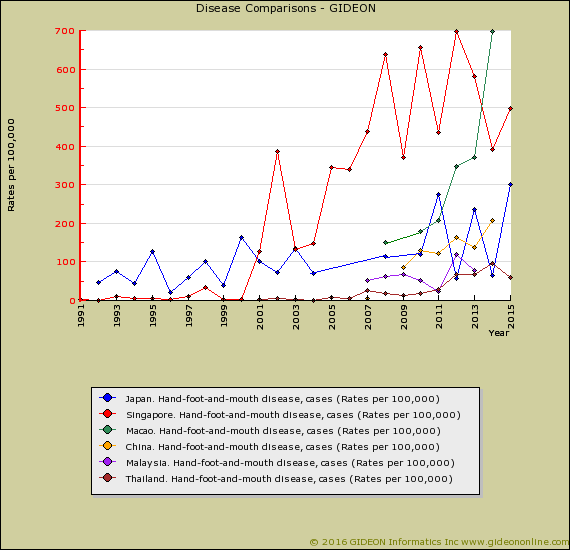
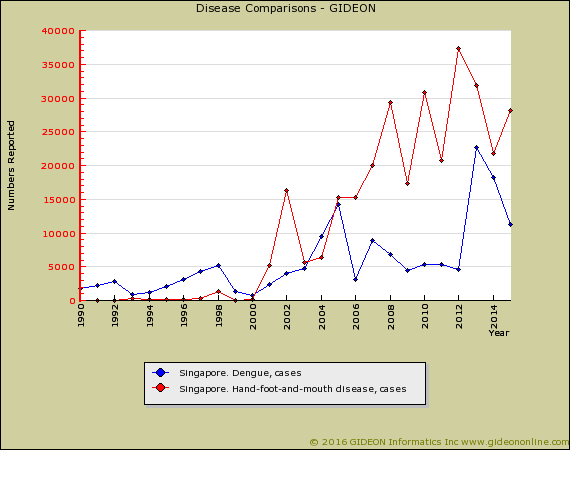
Highest rates of Hand, foot and mouth disease (HFM) in Asia are reported by Singapore and Macao.  In fact, the incidence of HFM in Singapore is even higher than that of the more familiar dengue fever. [1,2]

HFM1


HFM2

Reference:

  1. Berger SA. Infectious Diseases of Singapore, 2016. 461 pages, 112 graphs, 2073 references. Gideon e-books, https://www.gideononline.com/ebooks/country/singapore/
  2. See Gideon Graphs Tool at: https://www.gideononline.com/wp-content/uploads/Gideon-Graphs.pps


Yellow Fever and Fame

Infectious Diseases continually shape human history, often through their impact on leaders in Science, Politics, War, Religion, Industry and Art. The death of a King, President or Pope from plague or malaria can affect us all, and serves as a useful paradigm in the appreciation of these conditions. For many, yellow fever (YF) remains a “rare tropical disease” which (as in the current Angolan outbreak) periodically erupts in the developing world. Few realize that major YF outbreaks were recorded in the United States, Spain, Italy and even England into the early twentieth century. A chronology of outbreaks beyond The Tropics appears below.

A list of notables who died of YF includes Benjamin Latrobe, the architect who designed the United States Capitol Building, and Henry Lehman, the financier who founded Lehman Brothers. Both contracted the disease in New Orleans, respectively in 1820 and 1855. Heads of State who died of YF included Haitian President Alexandre Petion (died 1818) and Thomas Dundas, Governor of Guadeloupe (died 1794). Non-fatal attacks appear in the biographies of American President Zachary Taylor, Texas President Anson Jones and Chilean Supreme Director, Bernardo O’Higgins.

Other victims of YF included Cyrus McCormick, Thomas Nast, Donald Meek, John James Audubon and Alexander Selkirk. McCormick, inventor of the mechanical reaper, acquired the infection in Virginia at the age of 5. Nast, a legendary political cartoonist, was stricken in Ecuador in 1902; and Meek an iconic character actor, was rendered permanently bald after surviving Yellow fever during the Spanish American War. Audubon survived an attack of YF in 1803, after emigrating to Philadelphia from Haiti. That year, outbreaks of the disease were reported in both. Alexander Selkirk, the Scottish castaway who served as inspiration for Robinson Crusoe, died of YF during Navy service in West Africa (1721).   Indeed, military activity often exposes famous people to “exotic” diseases. Thus, British war hero Horatio Nelson suffered a nonfatal attack of YF in Cuba in 1780; and Samuel Nicholas, first Commander of the United States Marines, died during an outbreak in Philadelphia in 1790. A number of former Civil War Generals succumbed to the disease, including Charles Griffin (1867), Cyrus Hamlin (1867), John Bell Hood (1879) and Edward Ord (1883).

To date, over 500 health-care workers have died during the Ebola epidemic in West Africa; and it is no surprise that several notable victims of Yellow fever have been scientists working with the disease itself. Physicians John Conrad Otto, Philip Syng Physick and Benjamin Rush all survived attacks of YF while working in Philadelphia. Medical personnel who died of YF included doctors Jesse Willam Lazear (1900) and James Carroll (1907), and nurse Clara Maass (1901), who succumbed after purposely exposing themselves to the bites of infected mosquitoes in Cuba. Other physicians who died of YF (country – year of death) included Francois Carlo Antommarchi (Cuba – 1838), personal physician to Napoleon Bonaparte; Richard Bayley (New York -1801), the first Chief Health Officer of New York City; and Paul A. Lewis (Brazil – 1929). In 1928, Hideo Noguchi and William Alexander Young both died of Yellow fever while studying the disease in Ghana.

Notable victims of Yellow fever have also included three painters, a chess master, four authors / journalists, and two co-conspirators in the Lincoln assassination. A full listing and additional background data are available on a free website which I maintain at www.VIPatients.com   The site is interactive. Users can explore the medical history of over 22,000 “VIP’s” (and 130 famous animals) ; or generate lists based on disease, profession and year of death. Although specific diagnoses are derived primarily from biographies, which are often speculative or biased, entries are regularly updated as additional information becomes available. The author will value feedback and suggestions.

A Chronology of Yellow Fever Outbreaks Beyond The Tropics [1,2]

1730 – An outbreak (2,200 fatal cases) was reported in Cadiz, Spain (with subsequent outbreaks in 1731, 1736, 1764, 1800, 1802, 1805, 1810, 1813, 1819 and 1821.) 
1793 – An outbreak (4,044 fatal cases) of yellow fever was reported in Philadelphia, Pennsylvania.
1794 – An outbreak (360 fatal cases) was reported in Baltimore, Maryland.
1796 – An outbreak was reported in New Orleans, Louisiana.
1798 – Outbreaks were reported in Philadelphia, Pennsylvania (3,506 fatal cases) , New Haven, Connecticut and New York City.
1800 – An outbreak (1,197 fatal cases) was reported in Baltimore, Maryland.
1800 – An outbreak (60,000 fatal cases) was reported in Spain.
1802 – An outbreak was reported in Brest, France.
1803 – Outbreaks (606 fatal cases) were reported in New York City and Philadelphia, Pennsylvania.
1804 – An outbreak (2,000 cases, 650 fatal) of yellow fever was reported in Livorno, Italy.
1804 – Outbreaks were reported in Gibraltar and Alicante, Spain.1808 – An outbreak was reported in Georgia (U.S.).
1819 – An outbreak was reported in Cadiz, Spain.
1820 – An outbreak was reported in Savannah, Georgia.
1821 – An outbreak (20,000 fatal cases = one-sixth of the population) was reported in Barcelona following introduction by a ship from Cuba.
1823 – An outbreak was reported in Lisbon, Portugal.
1828 – An outbreak (5,383 cases, 1,183 fatal) was reported in Gibraltar.
1857 – An outbreak was reported in Oporto and Lisbon, Portugal.
1870 – An outbreak (1,235 fatal cases) in Barcelona was related to a ship arriving from Cuba.
1838 to 1839 – An outbreak was reported in Charleston, South Carolina.
1839 – An outbreak (250 fatal cases – 5% of the population) was reported in Galveston, Texas.
1852 – An outbreak was reported in Charleston, South Carolina.
1852 – An outbreak was reported in Southampton, England.
1855 – An outbreak was reported in Virginia.
1861 – An outbreak (40 cases, 26 fatal) was reported in Saint-Nazaire, France.
1862 – An outbreak was reported in Wilmington, North Carolina.
1863 – An outbreak was reported in Shreveport, Louisiana.
1865 – Outbreaks (27 cases, 17 fatal) were reported in Wales, and in Swansea, England (imported from Cuba).
1867 – An outbreak (1,150 fatal cases) of yellow fever was reported in Galveston, Texas.
1873 – An outbreak was reported in Shreveport, Louisiana.
1873 to 1875 – An outbreak was reported in Pensacola, Florida.
1876 – An outbreak was reported in Savannah, Georgia.
1877 – An outbreak was reported in Port Royal, South Carolina.
1878 to 1879 – Outbreaks of yellow fever were reported in Mississippi , Memphis, Tennessee and New Orleans, Louisiana (4,046 fatal cases).
1882 – An outbreak was reported in Pensacola, Florida.
1887 to 1888 – An outbreak was reported in Florida.
1888 – An outbreak of yellow fever was reported in Mississippi
1905 – Outbreaks were reported in New Orleans, Louisiana (8,399 cases) and Pensacola Florida.
1909 – An outbreak was reported on a ship arriving to Saint Nazaire, France from Martinique – with no secondary spread to the port.

References

  1. Berger SA. Yellow Fever: Global Status, 2016. 152 pates, 124 graphs, 983 references. Gideon e-books, https://www.gideononline.com/ebooks/disease/yellow-fever-global-status/
  2. Berger A. Infectious Diseases of the United States, 2016. 1,305 pages, 489 graphs, 15,433 references. Gideon e-books, https://www.gideononline.com/ebooks/country/infectious-diseases-of-the-united-states/

Update: Posted in ProMED
Lyme Disease in the United Kingdom

The following background data on Lyme disease in the United Kingdom were abstracted from Gideon www.GideonOnline.com and the Gideon e-book series.  [1,2] Primary references are available on request.

Time and Place:

Lyme disease is reported from East Anglia, Scotland, Wales, Yorkshire and Northern Ireland.  Highest incidence is associated with popular holiday destinations such as Exmoor, the New Forest, the South Downs, parts of Wiltshire and Berkshire, Thetford Forest, the Lake District, the Yorkshire moors and the Highlands and Islands of Scotland.  “Hot spots” for the disease include the New Forest and the Southwest region.  45% of reports originate in three contiguous counties in southern England:  Hampshire, Wiltshire and Dorset.  This area includes foci in and near the New Forest and Salisbury Plain. Other counties with a relatively high incidence include Devon and Somerset in southwestern England; and Norfolk in East Anglia.

Incidence:

Reporting rates in the United Kingdom are approximately 39% of true incidence (2011).  Case reports peak in the third quarter of each year, which accounts for 48% of all cases.

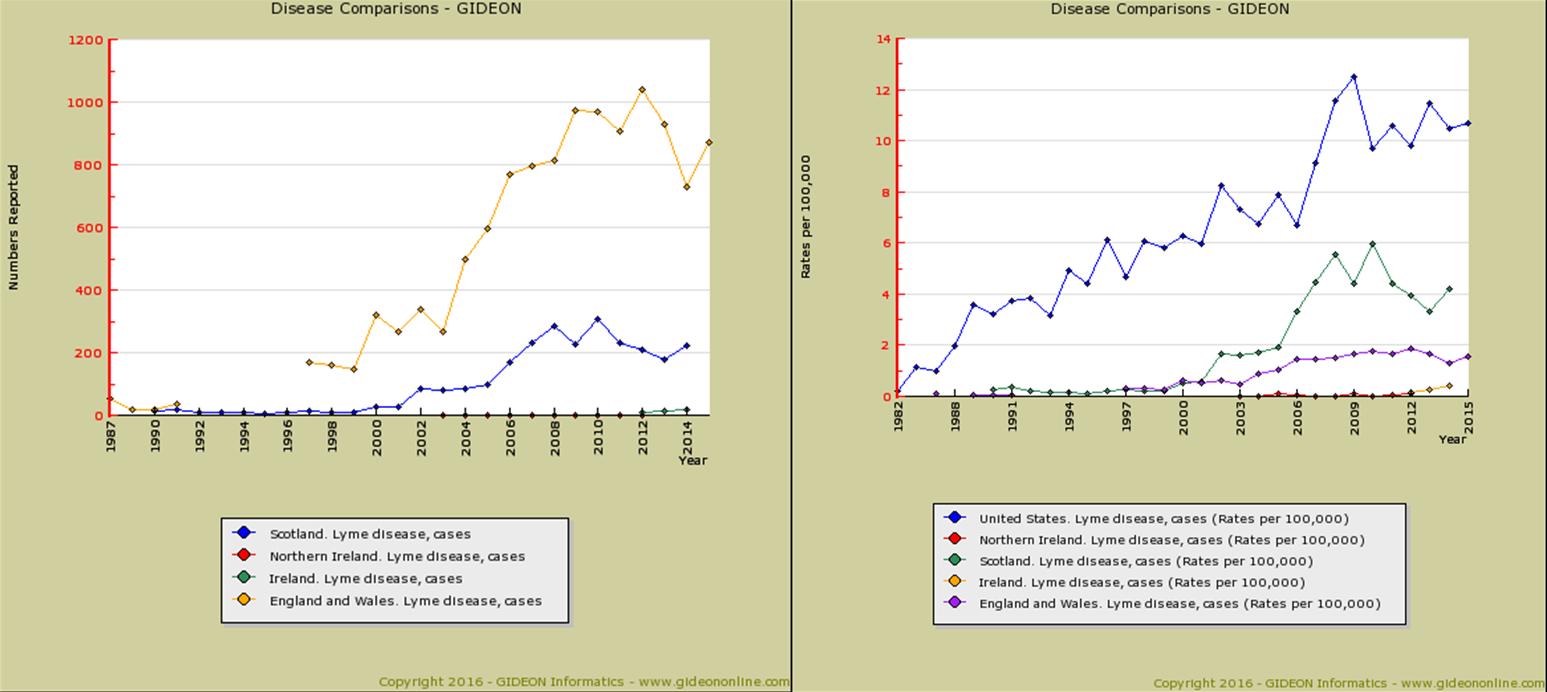
In the following graphs, I’ve contrasted case numbers and rates per 100,000 in the United Kingdom, with those reported in Ireland and the United States.  Note that highest disease incidence in the United Kingdom is reported from England and Wales;  and highest rates per 100,000 from Scotland.  Reported rates in the United States are approximately 2.5-fold those of Scotland.

lyme

Infections due to Borrelia burgdorferi, B. afzelii and B. garinii are identified.

Borrelia valaisiana and B. afzelii have been identified in ticks in Scotland.


Prevalence surveys:

23% of patients referred to an infectious disease unit for suspected Lyme disease (2006 to 2010)
2.3% of dog ticks in the United Kingdom (2009)
4.2% of ticks (Ixodes ricinus) in England (2014 publication)
0.5% of pet-dog ticks (2012 publication)
0% of tick larvae, 2.14% of nymphs and 0% of adults in South London parks (2015 publication)
8.6% of ticks in the Scottish Highlands (both B. afzelii and B. burgdorferi, 1997)
37% of ticks in wooded areas of southern Wales
8.6% of Highland ticks in Scotland (Borrelia burgdorferi, 1997)
5.6% of questing tick nymphs in Scotland (Borrelia burgdorferi, 2012 publication)
11.9% of grey squirrels in Scotland (Sciurus carolinensis, 2015 publication)

Seroprevalence surveys:

2.5% to 4.0% of blood donors in South England
0% to 0.5% of blood donors in the inner-city
25% of forestry workers in endemic areas (1989 publication)
14.3% of farmers in Northern Ireland (1990 publication)
6.5% of individuals in the Scottish Highlands (2004 to 2006)
23% of wild deer in England and Wales (2012 publication)

Reservoirs:

Grey squirrels (Sciurus carolinensis Gmelin) and pheasants (Phasianus colchicus Linneaus) 18 are important hosts for Ixodes ricinus, and may serve as amplifying hosts for Borrelia burgdorferi in this country.

Seropositive horses are found in most parts of the U.K.

Note featured on ProMed

References:
1. Berger SA. Lyme Disease: Global Status, 2016. 87 pages, 67 graphs, 1037 references. Gideon ebooks, https://www.gideononline.com/ebooks/disease/lyme-disease-global-status/

2. Berger SA. Infectious Diseases of the United Kingdom, 2016. 1317 pages, 971 graphs, 4,932 references. Gideon ebooks,
https://www.gideononline.com/ebooks/country/infectious-diseases-of-the-united-kingdom/

2016 Edition of GIDEON eBooks

Since initial publication in 2010, the popularity of GIDEON ebooks has continued to grow. A WorldCat search demonstrates how many libraries across the globe now purchase the series for reference .

The 2016 edition has expanded all content, graphs, maps and references based on extensive updates in the GIDEON web application. This latest edition has the largest content of all prior editions:

  • 423 ebooks
  • 121,603 total pages
  • 34,726 images and graphs
  • 684,799 references
  • 2 GB in total file size

Every library in the world should carry at least two of our volumes:

  • The largest ebook (over 1,500 pages), Infectious Diseases of the World – provides a summary of every human infectious disease in the world including disease distribution maps.
  • Infectious Diseases of [your own country] – provides unique extensive background on every infectious disease relevant to that country.

Other valuable references include:

  • Global status of [every infectious disease] – the perfect reference source for every Public Health Department or researcher.
  • Detailed and up-to-date information on every anti-infective drug and vaccine – important references for every pharmacy.
  • A complete encyclopedia on all human bacteria and yeasts – a must for any laboratory or health-care student.

Available for purchase through:

Lyme Disease Rates in Finland

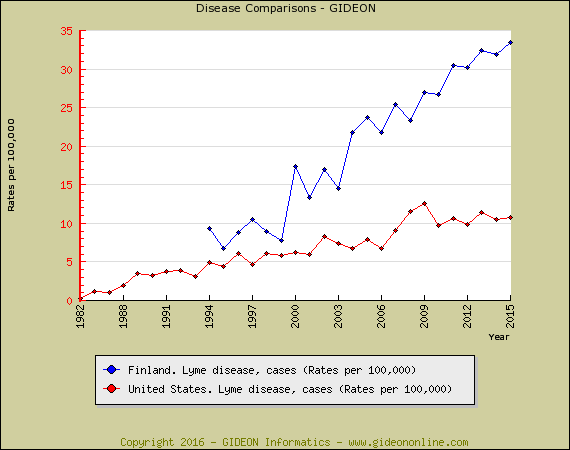
A recent report on ProMed that Lyme disease is an under-reported disease in Finland is disturbing.  Officially-reported rates have been increasing rapidly since the year 2000, and already exceed those of the United States by more than three-hundred percent !  [1,2]  See graph

Lyme-Finland

References:

  1. Berger S. Lyme Disease – Global Status, 2016. 83 pages, 66 graphs, 882 references. Gideon ebooks,  www.gideononline.com/ebooks/disease/lyme-disease-global-status/
  2. Berger S. Infectious Diseases of Finland, 2016. 482 pages, 130 graphs, 2,035 references. Gideon e-books

One Health – By the Numbers

Those of us who work in Human and Animal Health encounter zoonotic infectious diseases on an almost daily basis.  But precisely how common are these conditions?  A preliminary overview was undertaken to quantify and collate the impact of relevant diseases.  Data were generated using an interactive tool in Gideon. *

As depicted in the following tables, 59% (209) of all generic infectious diseases affecting mankind are derived from animal reservoirs.  Surprisingly, this percentage varies little when data are analyzed for specific countries selected at random from widely diverse regions.  Similarly, the distribution of diseases from country-to-country varies little, when collated by pathogen class, vector, vehicle and reservoir.

* See video tutorial at https://www.gideononline.com/video/  – scroll down to Diseases – Fingerprint

Zoonotic Infectious Diseases – Distribution by Reservoir

Region Diseases Zoonoses Bird Dog Cattle Rodent Pig
Worldwide 354 209 59% 49 14% 64 18% 50 14% 86 24% 39 11%
United States 247 129 52% 30 12% 43 17% 36 15% 52 21% 27 11%
China 253 132 52% 32 13% 47 19% 37 15% 53 21% 30 12%
France 222 106 48% 26 12% 36 16% 32 14% 38 17% 24 11%
Ghana 225 98 44% 22 10% 32 14% 30 13% 33 15% 23 10%
Brazil 257 130 51% 30 12% 42 16% 34 13% 50 19% 29 11%
Australia 220 102 46% 28 13% 31 14% 27 12% 33 15% 23 10%


Zoonotic Infectious Diseases – by Pathogen, Vector or Vehicle

Region Diseases Zoonoses Virus Parasite Bacterium Arthropod Food
Worldwide 354 209 59% 68 19% 72 20% 56 16% 79 22% 71 20%
UnitedStates 247 129 52% 28 11% 46 19% 45 18% 36 15% 51 21%
China 253 132 52% 24 9% 54 21% 47 19% 45 18% 58 23%
France 222 106 48% 19 9% 40 18% 42 19% 26 12% 44 20%
Ghana 225 98 44% 17 8% 36 16% 38 17% 20 9% 41 18%
Brazil 257 130 51% 30 12% 48 19% 42 16% 36 14% 51 20%
Australia 220 102 46% 28 13% 34 15% 41 19% 25 11% 44 20%

Tick-Borne Encephalitis in the Czech Republic

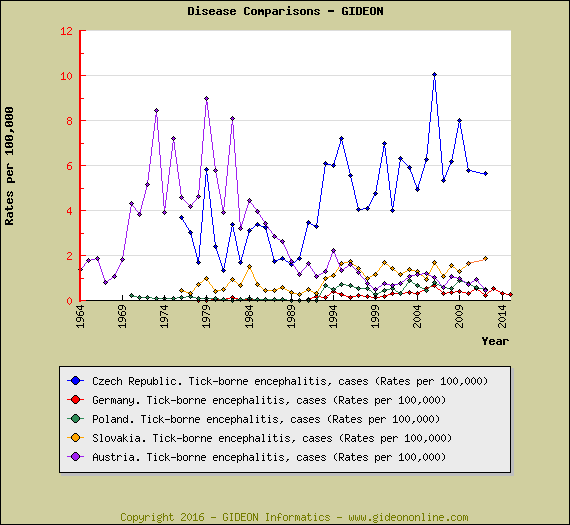
Rates of Tick-borne encephalitis (TBE) in the Czech Republic are similar to those reported by Austria during the 1970’s. [1,2]   Following the institution of mass vaccination by Austria in 1981, TBE rates decreased to levels experienced in neighboring countries. [3] Enhanced administration of TBE vaccine might also prove effective for the Czech Republic.
TBECzech

References:

1. Berger SA. Tick-Borne Encephalitis: Global Status, 2015. 65 pages, 45 graphs, 564 references. Gideon e-books, https://www.gideononline.com/ebooks/disease/tick-borne-encephalitis-global-status/

2. Berger SA. Infectious Diseases of the Czech Republic, 2015. 497 pages, 143 graphs, 2,097 references. Gideon e-books, https://www.gideononline.com/ebooks/country/infectious-diseases-of-the-czech-republic/

3. https://www.gideononline.com/wp-content/uploads/Gideon-Graphs.pps

Zika

When “Ebola” became a household word for most Americans in 2015, few realized that a more sinister outbreak was unfolding in their own back-yard. Chikungunya, a dengue-like illness which had previously been limited to the jungle areas of Africa and Asia, suddenly appeared in Latin America, resulting in over 2 million cases as of January 2016. And then Zika virus followed in the same region, threatening to attack a similar number of people. Unlike Chikungunya and Dengue, Zika virus infection has now been identified as a major cause of microcephaly (abnormally-small head) and other severe neurological disorders in babies born to women who are infected by Zika virus in early pregnancy.

GIDEON has been closely following Ebola, Chikungunya, Zika … and every other infectious disease – for over twenty five years. Health care profesionals can enter the signs and symptoms of patients from affected countries, and display a comprehensive, ranked list of possible diseases.

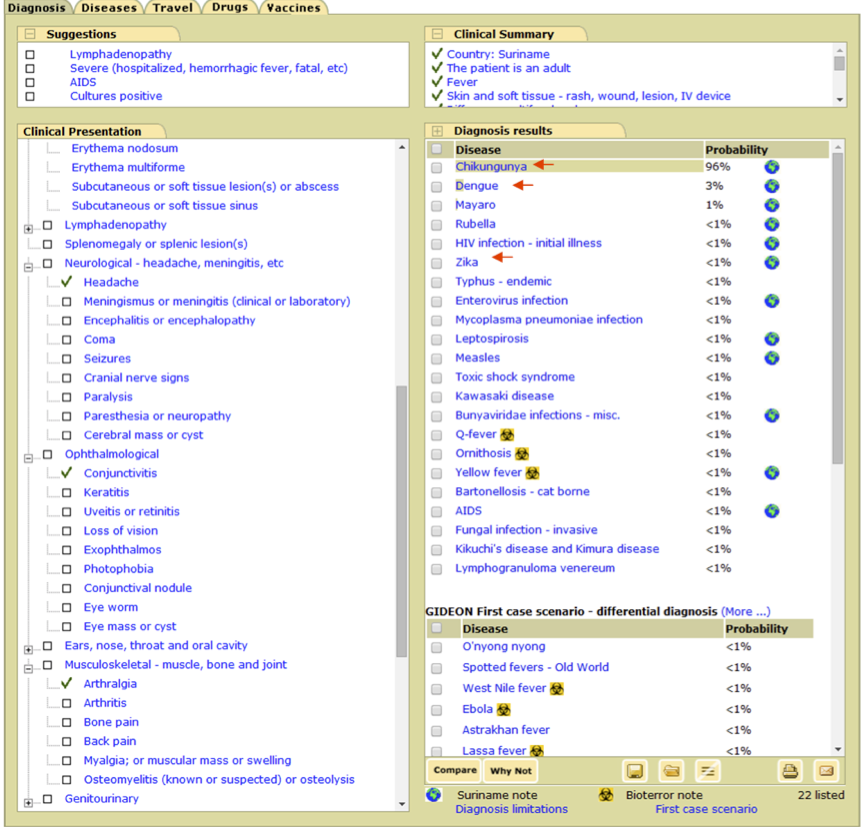
Findings of a recent patient treated after returning from Suriname with fever and rash were entered into GIDEON:

Suriname fever rash diagnosis

Note the red arrows to the right. GIDEON has indeed “considered” that the patient might be suffering from Chikungunya, Dengue, Zika – and a host of other common and lesser-known conditions.

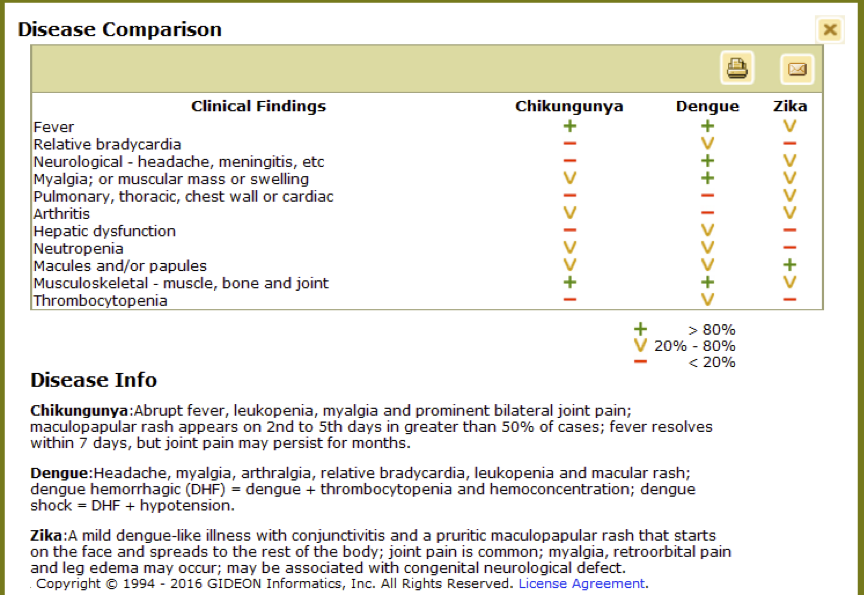
Users can easily access extensive background information on the diseases themselves, including maps, pictures and graphs, or explore their status on the global level, or within individual countries.  In this example, GIDEON compares the clinical features of Dengue, Chikungunya and Zika:

Compare Chikunhunya Dengue Zika

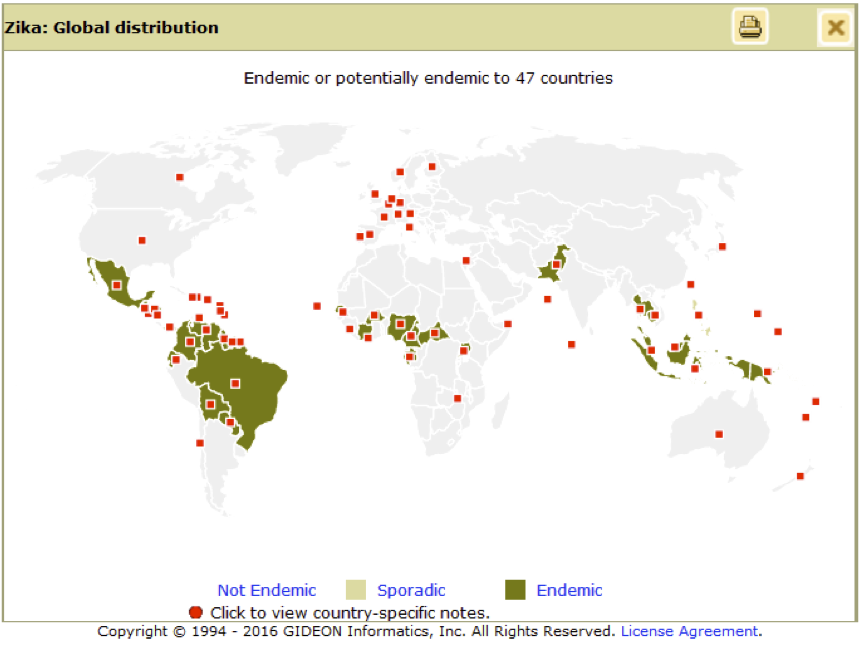
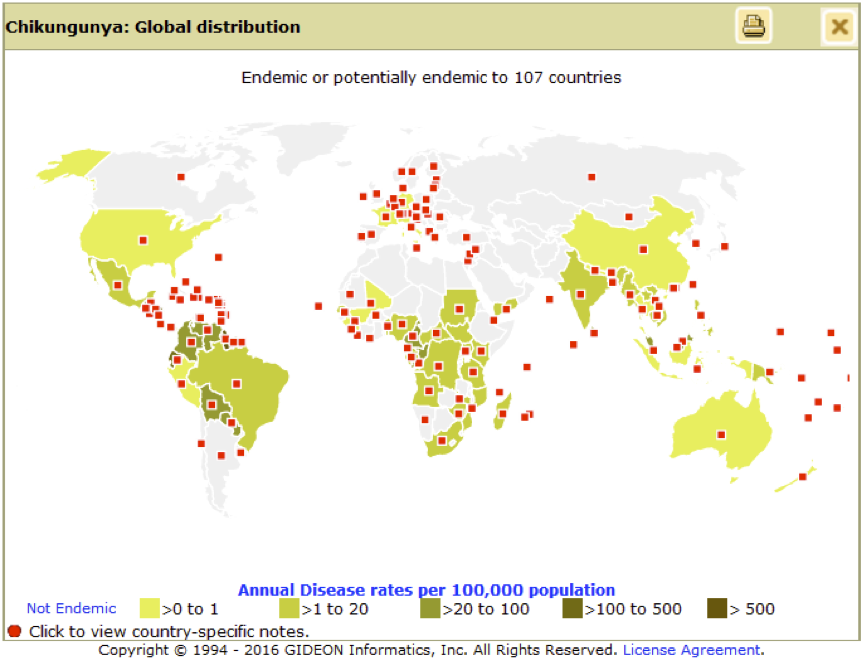
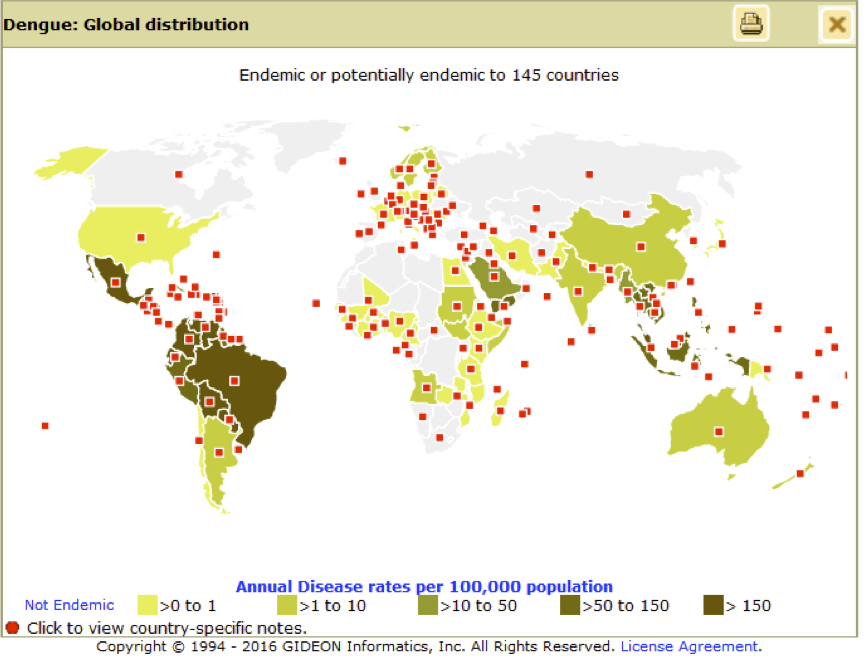
GIDEON maps the current global distributions of these three diseases:

Zika Global Distribution Chikungunya Global Distribution Dengue Global Distribution


GIDEON Sign In