GIDEON blog

Free Demo ► Latest Updates ► Video Tutorials ►
Subscribe , j x

Fifth Disease in Japan

The following background material on Fifth Disease in Japan is abstracted from Gideon www.GideonOnline.com and reference 1   Primary references are available on request to the author.
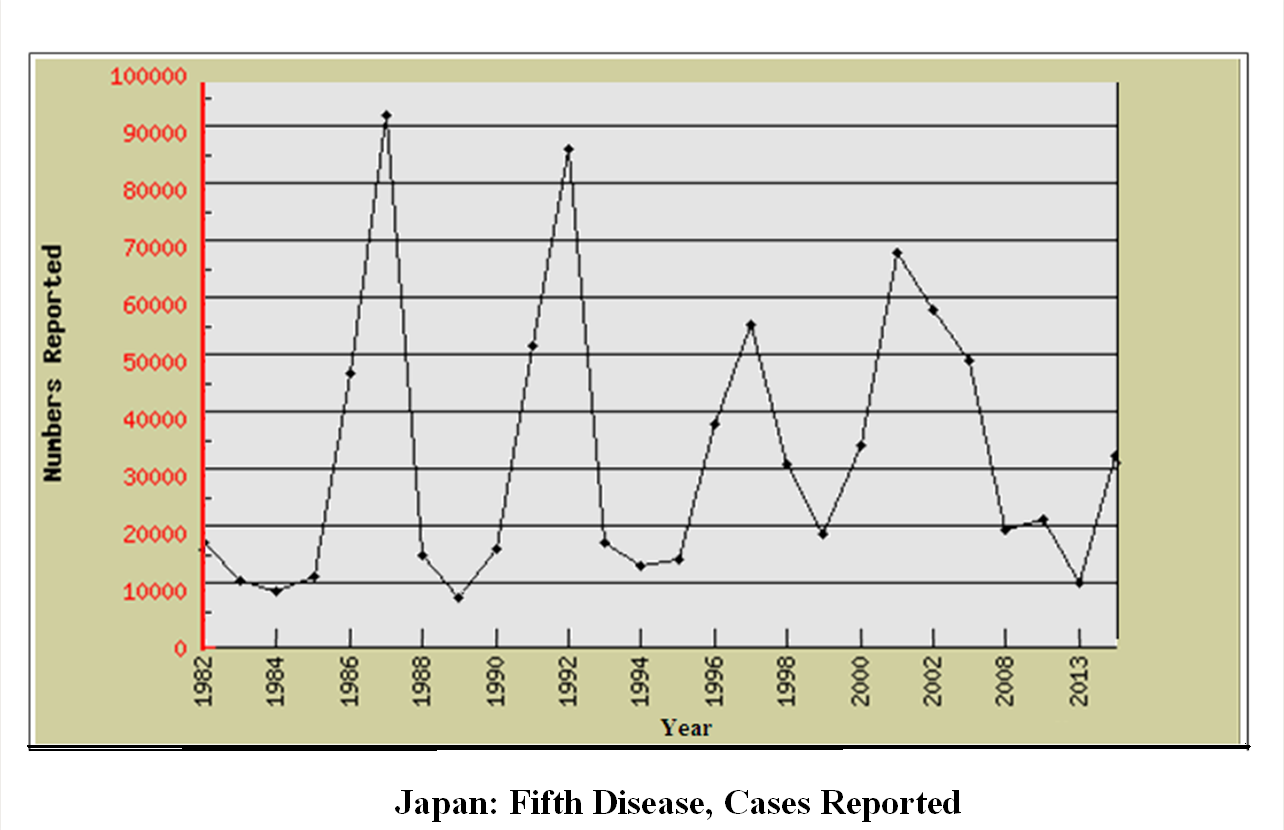
Epidemics of Parvovirus B19 infection occurred in Japan every ten years prior to 1980, and every five years since 1981.  Most cases occur during spring and summer, with highest rates among children ages 5 to 9 years.   See graph:
japan1

Parvovirus B19 infection causes an estimated 107 fetal deaths and 21 hydrops fetalis cases per year (2014 publication)
Eight cases of transfusion-associated Parvovirus B19 infection were reported during 1999 to 2008.

Prevalence surveys:
10% of nonimmune hydrops fetalis cases (1994 publication)

Seroprevalence surveys:
67.9% of healthy residents of Kyushu and Okinawa (IgG, 2013 publication)

2% of children ages 0 to 9 in 1973 and 16% in 1984

67% ages 20 to 29 in 1973 and 20% in 1984

80% ages 30 to 39 in 1973 and 56% in 1984

33% of pregnant women in Miyagi Prefecture in 1987, and 46% in 1997

Published outbreaks:
1977 to 1981 – Outbreaks of erythema infectiosum were reported – including 395 cases in one district of Tokyo.
1985 (publication year) – An outbreak of erythema infectiosum was reported.
1986 to 1987- Outbreaks of erythema infectiosum were reported.
1993 (publication year) – An outbreak of erythema infectiosum was reported among hospital staff members.
2000 (publication year) – An outbreak (10 cases) of nosocomial Parvovirus B19 infection was reported.

References:
1. Berger S. Infectious Diseases of Japan, 2015. 632 pages, 166 graphs, 3,706 references. Gideon e-book series, https://www.gideononline.com/ebooks/country/infectious-diseases-of-japan/
Lassa Fever and Travel

As of 2015, at least 57 cases of Lassa virus infection associated with travel have been reported.  The following chronology is abstracted from Gideon www.GideonOnline.com.  (I’ve also included a 2008 episode involving Lujo virus, a related pathogen).  Primary references are available on request

1969 – Lassa fever was first described when three American nurses working at Lassa, Nigeria contracted the illness.  Two died and the third was flown to America for treatment.
1971 – A nurse and physician from United Kingdom developed nonfatal Lassa fever in Sierra Leone.
1972 – A nurse from United Kingdom developed nonfatal Lassa fever in Sierra Leone.
1974 – A German physician contracted Lassa fever (nonfatal) in Nigeria.
1975 – An American aid worker developed nonfatal Lassa fever in Sierra Leone.
1975 – A physician was treated in the United Kingdom for Lassa fever acquired in Nigeria.
1976 – A Peace Corps worker returned to the United States from Sierra Leone with Lassa fever.
1976 – An engineer with Lassa fever (non-fatal) acquired in Nigeria was treated in the United Kingdom.
1980 – A case of Lassa fever (nonfatal) acquired in Burkina Faso was reported in the Netherlands.
1981 to 1982 – Two cases of Lassa fever acquired from Nigeria were treated in the United Kingdom.
1984 – A British geologist developed nonfatal Lassa fever in Sierra Leone.
1985 – A British nurse developed nonfatal Lassa fever in Sierra Leone.
1987 – A case of Lassa fever (nonfatal) was reported in Israel – an engineer who had been in Liberia and Sierra Leone.
1987 – A traveler developed Lassa fever in 1987 after returning to Japan.
1989 – A Canadian agricultural specialist developed Lassa fever (nonfatal) in Nigeria.
1989 – An engineer died in the United States of Lassa fever contracted in Nigeria.
1999 – A woman died of Lassa fever after returning to Germany from the Ivory Coast.
2000 – A Nigerian national died of Lassa fever after transfer to Germany for treatment.
2000 – A case of Lassa fever (fatal) from Sierra Leone was reported in the Netherlands.
2000 – A student died of Lassa fever in Germany after traveling through Burkina Faso, Ivory Coast and Ghana.
2000 – A British national acquired Lassa fever in Sierra Leone, and died while under treatment in England.
2000 to 2001 – Four Ghanaian soldiers serving in Sierra Leone contracted Lassa fever.
2003 – A British national acquired Lassa fever in Sierra Leone, and was treated successfully in the U.K.
2004 – A man died of Lassa fever in the United States following a trip to Liberia and Sierra Leone.
2004 – A case of Lassa fever (nonfatal) from West Africa was treated in the United Kingdom.
2005 – Two Pakistani soldiers died of Lassa fever in Liberia.
2006 – A man was hospitalized with Lassa fever in Germany, following travel to Sierra Leone.
2008 – An outbreak (5 cases, 4 fatal) of Lujo virus infection in South Africa followed hospitalization of an index patient from Zambia.
2009 – Two men died of Lassa fever in England  – one following travel to Nigeria , and one following travel to Mali.
2010 – An American traveler acquired Lassa fever in Liberia, and a South African civil engineer died of Lassa Fever in Sierra Leone.
2011 – A Swedish woman acquired Lassa fever in West Africa.
2014 – An outbreak (14 cases, 1 fatal) was reported in Liberia, including 11 cases among United Nations peace-keeping personnel.
2014 – An American traveler acquired Lassa fever (non-fatal) in West Africa.


MLA 2015 – Austin TX – booth 507 #mlanet15

See GIDEON in action at the EBSCO Health booth #507 at the Medical Library Association annual meeting in Austin, Texas next week.

Hepatitis A in Lebanon

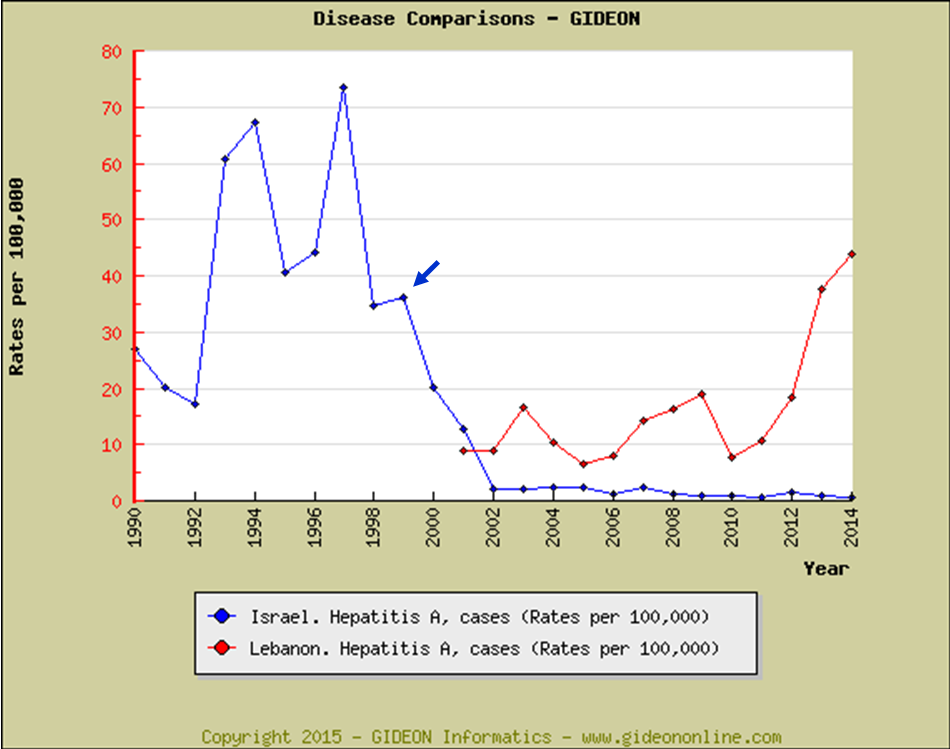
Hepatitis A rates in Lebanon are similar to those reported in neighboring Israel during the 1990’s [see graph] 
HepAIsrLeb

In 1999 (arrow) Israel became the first country to introduce universal Hepatitis A vaccination, a policy which might help reverse the increasing incidence experienced by Lebanon. [1-3]

References:

1. Berger SA. Infectious Diseases of Lebanon, 2015. 389 pages, 54 graphs, 1,569 references. Gideon e-books, https://www.gideononline.com/ebooks/country/infectious-diseases-of-lebanon/

2. Berger SA. Hepatitis A: Global Status, 2015. 184 pages, 183 graphs, 1,775 references. Gideon e-books, https://www.gideononline.com/ebooks/disease/hepatitis-a-global-status/

3. https://www.gideononline.com/wp-content/uploads/Gideon-Graphs.pps

Gaza: H5N1 Influenza and Population Density

A recent ProMED posting (Avian influenza (80): Palestinian Auth (GZ) HPAI H5N1, spread, RFI) states that, “The Gaza strip is one of the most dense[ly] populated territories on earth.” The population density of Gaza is 5,046 inhabitants per sq km. Compare this to Boston (5,115 per sq km). Indeed, the Israeli town of Sderot, the prime target for bombs and missiles from Gaza, boasts 5,367 inhabitants per sq km. Needless to say, other regions and cities in Asia are far more crowded than Gaza.

Gaza City, has the highest population density within the Gaza Strip itself, with 11,456 per sq km. But my own city, Ramat Gan, exceeds even this number, with 11,971 per sq km. Despite their higher population densities, Boston and Ramat Gan have not experienced H5N1 influenza; indeed, population numbers are not relevant to this strain, since human-to-human transmission is rare.

Hand, Foot and Mouth Disease in Singapore

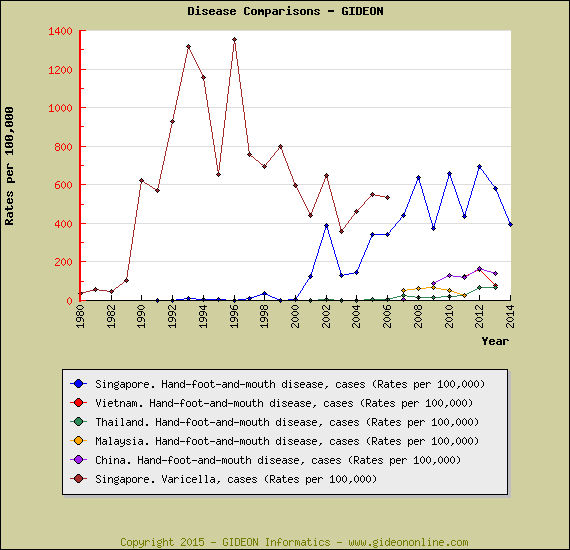
Rates of Hand, Foot and Mouth disease (HFM) in Singapore exceed those of all other reporting countries in Asia.  In fact, HFM is at least as common as varicella in Singapore [1,2].  See graph:


HFM


References:

1. Berger SA. Enterovirus Infections: Global Status, 2015. 102 pages, 67 graphs, 1,936 references. Gideon e-books, www.gideononline.com/ebooks/disease/enterovirus-infections-global-status/

2. Berger SA. Infectious Diseases of Singapore, 2015. 460 pages, 112 graphs, 1,964 references. Gideon e-books, www.gideononline.com/ebooks/country/singapore/

3. Gideon graph tool at www.gideononline.com/wp/wp-content/uploads/Gideon-Graphs.pps

Note appears on ProMED

Ross River Virus in Queensland

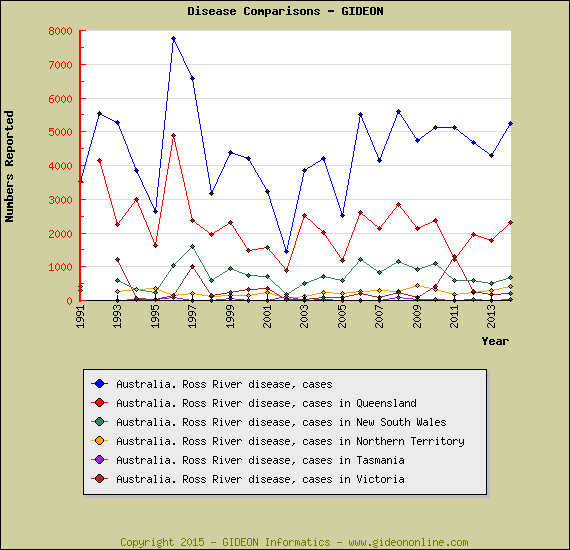
Queensland accounts for approximately 50% of Ross River virus infections reported in Australia. Notwithstanding an increase in incidence during January to February 2015, rates in Queensland have remained fairly constant for over two decades. [1,2] See graph

RRV

References:
1. Berger S. Infectious Diseases of Australia, 2015. 616 pages, 165 graphs, 3,941 references. Gideon e-books, www.gideononline.com/ebooks/country/infectious-diseases-of-australia/
2. Berger S. Australo-Pacific Arboviruses: Global Status, 2015. https://www.gideononline.com/ebooks/disease/australo-pacific-arboviruses-global-status/
3. www.gideononline.com/wp/wp-content/uploads/Gideon-Graphs.pps

Note featured on ProMED

Melioidosis in the United States

The following background data are abstracted from Gideon www.GideonOnline.com and the Gideon e-book series [1,2] (primary references available on request)

The first case of melioidosis in the Western hemisphere was diagnosed in the United States in 1945 – an American who had worked in the Panama Canal Zone during 1927 to 1928.

Sporadic autochthonous cases (five reports to 2013) have been reported from Arizona, Georgia, Hawaii, Oklahoma, Ohio and California. The fifth case of autochthonous melioidosis was reported in Ohio in 2013. Imported cases have originated from Laos, Mexico, Viet Nam and Thailand. Two cases imported from Honduras were reported in Florida in 2005; and an American girl acquired the disease in Aruba in 2011 (publication year).

A case of pneumonia and septicemia caused by Burkholderia thailandensis has been reported in the United States.

It has been estimated that 225,000 seropositive Army personnel returned from Viet Nam, and may still be at risk for reactivation. 81 individual case reports (14 fatal cases) of melioidosis acquired in Vietnam were published during 1965 to 1969. In one case, a Vietnam veteran developed melioidosis 29 years after returning to the United States. In another instance, a veteran developed the disease 63 years following return from the Pacific region. Venereal transmission was reported from a Vietnam veteran to his wife in the United States. 38% of American Marines acquired seropositivity toward melioidosis following a two-week stay in Thailand (2006).

Animal infection:
1969 – Five cases of melioidosis in three separate outbreaks were diagnosed among imported nonhuman primates – two stump-tailed macaque monkeys (Macaca arctoides), a chimpanzee (Pan troglodytes), a pig-tailed monkey (Macaca nemestrina) and a rhesus monkey (Macaca mulatta).
2007 (publication year) Burkholderia pseudomallei was isolated from two pet green iguanas (Iguana iguana) in California
2013 (publication year) – A pigtail macaque (Macaca nemistrina) imported from Indonesia into the United States was found to have melioidosis.

References:
1. Berger SA. Melioidosis and Glanders: Global Status, 2015. 51 pages, 10 graphs, 754 references. Gideon e-books, https://www.gideononline.com/ebooks/disease/melioidosis-and-glanders-global-status/
2. Berger SA. Infectious Diseases of the United States, 2015. 1,208 pages, 483 graphs, 13,730 references. Gideon e-books, https://www.gideononline.com/ebooks/country/infectious-diseases-of-the-united-states/

Note posted on ProMED

2015 series of GIDEON ebooks includes images

The 2015 GIDEON ebook series has been released with 423 ebooks.

New since 2014 edition:

Titles include:

Country series (231 volumes)
Disease series (188 volumes)
GIDEON Guide to Antimicrobial Agents
GIDEON Guide to Vaccines
GIDEON Guide to Medically Important Bacteria
GIDEON Guide to Medically Important Yeasts

Available at GIDEON ebooks and ebook distributors EBSCO, Overdrive, ebrary and Google Play.

Pertussis: Global Trends in Incidence and Vaccine Uptake

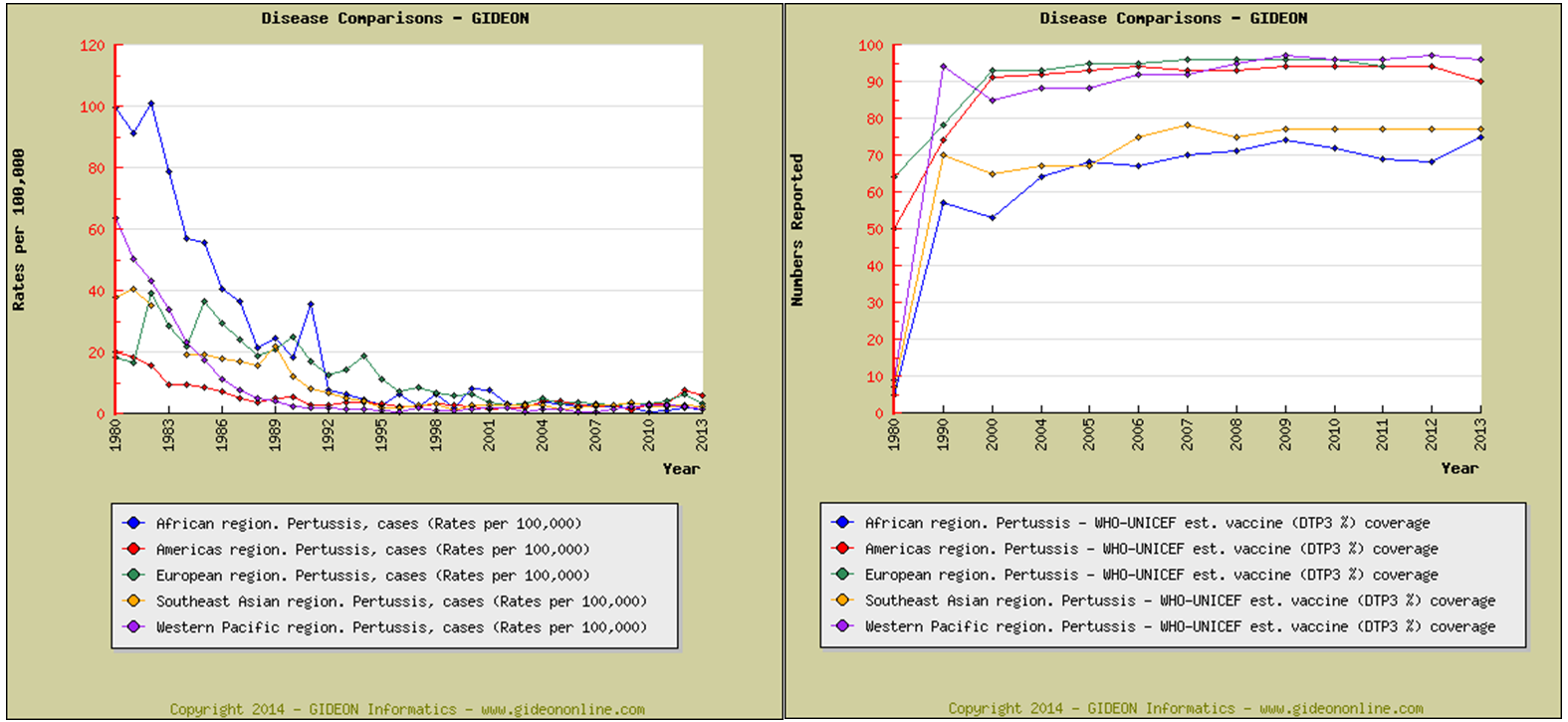
Recent pertussis outbreaks are of concern, but should not overshadow a dramatic decrease in disease rates documented during the past three decades. [1] In the following chart, I’ve compared regional trends in pertussis reporting and W.H.O. estimates of vaccine uptake [2] Note that vaccine coverage has changed little since 1990.

pertussis

References
1. https://www.gideononline.com/wp-content/uploads/Gideon-Graphs.pps
2. Berger S. Pertussis: Global Status, 2013. 353 pages, 511 graphs, 648 references. Gideon e-books, https://www.gideononline.com/ebooks/disease/pertussis-global-status/

GIDEON Sign In