GIDEON blog

Free Demo ► Latest Updates ► Video Tutorials ►
Subscribe , j x

Pathogens Associated with Animal Bites

Gideon www.GideonOnline.com lists 31 species of bacteria which have been associated with human infection following the bites of animals:
– Bacteroides tectus
– Bergeyella zoohelcum
– Bisgaard’s taxon
– Capnocytophaga canimorsus
– Corynebacterium canis
– Capnocytophaga cynodegmi
– Corynebacterium freiburgense
– Corynebacterium kutscheri
– CDC NO-1
– Erysipelothrix rhusiopathiae
– Fusobacterium canifelinum
– Halomonas venusta
– Kingella potus
– Moraxella canis
– Mycobacterium vulneris
– Neisseria animaloris
– Neisseria canis
– Neisseria weaveri
– Neisseria zoodegmatis
– Pasteurella caballi
– Pasteurella canis
– Pasteurella dagmatis
– Pasteurella multocida
– Pasteurella stomatis
– Psychrobacter immobilis
– Spirillum minus
– Staphylococcus intermedius
– Streptobacillus moniliformis
– Vibrio charchariae
– Vibrio harveyi

Although virtually all literature on the subject advocates administration of tetanus prophylaxis following animal bites, few if any cases of bite-associated tetanus have been documented.

South American Arenavirus Diseases

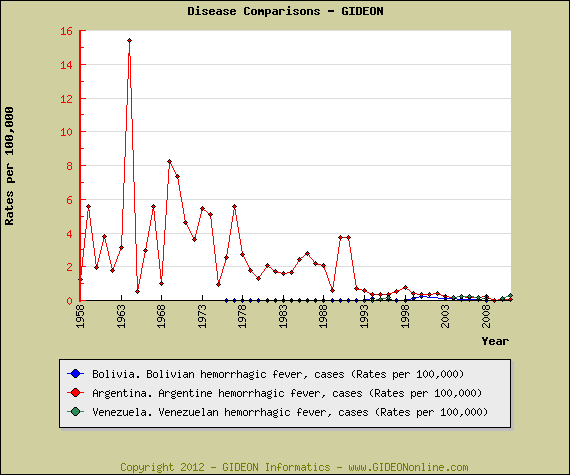
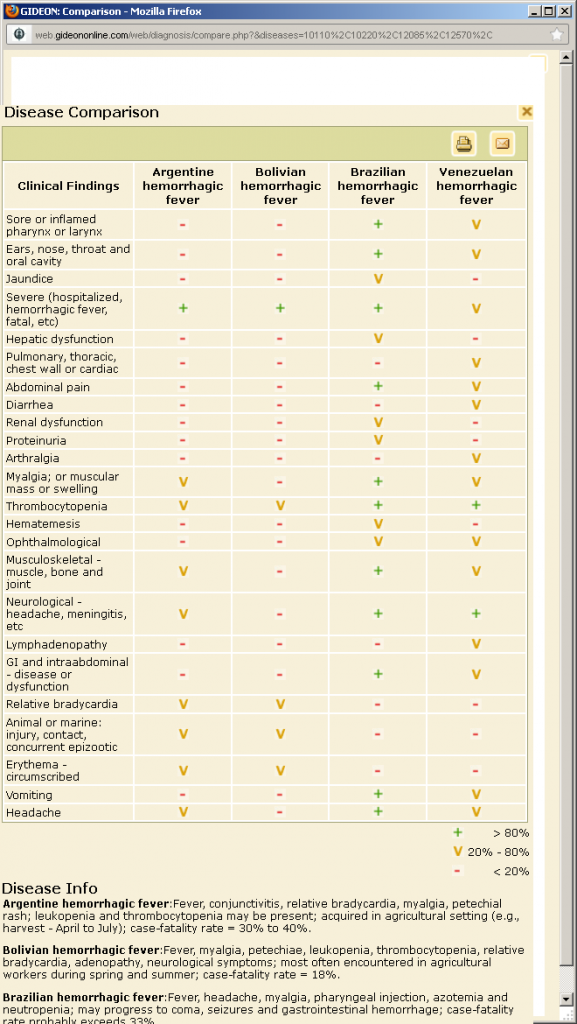
This week, ProMED summerized recent reports of Bolivian Hemorrhagic Fever and Hemorrhagic Fever in Latin America. Reporting statistics on Arenavirus diseases in this group suggest that rates for three of these conditions have been similar since 2000 [1,2]

The following chart comparing clinical features among the South American Arenavirus diseases was generated using a teaching tool in Gideon www.GideonOnline.com [3]:

References:
1. Berger SA. American Hemorrhagic Fevers: Global Status, 2012. Gideon e-books, https://www.gideononline.com/ebooks/disease/american-hemorrhagic-fevers-global-status/
2. Gideon graph tool at Gideon-Graphs.pps
3. Gideon compare tool at Compare-function.pps

Salmonella in Finland

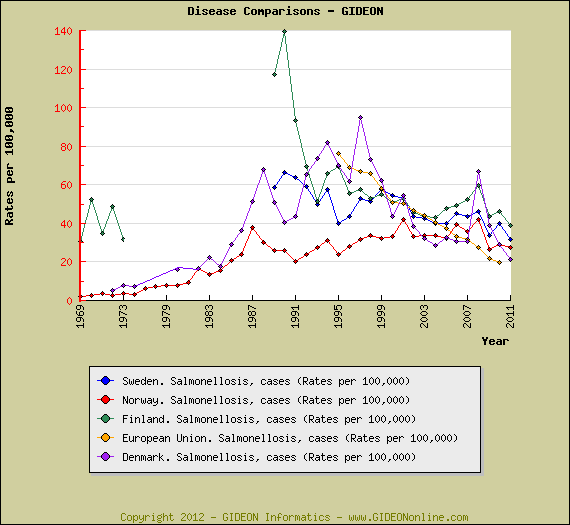
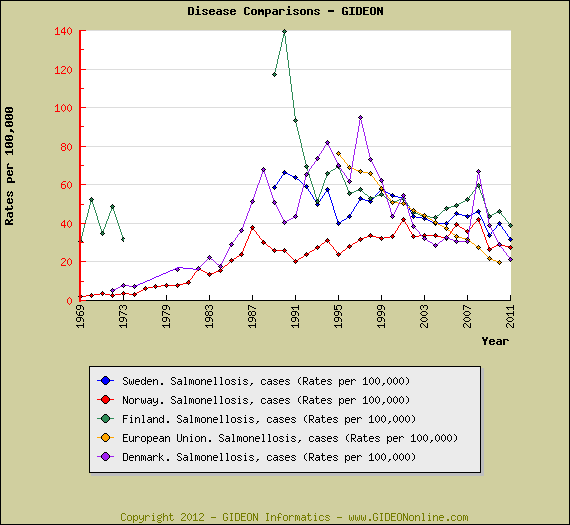
Although Campylobacter has replaced Salmonella as the most commonly reported agent of diarrhea in Finland, salmonellosis rates remain higher than those reported by other Scandinavian countries. [1,2] See graphs [3]

References:
1. Berger SA. Infectious Diseases of Finland, 2012. 420 pages, 127 graphs, 1558 references. Gideon e-books, https://www.gideononline.com/ebooks/country/infectious-diseases-of-finland/
2. Berger SA. Salmonellosis: Global Status, 2012. 252 pages, 300 graphs, 2297 references. Gideon e-books, https://www.gideononline.com/ebooks/disease/salmonellosis-global-status/
3. Gideon graph tool at https://www.gideononline.com/wp-content/uploads/Gideon-Graphs.pps

Note featured on ProMED

Salmonellosis in Italy

The following background data on salmonellosis in Italy are abstracted from Gideon www.GideonOnline.com and the Gideon e-book series. [1,2]

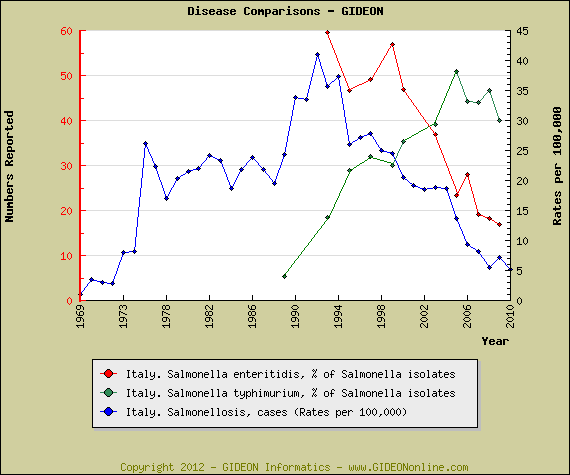
Since 1990, decreasing rates of salmonellosis in Italy have been paralleled by a relative decrease in cases caused by Salmonella enteritidis – see graph [3] The number of salmonellosis outbreaks has also declined, from a high of 552 (3,495 cases) in 1992, to 107 (575 cases) in 2010.

Prevalence surveys:
19.2% of childhood diarrhea episodes in Italy
7.3% of pediatric hospitalizations for diarrhea in Rome (1985 publication)
22.9% of children with gastroenteritis presenting to a single hospital (Sondrio Province, Lombardi, 2003 to 2006)
34% of foodborne outbreaks in the Piedmont region (1,250 outbreaks of salmonellosis during 2002 to 2009)
11.1% of patients with acute diarrhea (2005)
0% of cheeses (2004)
0% of ready-to-eat salads from process lots (2006 to 2008)
2.2% of foods of animal origin (2001 to 2002)

Notable outbreaks:
1966 (publication year) – An outbreak of typhoid (302 cases) and other Salmonella infection s (60 cases) was reported.
1966 – An outbreak of Salmonella typhimurium infection was reported in Biella.
1974 (publication year) – An outbreak of Salmonella agona infection was reported.
1974 (publication year) – An outbreak of Salmonella typhimurium infection was reported.
1974 (publication year) – An outbreak of Salmonella enteritidis infection was reported in the area of Paterno (Catania).
1975 – An outbreak (23 cases) of Salmonella oranienburg infection in Rome was associated with a commercial air flight.
1982 – An outbreak (245 cases) of Salmonella napoli infection in England and Wales was caused by contaminated chocolate bars imported from Italy.
1987 – An outbreak of Salmonella typhimurium infection was reported in Palermo.
1987 – Outbreaks (2 outbreaks) of Salmonella enterica subsp. enterica serovar Kottbus infection were reported in Lombardy.
1987 to 1988 – An outbreak (110 cases) of Salmonella wien infection was reported in a neonatal unit in Palermo.
1987 to 1988 – An outbreak of Salmonella typhimurium infections in Isernia was related to consumption of salsicce.
1989 to 1991 – Outbreaks of Salmonella enterica subsp. enterica serovar Bovismorbificans were reported in southern Italy.
1991 – Outbreaks (33 outbreaks) of egg-related Salmonella enteritidis infection were reported in northern and central Italy.
1993 (publication year) – An outbreak of Salmonella enteritidis infection was reported in a nursing home.
1994 – An outbreak (448 cases) of Salmonella hadar infection was associated with a canteen at a building site in central Italy.
1995 – An outbreak (83 cases) of Salmonella enterica Typhimurium infection in the Lombardy region was ascribed to contaminated salami.
1997 – An outbreak (29 cases, 12 hospitalized, 1 fatal) of Salmonella hadar infection was reported from a restaurant in Rimini – ascribed to roast rabbit.
1997 – An outbreak of Salmonella enteritidis PT3 infection was reported in northeastern Sardinia.
1998 (publication year) – An outbreak of Salmonella enteritidis PT4 infection in southern Italy was related to consumption of an egg-based dessert.
1998 – An outbreak (7 infants) of Salmonella bongori infection was reported in Sicily – source unknown.
1998 – An outbreak (9 cases) of Salmonella enteritidis infection was related to consumption of a commercially produced cheese.
1998 – An outbreak (13 cases) of Salmonella blockley infection in Germany was caused by eel imported from Italy.
1998 – An outbreak (several hundred cases) of Salmonella enteritidis infection in Benvenuto was associated with iced cake served at a religious festival.
1998 – An outbreak of Salmonella enteritidis infection among Japanese travelers returning from Italy was related to consumption of scrambled eggs in a hotel in Rome.
2000 (publication year) – An outbreak (113 cases) of Salmonella enteritidis infection in Bari was associated with an egg-based ice cream served at a wedding party.
2004 – An outbreak (63 cases) of Salmonella typhimurium DT 104A infection in the Rome region was associated with traditional pork salami.
2005 – An outbreak (22 cases) of Salmonella typhimurium DT 104 infection in Denmark was caused by raw beef carpacio imported from Italy.
2005 – An outbreak (153 cases) of Salmonella enterica serotype enteritidis infection was reported among school children in Florence.
2005 – An outbreak of Salmonella enterica serovar. enteritidis infection in Bari was ascribed to contaminated rice arancini.
2006 – An outbreak (13 cases) of Salmonella typhimurium infection in Sweden was caused by contaminated salami imported from Italy.
2007 – An outbreak (56 cases) of salmonellosis related to contaminated spaghetti at a hotel in Spain involved tourists from France, Italy, Spain, Romania, Czech Republic and Albania.
2007 – An outbreak (16 cases) of Salmonella enteritidis infection in Sicily was associated with eggs used to prepare pastry for a barbecue.
2008 – An outbreak (30 cases) of salmonellosis was reported among British tourists at a hotel in Brescia.
2010 – An outbreak (500 cases) of Salmonella enterica infection in France was related to ingestion of contaminated hamburger imported from Italy.
2011 – An outbreak of Salmonella enterica serovar. Strathcona infections in Denmark (43 cases), Germany (14 cases) and Austria (1 case) was related to contaminated tomatoes imported from Italy.
2012 (publication year) – An outbreak of Salmonella enterica subspecies enterica serovar Berta infection was reported.

References:
1. Berger SA. Infectious Diseases of Italy, 2012. 486 pages, 113 graphs, 2696 references. Gideon e-books, https://www.gideononline.com/ebooks/country/infectious-diseases-of-italy/
2. Berger SA. Salmonellosis: Global Status.; Gideon e-books, 252 pages, 300 graphs, 2297 references. https://www.gideononline.com/ebooks/disease/salmonellosis-global-status/
3. Gideon graph tool at https://www.gideononline.com/wp-content/uploads/Gideon-Graphs.pps

Note featured on ProMED

Listeriosis in New Zealand

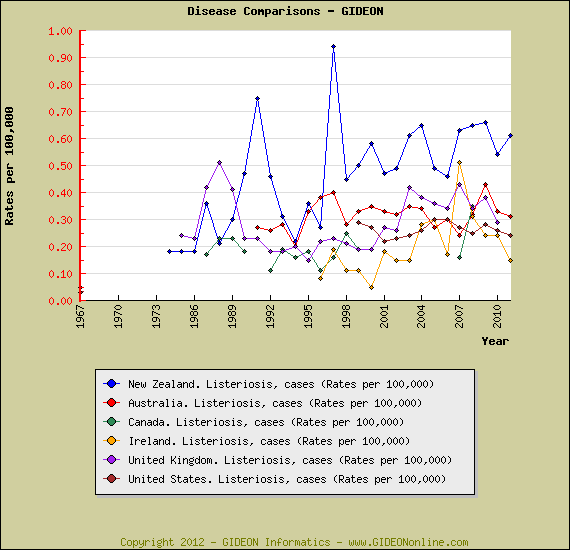
Among the major English-speaking countries, New Zealand reports the highest incidence of listeriosis per 100,000 population – approximately twice the rate reported in Australia – see graph [1-3]: /wp-content/uploads/Listeriosis-NZ.png

Gideon www.GideonOnline.com records five outbreaks of listeriosis in New Zealand during 1969 to 2000, including:
1980 – An outbreak (22 cases, 5 fetal deaths) of perinatal listeriosis among three obstetrics hospitals in Auckland.
1981 to 1982 – An outbreak (18 cases, 3 abortions and one neonatal death) in Christchurch.
1992 – An outbreak (2 cases) of perinatal listeriosis related to contaminated smoked mussels.

References:
1. Berger SA. Infectious Diseases of New Zealand, 2012. 413 pages, 136 graphs, 1534 references. Gideon e-books, https://www.gideononline.com/ebooks/country/infectious-diseases-of-new-zealand/
2. Berger SA. Listeriosis: Global Status, 2012. 95 pages, 105 graphs, 557 references. Gideon e-books, https://www.gideononline.com/ebooks/disease/listeriosis-global-status/
3. Gideon Graph Tool at https://www.gideononline.com/wp-content/uploads/Gideon-Graphs.pps

Note featured on ProMED

Salmonellosis in Thailand

The following review of salmonellosis in Thailand is abstracted from Gideon www.GideonOnline and the Gideon e-book series. [1,2]

44,078 isolates of Salmonella from human sources were registered in Thailand during 1993 to 2002.
– The most common serovar. from human sources was Salmonella enterica Weltevreden (12.5% of isolates); and the most common source for this serovar. appeared to be frozen seafood.
– Salmonella Kedougou is a major cause of human infections in northern Thailand, especially during warmer periods.
– During 1993 to 2002, Salmonella enteritidis accounted for 11.4% of human isolates, and S. typhimurium for 5.3%.

Prevalence surveys:
4% of children hospitalized for diarrhea in Chiang Mai (1983 to 1984)
18% of dysentery among children up to age 12 years (Bangkok region, 2002 publication)
6% of children ages 3 months to 5 years with diarrhea, and 9% of asymptomatic controls (rural Thailand, 2010 publication)
4% of travelers’ diarrhea in Phuket (2005 to 2006)
19.7% of AIDS-associated diarrhea (Salmonella B, Nothaburi, 1996)
15.5% of AIDS patients with diarrhea (Bangkok, 1996 publication)
2.6% of AIDS patients in Northern Thailand presenting with pneumonia had Salmonella bacteremia (1996 to 2002)
15% of blood-stream infections among HIV-positive patients (Salmonella spp, Bangkok, 2004 to 2008)
22% of diarrhea episodes among US soldiers deployed in Nakhon Sri Thammarat (2000) and Phitsanulok (2001)
4% of chickens, 9% of slaughtered chickens and 57% of marketed chicken; 6% of pigs, 28% of slaughtered pigs and 29% of pork; 3% of dairy cows (Chiangmai and Lampoon, 2000 to 2003)
61% of retail meat and poultry samples in Bangkok – the most common serotypes were Anatum, Corvallis and Derby (2003 publication)
21% of uncooked seafood samples from open markets and supermarkets in Bangkok (Salmonella enterica, 2008)
18% of food, 7% of drinking water and 11% of food handlers (stool samples) in open markets of Khon Kaen (2002)

Notable outbreaks:
1976 to 1978 – An outbreak of Salmonella krefeld gastroenteritis was reported primarily among children, nationwide.
1990 – An outbreak of Salmonella enteritidis infection involving most of the country was related to contamination from chickens.
1990 – An outbreak (5 cases) of Salmonella Ohio infection in Bangkok was caused by contamination of ham served on a commercial airline flight.
1991 (publication year) – An outbreak (40 cases) of Salmonella urbana infection in neonatal nurseries of a hospital in Bangkok was caused by a contaminated wash basin.
2001 – An outbreak of Salmonella Schwarzengrund infections in Denmark and the United States was traced to contaminated chickens in Thailand.
2005 – An outbreak of gastroenteritis at a school in Bangkok was ascribed to both Salmonella and Shigella infections.

References:
1. Berger SA. Infectious Diseaseds of Thailand, 2012. 496 pages, 164 graphs, 2316 references. Gideon e-books, https://www.gideononline.com/ebooks/country/infectious-diseases-of-thailand/
2. Berger SA. Salmonellosis: Global Status, 2012. 252 pages, 300 graphs, 2297 references. Gideon e-books, https://www.gideononline.com/ebooks/disease/salmonellosis-global-status/

Leprosy: India vs. Brazil

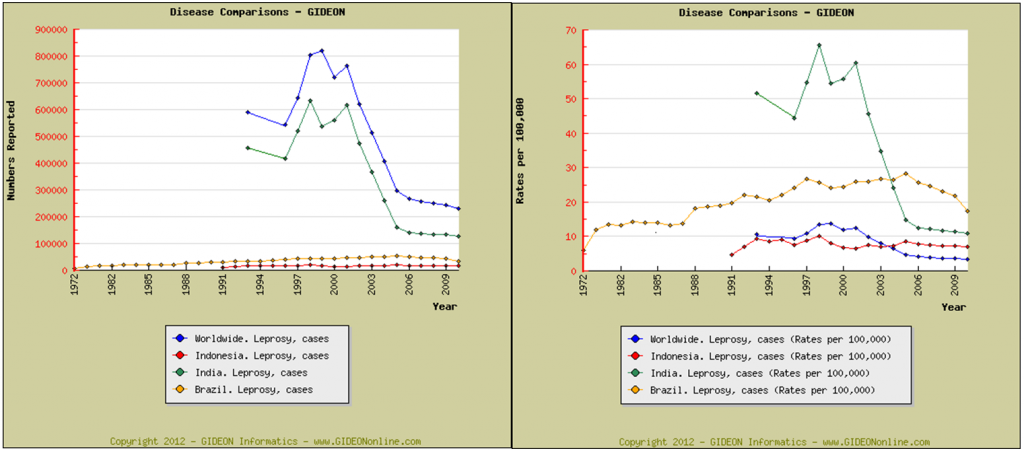
India continues to account for over fifty percent of the global leprosy burden; however, since 2004 disease rates per 100,000 population in Brazil have exceded those in India. [1-3] See graph:

References:
1. Berger SA. Infectious Diseases of India, 2012. 503 pages, 67 graphs, 4248 references. Gideon e-books, https://www.gideononline.com/ebooks/country/infectious-diseases-of-india/
2. Berger SA> Leprosy: Global Status, 2012. 236 pages, 376 graphs, 226 references. Gideon e-books, https://www.gideononline.com/ebooks/disease/leprosy-global-status/
3. 3. Gideon Graph Tool at https://www.gideononline.com/wp-content/uploads/Gideon-Graphs.pps

Note featured on ProMED

EHEC in Finland

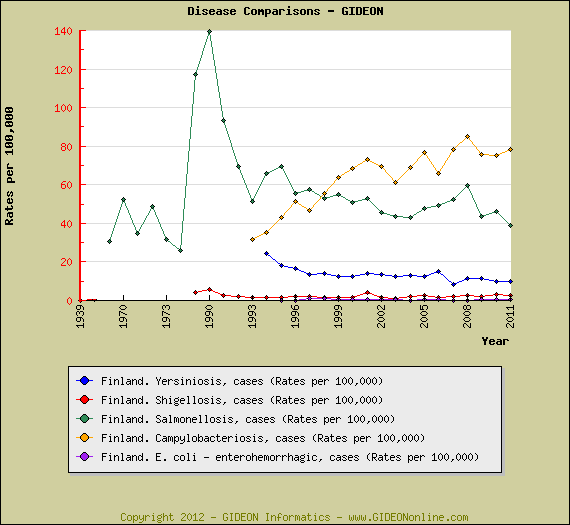
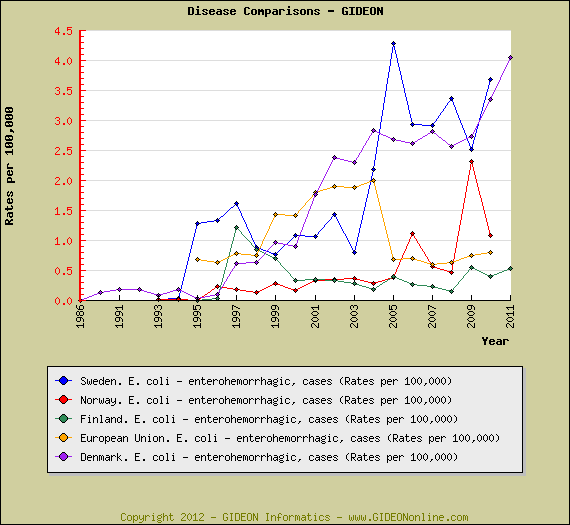
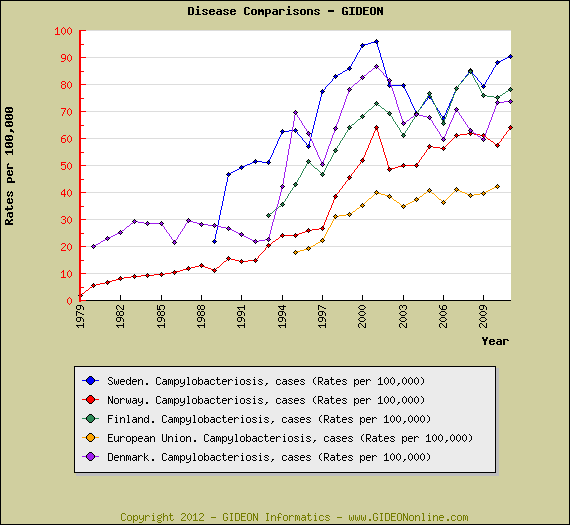
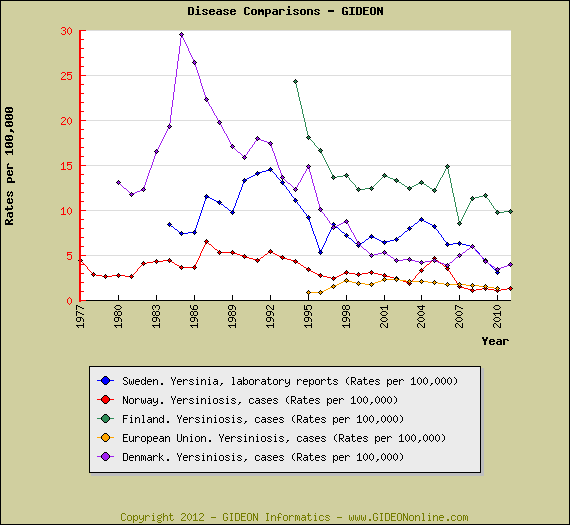
A recent cluster of milkborne infections belies the fact that rates of enteropathic E. coli (EHEC) infection in Finland are the lowest in Scandinavia – see graph. [1] In contrast, rates of salmonellosis, yersiniosis and campylobacteriosis are relatively high in Finland – see graphs.

Graph source data are abstracted from Gideon www.GideonOnline.com and the Gideon e-book series. [2,3]

References:
1. Gideon Graph Tool at https://www.gideononline.com/wp-content/uploads/Gideon-Graphs.pps
2. Berger SA. Infectious Diseases of Finland, 2012. 420 pages, 127 graphs, 1558 references. Gideon e-books, https://www.gideononline.com/ebooks/country/infectious-diseases-of-finland/
3. Berger SA. Escherichia coli Diarrhea: Global Status, 2012. 158 pages, 151 graphs, 3219 references. https://www.gideononline.com/ebooks/disease/escherichia-coli-diarrhea-global-status/

Malaria in Cambodia

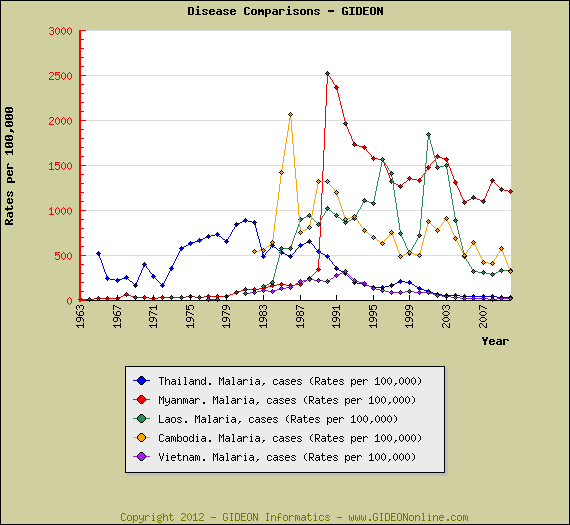
Decreasing malaria rates in Cambodia appear to reflect a general trend in the region – see graph: [1-3]

References:
1. Berger SA. Infectious Diseases of Cambodia, 2012. 362 pages, 52 graphs, 1,370 references. Gideon e-books, https://www.gideononline.com/ebooks/country/infectious-diseases-of-cambodia/
2. Berger SA. Malaria: Global Status, 2012. 398 pages, 537 graphs, 2,128 references. Gideon e-books, https://www.gideononline.com/ebooks/disease/malaria-global-status/
3. Gideon Graph Tool at https://www.gideononline.com/wp-content/uploads/Gideon-Graphs.pps

Anthrax in Georgia

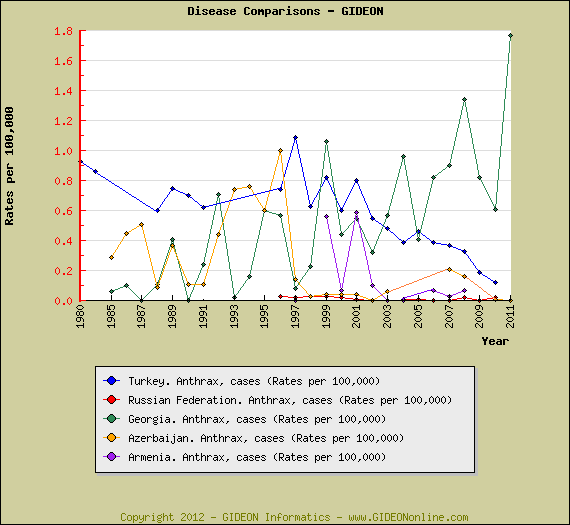
Rates of anthrax in Georgia have been increasing since 2005, and now exceed those of surrounding countries (see graph) [1-3]

References:
1. Berger SA. Infectious Diseases of Georgia, 2012. 364 pages, 90 graphs, 1174 references. Gideon e-books, https://www.gideononline.com/ebooks/country/infectious-diseases-of-georgia/
2. Berger SA. Anthrax: Global Status, 2012. 291 pages, 452 graphs, 1420 references. https://www.gideononline.com/ebooks/disease/anthrax-global-status/
3. Gideon Graph Tool at https://www.gideononline.com/wp-content/uploads/Gideon-Graphs.pps

GIDEON Sign In