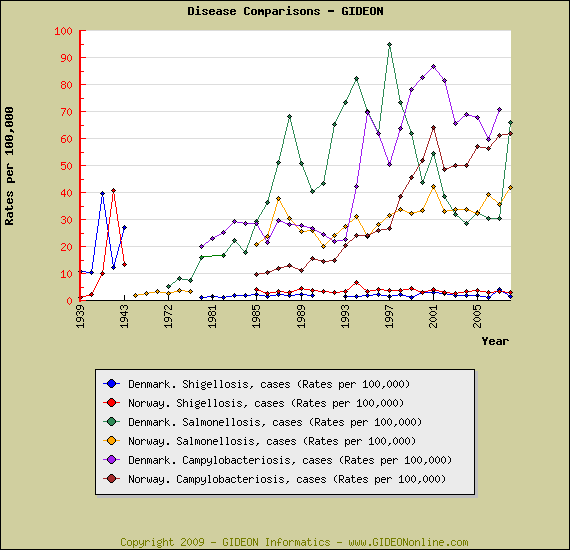
A recent outbreak related to imported snow peas belies the fact that shigellosis rates in Denmark and Norway have remained consistently low for more than two decades.
Update: reported in ProMED
A recent outbreak related to imported snow peas belies the fact that shigellosis rates in Denmark and Norway have remained consistently low for more than two decades.
Update: reported in ProMED
A recent episode in Brescia is the latest of several outbreaks of viral gastroenteritis in Italy. The following background information is abstracted from GIDEON:
Primary references are available on request.
Prevalence surveys:
Adenoviruses account for 7% of pediatric hospitalizations in Rome for diarrhea, Rotavirus 18.2%, Astrovirus 1% (1987 to 1989)
Adenoviruses account for 17.6% of pediatric hospitalizations in Rome for diarrhea, Rotavirus 26.7%, non-polio Enteroviruses 8.5%, Coronaviruses 1.8%, Parvoviruses 0.9% (1985 publication)
Adenoviruses account for 6% of pediatric hospitalizations in Sicily for diarrhea, Rotavirus 25.1%, Astrovirus 7%, Norovirus 18.6% (2003)
Adenoviruses are found in 6.2% of pediatric patients with acute diarrhea (2005)
Noroviruses account for 10.4% of hospitalized pediatric gastroenteritis cases in northern Italy (2002)
Noroviruses were the most frequently involved viruses (23.7%) in sporadic acute diarrhea among hospitalized children and were more common in children >5 years (37%) than in children <5 years (10%). The frequency of Rotavirus, enteric Adenovirus and Astrovirus was 12.2%, 1.6% and 2.4%, respectively. (Brescia, 2007 publication)
Read the rest of this entry »
A recent episode of E. coli infection in Ontario belies the fact that onions are only rarely implicated in food-related disease outbreaks. As of June 2009, 8,471 infectious diseases outbreaks have been included in GIDEON. Onions were involved in only seven (0.08%) of these:
1983 – United States – Botulism – 28 – sauteed onions
1996 to 1997 – United States – Hepatitis A – 90 – green onions
1997 – United States – Cryptosporidiosis – 54 – green onions
1998 – United States – Hepatitis A – 43 – green onions
2003 – United States – Hepatitis A – 170 – green onions
2005 – Russia – Yersinia pseudotuberculosis – 33 – cabbage and onion salads.
2006 – United States – E. coli O157 – 99 – either green onions or shredded lettuce
Virtually everything that we humans do for pleasure could place us at risk for illness, or even death. In recent years, a growing variety of medical conditions has been reported among travelers. The ‘top-ten’ from this list follow:
A recent case in Taiwan is the latest of over 20 foreign travelers who have acquired Coccidioidomycosis in Americas. A module in GIDEON maintains a chronology of all instances of travel-related infection (rabies, trypanosomiasis, trichinosis, Lassa fever, gnathostomiasis, melioidosis, etc). The following list is abstracted from the program.
[primary references are available on request]
Year* Country Cases Comment
1975* Finland 1
1976* Switzerland 1
1990 Israel 1
1993 Czech Republic 1
1996* Netherlands 1
1998* Hungary 1
2001 U.K, Finland, New Zealand 3 Associated with public event
2001 Germany 2 Acquired in Costa Rica
2002 India 1 Fatal infection
2003 Israel 1
2008* France 1
2008* Japan 4 Case series
2008* Poland 1
2009* Netherlands 1
* Year of publication (other cases refer to year of occurrence)
Update: Appeared in ProMED
Reports of a recent outbreak in Sindh question the relative likelihood of various forms of viral hepatitis in Pakistan. The following data are abstracted from GIDEON. One of the modules in GIDEON follows all published prevalence surveys (Ascariasis, Chlamydial infection, Trachoma, Leprosy …) and seroprevalence surveys (HIV infection, Toxoplasmosis, Rubella … etc) – for every infectious disease, in every country.
[primary references available on request]
Viral hepatitis in Pakistan:
Hepatitis A:
Prevalence
4% of acute hepatitis in pregnant women in Karachi
5.4% of acute hepatitis in Lahore.
Seroprevalence:
94% of children by age 5 (Karachi, 1994 publication)
100% of children ages 14 to 15 (Karachi, 2002 to 2004)
40.57% of persons with clinical suspicion of acute hepatitis (2003 to 2004)
Historical:
Tick-borne relapsing fever was first described in the United States in 1915 (Colorado).
– The first case of louse-borne infection in the United States during the twentieth century was reported in 1976 – imported from Ethiopia.
Time and Place:
Peak incidence is reported during the summer, with 47% of cases from July to August.
– The disease is most common in Arizona, California, Colorado and Oregon.
– Sporadic cases are reported from Idaho, Kansas, Montana, Nebraska, New Mexico, Oklahoma, Texas, Utah, Washington and Wyoming.
– Most cases occur in the Cascade, Rocky Mountain, San Bernadino and Sierra Nevada ranges.
– 40% of cases occur in tourists to endemic areas (1977 to 2000).
Read the rest of this entry »
A recent outbreak in Dulovo belies the fact that measles rates in Bulgaria and surrounding countries have decreased considerably in recent decades. See graph:
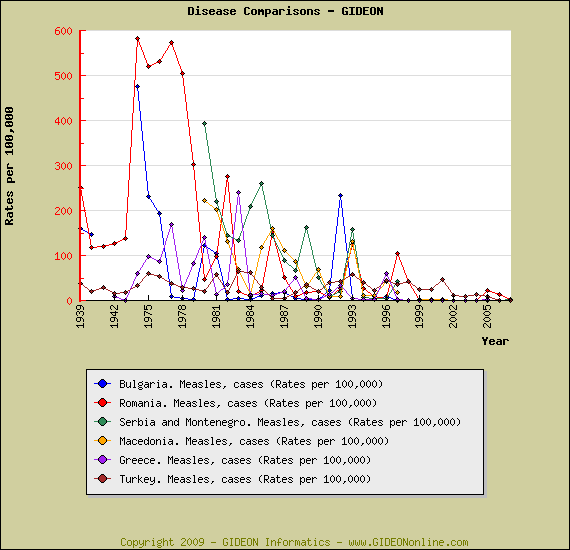
We may assume that decreasing rates are the result of excellent vaccine coverage, which currently exceeds 90% for all countries in the region. See graph:
Read the rest of this entry »
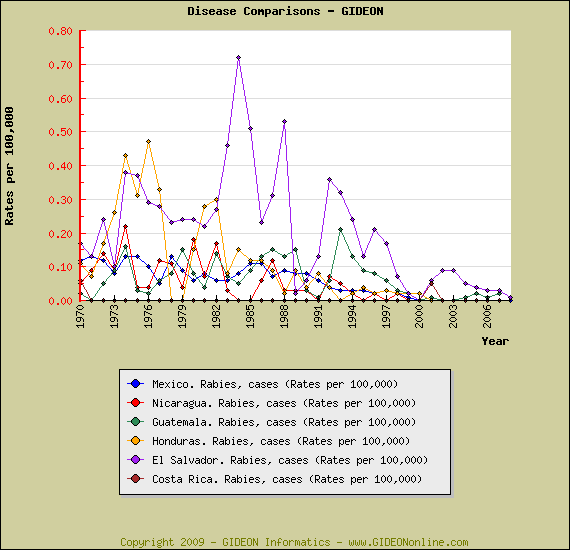
Reports of two recent cases of in Jalisco underline the fact that rabies is still a problem in this region. Although Mexico has reported 0 to 2 cases yearly since 2000, highest rates in the area are encountered in El Salvador.
Los Angeles, Calif. (PRWEB) May 5, 2009 — The first recorded outbreak of influenza occurred in 1580, according to GIDEON, the online infectious disease database used by medical professionals worldwide. As of 2003, an additional 31 pandemics had been documented, including 21 million deaths estimated from an H1N1 pandemic from 1918 to 1919. From 1958 to 2005, 50 cases of swine influenza virus infection (mostly H1N1) were reported in humans.
GIDEON reports that up until 2006, a total of 46 cases of human infection by swine influenza viruses had been reported, including 31 in the United States; six in Czechoslovakia; four in the Netherlands; three in Russia; one in Canada and one in Hong Kong. These figures include an outbreak with 12 cases/1 fatal at a military facility in New Jersey, United States in 1976.
Dr. Stephen Berger, MD, co-founder, and Medical Advisor for GIDEON, is available for interviews. He is regarded as one of the foremost experts on infectious diseases and has published more than 180 articles and books, including Introduction to Infectious Diseases and The Healthy Tourist. Dr. Berger is currently affiliated with the Tel Aviv Medical Center as both Director of Geographic Medicine and of Clinical Microbiology.
GIDEON is a comprehensive, easy-to-use, interactive Web-based infectious disease knowledge management tool that helps medical personnel worldwide diagnose and treat infectious diseases. GIDEON is in use by hundreds of medical institutions, universities, and public health departments worldwide including Children’s Hospital Oakland, World Health Organization (WHO), Center for Disease Control (CDC), Yale University, Hong Kong University, and the Los Angeles County Health Department. For additional information on GIDEON Informatics, visit www.gideononline.com or call 888-664-3366.
For more media information on swine flu, or for interviews, please contact:
Lisa Hendrickson
516-643-1642
lisa (at) lchcommunications (dot) com
Lost password?
New to GIDEON?
Book a free demo