GIDEON blog

Free Demo ► Latest Updates ► Video Tutorials ►
Subscribe , j x

Hantavirus Infections in Scandinavia

A recent report of Hemorrhagic Fever and Renal Syndrome (HFRS) activity in Finland reminds us that this country continues to report the highest rates for Hantavirus infection in the region. In the attached graph, I’ve compared disease reporting in Finland with that of neighboring countries.

hanta-finland

Update: Appeared in ProMED

Famous People: How They Died in 2008

(In addition to its decision support application dealing with Infectious Diseases, Microbiology and Toxicology, GIDEON Informatics, Inc as part of GIDEON Labs, maintains a second service – www.VIPatients.com – which follows the diseases and deaths of all famous persons throughout history. The user can review all diseases of a specific VIP, or generate a list of famous persons by Profession, Disease, Year – or any combination. The following is based on data generated from the site).

On December 31, the Media will once again recount all of the wars, earthquakes, divorces, births, rapes, sporting records …. Inevitably, a long list of famous persons will have passed on: most “after a long illness,” “suddenly” or “of natural causes.” 427 famous folk died of specified misfortunes in 2008. For the purpose of this research, “famous” is defined as “well recognized by the general public at large.”

Read the rest of this entry »

2008 – A year of new outbreaks and new bugs

Predictably, 2009 will be greeted with endless publications that recount the divorces, disasters, political events, athletic records, and famous deaths of 2008. Sadly, the routine misfortunes which visit most of the world will be largely neglected. Individual countries are burdened by major outbreaks of infectious disease on an almost daily basis, but few people in the West hear of these episodes unless they are sensationalized by the media (Ebola) or are seen as a threat to other developed nations (Avian influenza).

Although the current outbreak of Avian influenza (“bird flu”) began in 2003 and has continued well into 2008, the number of reported cases and deaths has actually been decreasing since, 2006. A total of only 387 cases, and 245 deaths, from this infection, have been reported to date. In other words, the chance of dying from a lightning bolt or scorpion sting in one of the infected countries is far greater than the chance of acquiring bird flu.

During the past year, cases of human disease were reported in only 5 countries – while infection of birds occurred in 23 countries.

Note that the cases appear to occur in waves – first involving Vietnam, then Indonesia, and finally Egypt.

Speaking of Egypt, few realize that a classic disease associated with that country continues to affect many parts of the world. Four countries reported plague outbreaks during 2008: China, Madagascar, Uganda, and the Democratic Republic of Congo.

Does anybody still remember ‘Ebola.’? Ebola became a household word in 1995 when cases in Africa appeared on the backdrop of one or more Hollywood movies about lethal bugs carried to America by villains, monkeys, and other primates. The good news is that no Ebola outbreaks occurred in 2008; though few realize that more cases were reported in Africa during ’07 than during the panic-year of ’95.

The next panic-year in America was 2001 when anthrax evolved into a mail-order disease. In 2008, a man in London died of anthrax acquired from African animal skins used to make drums. Similar cases were reported in Scotland and in New York City in 2006. No fewer than twenty countries reported outbreaks of human (11 countries) or animal anthrax in 2008. As is often the case, these outbreaks occurred in areas of misery and upheaval – Iraq and Zimbabwe.

In fact, Zimbabwe has become a paradigm for epidemics in recent months. As we move into 2009, a massive outbreak of cholera is spreading through the country, with many cases in the capital city and infected refugees spreading the disease into neighboring South Africa. Outbreaks of cholera were officially reported by 37 countries in 2008, while many others reported “severe diarrhea” – a euphemism for cholera, often used by nations that would rather not scare tourists with the “C” word.

For diseases, 2008 was a matter of “business as usual.” Dysentery, salmonellosis, influenza, conjunctivitis, Legionnaire’s disease, Norovirus gastroenteritis, Lyme disease, plague, rabies … simply plague humanity.

The Health establishment once promised us that at least two diseases would be eliminated by the 21st century: Poliomyelitis and Measles. Sadly, outbreaks of both were still reported in 2008. In both cases, safe and effective vaccines are simply not being used in some populations. In contrast, other diseases for which vaccines do not exist will continue to worry us all into 2009 – AIDS, Malaria, Dengue, Hepatitis C, West Nile fever…

Inevitably, each new year heralds the discovery of new diseases and pathogens. Sadly, new antibiotics and vaccines appear at a slower pace. One of the more interesting outbreaks of 2008 involved over 1 million cases of Chikungunya in India, Malaysia, and nearby countries. Chikungunya is caused by a virus spread by mosquitoes and is characterized by fever, rash, and severe inflammation of joints. Inevitably, the disease began to be reported among tourists returning from affected countries (approximately 50 to the United States, and almost 1,000 to France) and ultimately 337 cases acquired in Italy in 2007, as local mosquitoes began to transmit the virus. These events remind us of the entry of West Nile fever into the United States in 1999, and to forebode similar events in years to come.

The good news is that some diseases are disappearing. Cases of leprosy are on the decline, with fewer than 500,000 lepers estimated for the entire planet as of this year. A rather nasty parasite, Dracunculus, incapacitated over 720,000 Africans in 20 countries as recently as 1988; fewer than 10,000 in 9 countries as of 2008. SARS has simply disappeared as a disease, with no cases reported since the outbreak of 2003. Active mass treatment and prevention campaigns continue to reduce the incidence of river blindness, childhood meningitis, tetanus, diphtheria, and some forms of hepatitis.

Measles in Qatar

Steve Berger quoted in ProMED:

Although vaccine coverage in Qatar has lagged slightly behind those of neighboring countries, a slight increase in disease incidence during 2007 belies the fact that measles cases have been dramatically reduced through expanded immunization since 1990. This graph illustrates regional vaccine coverage estimates, and this graph displays trends in measles incidence for Qatar in comparison with concurrent vaccine coverage.

Hepatitis B and C in Pakistan

Recent reports of hepatitis B and C in Sindh underscore a general trend toward high hepatitis rates in Pakistan. The following serosurvey data regarding Hepatitis A-G are abstracted from GIDEON (primary references available on request).

Hepatitis A seroprevalence:
94% of children by age 5 (Karachi, 1994 publication)
100% of children ages 14 to 15 (Karachi, 2002 to 2004)
40.57% of persons with clinical suspicion of acute hepatitis (2003 to 2004)

Read the rest of this entry »

Interview with GIDEON’s CEO

Steve Stallman recently interviewed Uri Blackman, GIDEON’s CEO, in SCribe magazine, which was mentioned in the Technology Council of Southern California blog. The interview provides some background on the company and the benefit of GIDEON to its users:

What is the main value proposition you offer?
Originally, we focused on compiling the entire world’s data for Infectious Diseases in one easy to use location combined with medical decision support. Now we have taken this to the next level by adding other medical domains on our platform. We help identify the diseases, their global footprints, and provide specific information on treatments. Medical professionals now have one clear source to get the most up to date information, which can change by the minute. This often makes them aware of things they never thought of and helps them make the best decision possible.

African Trypanosomiasis among Tourists

In October, 2008 an American tourist in Tanzania acquired trypanosomiasis. At least 40 such cases have been reported since 1970. The following chronology is abstracted from Gideon. Note that the country of disease acquisition was reported in 37 cases – of which Tanzania accounted for 18 and Malawi 11.

Year:
1970 – A case of trypanosomiasis was reported in Switzerland.
1970 – Two American tourists acquired trypanosomiasis while in Kenya and Rwanda.
1975 – A Swedish tourist acquired trypanosomiasis in Gambia.
1977 – A case of trypanosomiasis was reported in Switzerland.
1981 – An American acquired trypanosomiasis in Tanzania.
1990 (publication year) – Two Swiss nationals acquired trypanosomiasis in Rwanda.
1997 – A Brazilian acquired trypanosomiasis in Angola.
1998 – An Australian acquired trypanosomiasis in Tanzania.
2000 – One American and one British national acquired trypanosomiasis in Tanzania.
2001 – Eleven persons acquired trypanosomiasis in Tanzania: three Dutch, two Italians, and one each Swedish, Norwegian, Belgian, South African, American and British.
2001 – A British national acquired trypanosomiasis in Zambia.
2004 – Two British brothers acquired trypanosomiasis in Tanzania.
2004 – Two Italians acquired trypanosomiasis, in Gabon and Central African Republic.
2005 – An American acquired trypanosomiasis in Tanzania.
2005 – Two South Africans acquired trypanosomiasis in Malawi.
2007 – A British national, 5 South Africans, 1 Canadian and two Australians acquired trypanosomiasis in Malawi.

Increase in tick-borne diseases, U.S.A.

Rates of tick-borne infections in the United States have been increasing dramatically since 2000. See attached graph (Lyme disease displayed as cases/100,000 to allow fit). Although this phenomenon might reflect changes in human population density and artifacts of reporting and diagnosis, I suspect that these data are related to increasing tick and animal reservoir populations.

Update: Also referenced in ProMED

Updates added for Google Chrome and Apple Safari browsers

Due to a number of requests, a few updates to the GIDEON code were made to enhance compatibility with the webkit based browsers: Apple Safari and Google Chrome. Essentially this improved marking signs and symptoms in these browsers and enhances the GIDEON experience on the Apple iPhone.

Please let us know how this is working for you.

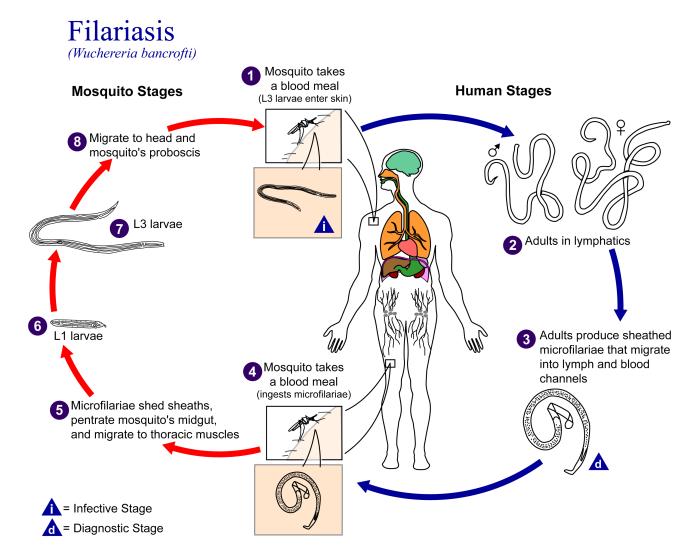
Filariasis in the Philippines

Lifecycle of Wuchereria bancrofti, an agent of Filariasis
The lifecycle of Wuchereria bancrofti, one of the causal agents of Filariasis (Source: CDC)

UPDATED: Click here to read our latest article on all three types of Filariasis

645,232 cases of filariasis (both forms) were estimated for the Philippines from 1963 to 1996.

Wuchereria bancrofti

Time and Place:
– Bancroftian filariasis is endemic to southern Luzon, Mindanao, Mindoro, Palawan, Samar, Leyte, Sorsogon and Bohol.
– 43 of 63 provinces were endemic n 1960; 45 of 77 provinces as of 1996 4 ; 290 municipalities as of 2001; 351 of 1,566 municipalities as of 2003; 39 of 79 provinces as of 2004.
– Cases have recently been registered in Marinduque.
– Both forms of filariasis (W. bancrofti and B. malayi) coexist in only four provinces: Davao Oriental, Palawan, Eastern and Northern Samar 6 and Surigao del Sur.
– In 1984, 20 million persons were considered at risk for filariasis (both W. bancrofti and B. malayi) in the Philippines; 23.5 million in 2002; 15,034,765 in 2006; 21,882,581 in 2007.
– Only two provinces (Marinduque and Sulu) were considered ‘high prevalence’ areas (>10%) as of 1993.

Disease in the Philippines is nocturnally periodic.

Read the rest of this entry »

GIDEON Sign In