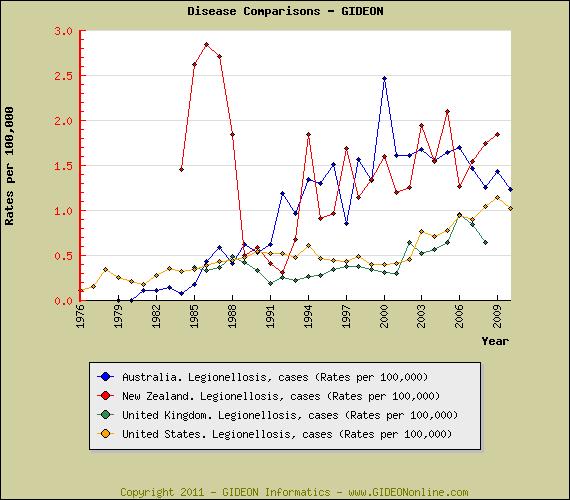
Rates of legionellosis in Australia and New Zealand have changed little since 2000, but remain somewhat higher than those of the United States and the U.K. – see graph:
The following background data are abstracted from the Gideon e-book series. 1,2 [primary references available on request]
Time and Place:
In Australia, highest legionellosis rates are reported during March to May.
– Legionella pneumophila infection peaks in summer and autumn, and L. longbeachae in spring.
– 69% of patients are males (1991 to 2000), and 71% of patients are above age 49 (1996).
– 2,170 cases of legionellosis were reported during 1991 to 2000.
L. longbeachae accounts for 22% of isolates nationwide, and is the predominant species in Western Australia (apparently associated with potting soils in South Australia).
22 outbreaks were reported during 1992 to 2000.
Notable outbreaks:
1986 – An outbreak of legionellosis was reported in South Australia.
1987 (publication year) – An outbreak of legionellosis was reported in Wollongong, New South Wales.
1987 – An outbreak (53 cases, 13 fatal) was reported in Illawarra, Southeast Sydney.
1992 – An outbreak (26 cases, 6 fatal) was associated with the Fairfield business district in Sydney.
1996 (publication year) – An outbreak (33 cases) was associated with a hotel car park in Sydney.
1998 (publication year) – An outbreak (11 cases) of community-acquired legionellosis was reported in Western Sydney.
1998 – An outbreak (58 cases, 7 fatal) was reported in Victoria. Of these, a cluster of 18 cases was linked to a contaminated cooling tower in a northern Melbourne suburb.
1998 – Two cases were reported among travelers returning from Bali.
2000 – An outbreak (125 confirmed cases; 2 fatal) was traced to a water cooling tower at the Melbourne Aquarium.
2002 (publication year) – An outbreak (5 cases) of Legionella longbeachae was reported in an intensive care unit.
2005 – An outbreak (12 cases) in the business district of Wollongong, New South Wales was ascribed to a contaminated cooling tower.
References:
1. Berger SA. Infectious Diseases of Australia, 2011. 503 pp. Gideon e-book series, https://www.gideononline.com/ebooks/country/infectious-diseases-of-australia/
2. Berger SA. Legionellosis: Global Status, 2011. 90 pp. Gideon e-book series. https://www.gideononline.com/ebooks/disease/legionellosis-global-status/