A recent cluster of cases on Coff’s Coast reminds us that Q-fever continues to be a common disease in Australia. The following backgroud data are abstracted from the Gideon e-book series. [1,2] Primary references are available on request.
Time and Place:
– Q-fever was first characterized in Australia, in 1939.
– Queensland and New South Wales account for over 90% of cases.
– Over 50% of cases are directly, or indirectly related to meat processing.
– The male/female ratio for reported cases is approximately 5-to-1.
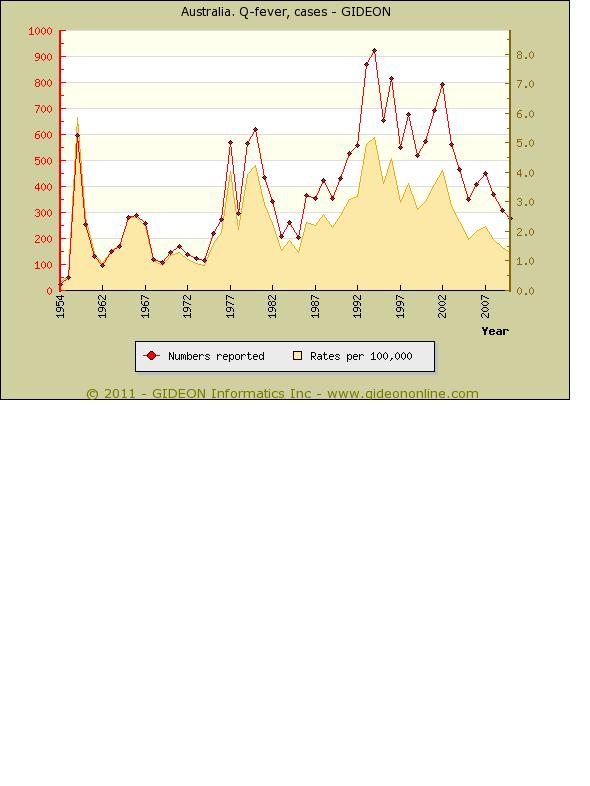
Disease rates have gradually increased over the past six decades – see graph:
Travel and Q-fever:
2002 (publication year) – Three Japanese workers acquired Q-fever while in Australia and New Zealand. 7
2005 – An American tourist acquired Q-fever in Australia. 8
Seroprevalence surveys:
18.5% of non-vaccinated meat workers in central Queensland (2001 publication)
6.5% of persons below age 25 years in South West Queensland (2010 publication)
66% of persons in Kimberly have evidence for prior exposure (2002)
7% of persons in the Hunter New England region of New South Wales (2006 to 2009)
The average rate among abattoir workers in Victoria is 6,600 per 100,000 during the first 10 years of exposure.
– As of 1996, vaccination programs were identified in one-third of abattoirs.
– Routine immunization of abattoir workers in endemic areas was introduced in 2002.
– As of 2009, vaccine update is 100% among abattoir workers and 43% among farmers.
The standard vaccine (‘Q-vax’) is prepared from Inactivated phase I whole Coxiella burnetii. A dose of 0.5 ml s.c. (deltoid region) is indicated for high-risk populations (eg, occupational exposure), and confers immunity for five years. Few sides effects are reported, and are limited to fever and headache.
A variety of local mammals serve as reservoirs, including the bandicoot (Isoodon torosus).
– Amblyomma triguttatum triguttatum ticks are implicated in the epidemiology of Q fever in Queensland.
Notable outbreaks:
1959 (publication year) – An outbreak of Q-fever in Queensland was associated with sheep contact.
1962 (publication year) – An outbreak was reported in a meat-works in South Australia.
1969 – An outbreak in a Brisbane ‘meat works’ affected 7.9% of workers.
1979 – An outbreak (110 cases) was reported at an abattoir in Victoria.
1998 – An outbreak (29 confirmed and 8 suspect cases) was reported at an abattoir in New South Wales.
2004 – An outbreak (9 confirmed and 6 suspect cases) was reported among farmers in South Australia.
2005 – An outbreak (5 cases) was reported among persons involved in calving activities, in New South Wales.
2006 (publication year) – An outbreak (4 cases) was reported among workers at a cosmetics factory.
2006 (publication year) – An outbreak (27 cases) was reported in rural South Australia.
2007 – An outbreak (5 cases confirmed, 1 possible fatal case) was associated with an abattoir in South Australia.
References:
1. Berger SA. Infectious Diseases of Australia, 2011. 503 pp., 158 graphs. Gideon e-book series, https://www.gideononline.com/ebooks/country/infectious-diseases-of-australia/
2. Berger SA. Q-fever: Global Status, 2011. 73 pp, 57 graphs. Gideon e-book series, https://www.gideononline.com/ebooks/disease/q-fever-global-status/
Update: Reported in ProMED