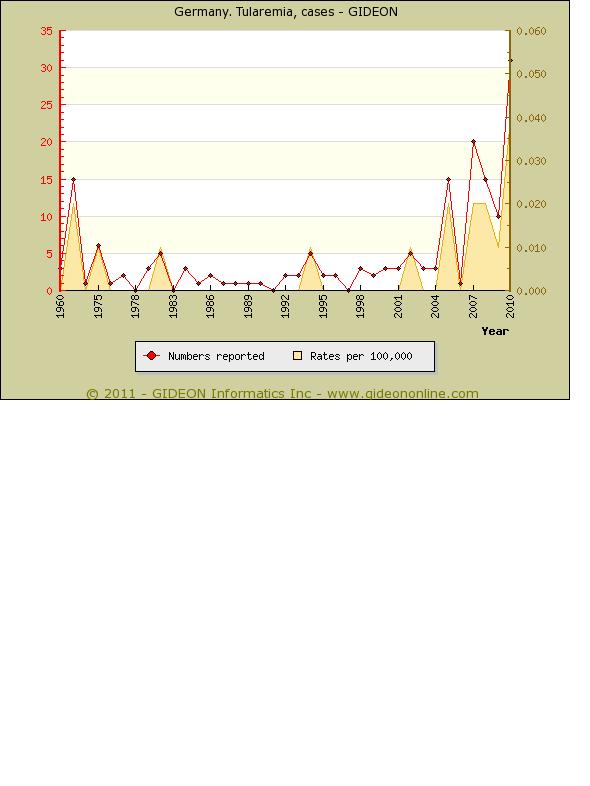
688 cases of tularemia were reported in Germany during 1949 to 2006 (including 220 cases in East Germany during 1949 to 1989) – see graph.
The following background data are abstracted from the Gideon e-book series (primary references available on request). [1,2]
Although tularemia in Germany is associated with wild animal contact, individual cases have been ascribed to ingestion of hare meat in a Berlin restaurant, and acquisition from a mosquito bite.
Prevalence surveys:
1.2% of bird-feeding and 1.5% of rodent-feeding ticks in central Germany (2007)
Seroprevalence surveys:
2.32% of persons in Leutkirch, Baden-Wuerttemberg (2008 publication)
3% of hunters in Styria and Burgenland (2003 publication)
1.7% of hunters in an endemic area (2008 publication)
3.1% of wild boars from Mecklenburg-Western Pomerania (1995 to 1996)
Isolation of Francisella tularensis subsp. holarctica from a European brown hare (Lepus europaeus) from Thuringia, Germany, was described for the first time in 2007
– F. tularensis was recovered from five species of rodents and water samples in an endemic area, with carriage rates ranging from 2.04% to 10.87% (2008 publication)
Notable outbreaks:
2005 – An outbreak (10 cases) among hunters in Griesheim (Hessen) was associated with skinning hares.
2007 (publication year) – An outbreak of tularemia was reported in a colony of semi-free-living common marmosets (Callithrix jacchus) in Goettingen.
2007 (publication year) – An outbreak of tularemia (18 cases) was reported among captive cynomolgus monkeys (Macaca fascicularis) at a Primate Center.
2007 – An outbreak (3 cases) in Baden Wertemberg was associated with rabbit contact.
References:
1. Berger SA. Infectious Diseases of Germany, 2011. 488 pp, 145 graphs, 1906 references. Gideon e-book series, https://www.gideononline.com/ebooks/country/infectious-diseases-of-germany/
2. Berger SA. Tularemia: Global Status, 2011. 45 pp, 39 graphs, 336 references. Gideon e-book series, https://www.gideononline.com/ebooks/disease/tularemia-global-status/