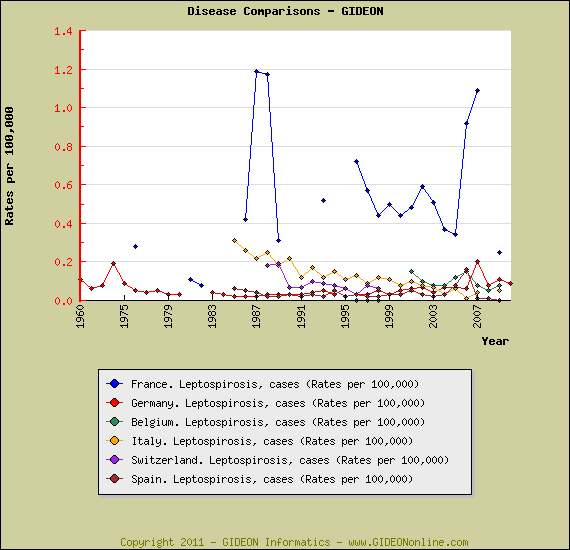
Most cases occur in the river basins of the southwest coast, notably Franche-Comte, Champagne-Ardennes and Poitou-Charentes. During 1996 to 2005, disease rates in Ardennes varied from 1.7 to 7.9 per 100,000 – approximately 10-fold the national rate.
48% of cases are reported during July through September.
The principal reservoirs in this country are rats, pigs, cattle, mice, buffalo, horses and coypu (Myocastor coypus).
Prevalence surveys:
29.7% of cattle, 51% of pigs, 78.6% of horses, 10% to 20% of wild rodents (1997)
44% of rodents (2008 publication)
Leptospira accounts for 1.3% of bacterial species causing uveitis (2001 to 2007)
23% of European mink (Mustela lutreola, 22% of polecats (Mustela putorius), and 15% of free-ranging American mink (Mustela vison) in southwestern France (1990 to 2007)
Infecting species:
– The principal species are Leptospira serovars icterohaemorrhagiae (30% of cases), australis, grippotyphosa (23% of cases), sejroe, Ballum, hebdomadis, canicola, bataviae and pomona.
– Rare instances of infection by Leptospira broomii have been reported.
References:
1. Berger SA. Infectious Diseases of France, 2011. 687 pp, 286 graphs, 2159 references. Gideon e-books, https://www.gideononline.com/ebooks/country/infectious-diseases-of-france/
2. Berger SA. Leptospirosis: Global Status, 2011. 148 pp, 165 graphs, 834 references. Gideon e-books, https://www.gideononline.com/ebooks/disease/leptospirosis-global-status/
Update:
Reported on ProMED