The following review of Campylobacter infection in New Zealand is abstracted from Gideon www.GideonOnline.com and the Gideon e-book series. [1,2] Primary references are available on request
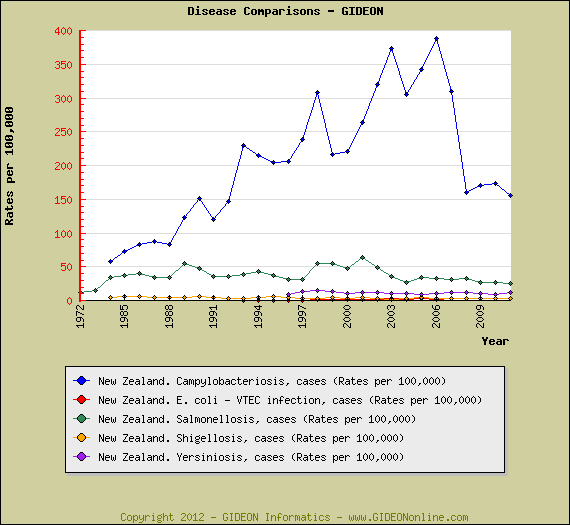
Campylobacter infection is the most common reportable cause of bacterial diarrhea in New Zealand.. In fact, the incidence of campylobacteriosis exceeds that of any other reportable disease in New Zealand, accounting for 42.5% of all notified cases of infectious disease in 2010 (see graph [3] )
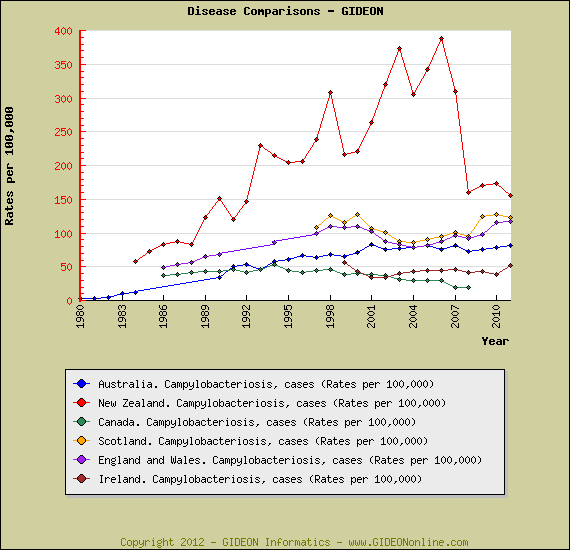
Rates of campylobacteriosis in New Zealand exceed those of the other major English-speaking countries (see graph 3] )
Time and Place:
– Highest rates are reported during late spring and early summer (November to January).
– Rates on South Island are correlated with lower socio-economic level, proportion of persons ages 25 to 44 and density of fresh food outlets.
– The Far North and much of the rural North Island report relatively low disease incidence during summer, with minimal inter-seasonal variation.
– A higher summer incidence and more seasonality variation is found in some North Island cities (Auckland, Hamilton, Napier) and some area of the South Island.
– The highest summer incidence and inter-seasonal variation is reported in Christchurch, Dunedin, much of the South Island, Wellington and Upper Hutt.
Graph Notes:
– Disease incidence varied from 1,915 cases in 1984, to 15,873 in 2006.
– Decreasing disease rates after 2007 were ascribed to disease control among poultry. – 17 fatal cases were reported during 1997 to 2011 – including 5 in 2002.
– 2,056 patients were hospitalized for Guillain-Barre syndrome (GBS, often associated with Campylobacteriosis) during 1988 to 2010.
– During this period, rates of GBS declined by a factor of 13%, following control of campylobacteriosis in poultry.
– During 1997 to 2011, between 10 outbreaks (1997) and 57 outbreaks (1999) have been registered per year.
Prevalence surveys:
6.8% of dairy calves (Campylobacter jejuni, Manawatu region, 2002)
44.8% of broiler chicken carcasses (2008 publication)
89% of domestic backyard chicken flocks in Canterbury (2011 publication)
0.34% of raw milk samples (2012 publication)
85% of surface water samples in Canterbury (2009 publication)
Seroprevalence surveys:
48% of ewes (Campylobacter fetus fetus, 2006 to 2009)
Notable outbreaks:
1987 (publication year) – An outbreak (19 cases) of campylobacteriosis in Christchurch was related to contamination of the water supply.
1990 – An outbreak (44 cases) of Campylobacter enteritis occurred at a camp near Christchurch.
1997 (publication year) – An outbreak (19 cases) was related to contamination of a town water supply.
1990 – An outbreak (99 cases) of Campylobacter enteritis occurred at a camp near Christchurch – drinking water was identified as the source.
2005 (publication year) – An outbreak (3 cases) in Christchurch was associated with consumption of pre-cooked sausages.
2006 – An outbreak (100,000 cases estimated) was associated with contaminated chicken.
References:
1. Berger SA. Infectious Diseases of New Zealand, 2012. 413 pages, 136 graphs, 1534 references. Gideon e-books, https://www.gideononline.com/ebooks/country/infectious-diseases-of-new-zealand/
2. Berger SA. Campylobacteriosis: Global Status, 2012. 96 pages, 95 graphs, 823 references. Gideon e-books, https://www.gideononline.com/ebooks/disease/campylobacteriosis-global-status/
3. Gideon graph tool at https://www.gideononline.com/wp-content/uploads/Gideon-Graphs.pps
Note featured on ProMED