The following background data regarding cutaneous leishmaniasis in Israel are abstracted from Gideon www.GideonOnline.com and the Gideon e-book series. [1,2]
Time and Place:
– Cutaneous leishmaniasis is endemic to the Jordan Valley, Dead Sea shore, central Negev, and Sinai border.
– Cutaneous leishmaniasis has been a reportable disease since 1956.
– Rates increased after the Six-day war of 1967, following acquisition of Judea and Samaria.
– Highest rates are encountered during June to October.
– Emerging foci have been identified in the areas of Nizzana (western Negev) and Yerucham. Nizzana accounts for 55% of cases among military personnel. (1996 to 2006)
– Fifteen cases of cutaneous leishmaniasis due to Leishmania major were reported from Sde Eliyahu (Beit She’an Valley) in 2007; 99 cases during 2008 to 2011.
– Increasing rates of leishmaniasis were reported in northern Israel during 1999 to 2003 (62.5 per 100,000 in Tiberias in 2003).
– Rates among military personnel were 0.11 per 100,000 in 2002, increasing to 196 per 100,000 in 2006
– 371 cases were reported from a university clinic in Jerusalem during 1988 to 1992.
– Four deaths were ascribed to cutaneous leishmaniasis during 1954 to 2003 – one in 1955 and three in 1958.
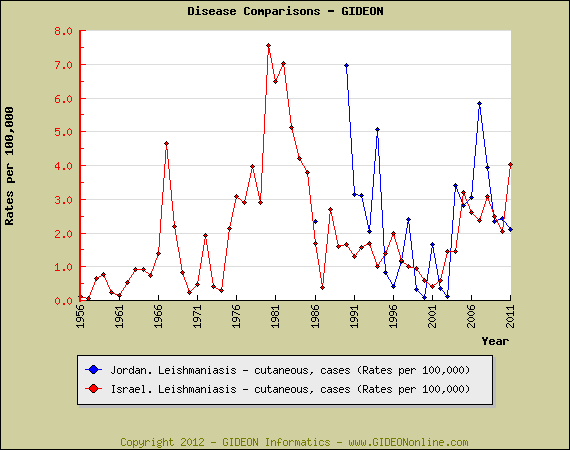
Rates of cutaneous leishmaniasis in the two countries which comprise historic palestine (Israel and Jordan) have been strikingly similar since 1991 – see graph [3] :
Agents:
– Most cases are due to Leishmania major, with sporadic infections by L. tropica.
– 33 cases of Leishmania tropica infection were documented in Tiberias and four nearby villages during 1996 to 2002.
– 161 cases of Leishmania tropica infection were reported in the Jerusalem district during 2004 to 2005, including 127 in Ma’ale Adumim.
– 72 cases of Leishmania major infection were reported from rural areas near Beit She’an during 2006 to 2008.
Reservoirs:
– The local reservoirs are Psammomys obesus (Jordan Valley, Arava and southern Israel) and Meriones crassus (western Negev).
– The hyrax (Procavia capensis) is a proven reservoir in northern Galilee, including areas of Leishmania tropica adjacent to the Sea of Galilee.
– Voles (Microtus guentheri) in Sde Eliyahu (Beit She’an region) are infected by Leishmania major.
– Sporadic infection has also been documented in gerbils (Gerbillus dasyurus).
– Leishmanial DNA has also been identified in Gerbillus dasyurus.
Prevalence surveys:
58% of rock hyraxes (Procavia capensis) in Ma’ale Adumim (PCR, 2010 publication) 14
19% of rock hyraxes (Procavia capensis, 2008 to 2010)
49% of Psammomys obesus, 43% of Meriones crassus, 33% of Paraechinus aethiopicus, 3% of Gerbillus dasyurus, 23% of Erinaceus concolor and 14% of Meriones tristami (2008 to 2011)
7.8% of golden jackals (Canis aureus) and 8% of red foxes Vulpes vulpes) (Leishmania tropica, 2010 publication)
18% of Phlebotomus papatasi sand flies and 16.5% of voles (Microtus guentheri in Sde Eliyahu (Beit She’an Valley, 2011 publication)
Vectors:
– The local vectors are Phlebotomus papatasi (for Leishmania major) and Ph. (Paraphlebotomus) sergenti(for Leishmania tropica).
– Ph. (Adlerius) arabicus is a proven vector of Leishmania tropica in the Northern Galilee.
– Ph. sergenti is implicated in transmission of L. tropica in the area of Tiberias; Ph. arabicus in the area of Karzim, Karkom and Amhun.
– Species found in the Judean Desert include Ph. (Paraphlebotomus) sergenti, Ph. papatasi, Ph. syriacus and Ph. Tobbi
Notable outbreaks:
1994 – An outbreak (32 cases) was reported in Yerucham.
2009 (publication year) – An outbreak of Leishmania tropica and Leishmania major infections was reported in Kfar Adumim (Jerusalem region).
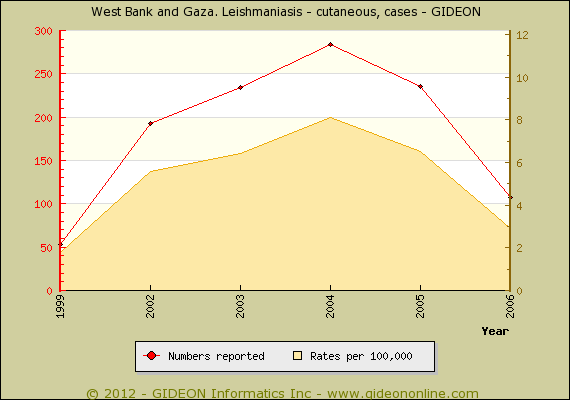
Notes regarding the West Bank and Gaza – see graph:
– 28 cases of L. tropica infection were confirmed in Jericho during 1997 to 2002, accounting for 48.5% of cutaneous leishmaniasis.
– 466 cases of cutaneous leishmaniasis were reported in Jenin District during 2002 to 2009 (23 per 100,000 per year) – 93.6% due to Leishmania tropica 21 and 6.4% Leishmania major. Cases of cutaneous infection by Leishmania infantum were also identified.
– 26.3% of persons in the vicinity of Jericho are seropositive.
– The principal vectors in the West Bank (Jenin) region are Phlebotomus papatasi (for Leishmania major) and Ph. Sergenti (L. tropica).
References:
1. Berger SA. Infectious Diseases of Israel, 2012. 519 pages, 223 graphs, 1982 references. Gideon e-books, https://www.gideononline.com/ebooks/country/infectious-diseases-of-israel/
2. Berger SA. Cutaneous and Mucosal Leishmaniasis: Global Status, 2012. 106 pages, 92 graphs, 837 references. Gideon e-books, https://www.gideononline.com/ebooks/disease/cutaneous-and-mucosal-leishmaniasis-global-status/
3. Gideon graph tool at https://www.gideononline.com/wp-content/uploads/Gideon-Graphs.pps