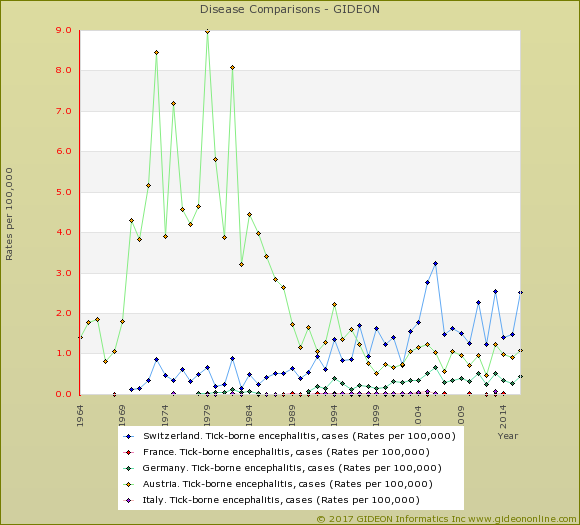
Rates (per 100,000) of tick-borne encephalitis in Switzerland have increased somewhat since the year 2000, and are currently higher than those reported by surrounding countries. The following image was created by a tool in GIDEON that converts incidence data into population rates and combines user-selected graphs into a single chart.
Note featured in ProMED
October 15th, 2017 at 10:24 pm
Hi,
Thank you for this post. However, I would like to point out that TBE is not endemic in all parts of Germany, with ~85% of cases occurring in only 2 of the 16 federal states. Thus for a comparison with Switzerland, incidence should best be compared with state-specific incidence in Bavaria and Baden-Württemberg, which was 1.4 cases/100,000 inhabitants/year in males and 0.7 in females; 1.2 total, from 2013-2016.
Kind regards
Dr. Wiebke Hellenbrand
Robert Koch-Institut
Department of Infectious Disease Epidemiology
FG33 Immunization Unit
Seestr. 10
D – 13353 Berlin
October 16th, 2017 at 10:04 pm
Dr. Hellenbrand
Thank you for these additional data regarding TBE in Germany. Gideon follows the status of all infectious diseases on a global level, as well as in individual countries. The current database contains 22,201 individual country notes (2.3 million words of text; 208,041 linked references). Expansion to include data on the level of individual states (provinces, cantons, oblasts…) – and construct year-by-year graphs vs. individual populations – is beyond our capacity.
As you point out, rates for every disease will vary from region to region in any individual country. Thus (as in my note) highest national rates are reported by Switzerland, most reports in that country originate from Thurgau, Schaffhausen, Zurich, Thun and Biel – also in Bern, Aargauand Graubunden.
You will receive relevant Gideon notes regarding Germany / Switzerland from the website.
Best regards
SB