GIDEON blog

Free Demo ► Latest Updates ► Video Tutorials ►
Subscribe , j x

GIDEON in Korea

Dr. Steve Berger will be presenting GIDEON this weekend at the BIT’s 1st World Congress of Virus and Infections 2010 (WCVI-2010)  in Busan, Korea.

He will be giving the keynote speech entitled “Informatics and Decision Support in Clinical Virology: A Global Web-based Program“.

Time: 14:10, August 1, 2010 (Sunday)

Place: Room No. 201, 2nd Floor, Convention Hall, BEXCO

Abstract:

A Global Web-based System for Disease Simulation and Informatics in the Field of Geographic Medicine

Stephen A. Berger, M.D.

347 generic infectious diseases are distributed haphazardly in time and space; and are challenged by 342 drugs and vaccines. Over 3,000 pathogenic bacteria, viruses, parasites and fungi have been described in human disease. An ongoing project for decision support and informatics will serve as a paradigm to demonstrate an approach to web-based systems for Geographic Medicine. The first module in the program generates ranked differential diagnoses based on signs, symptoms, laboratory tests, exposure history, country of acquisition and incubation period; and can be used to diagnose or simulate any infectious disease scenario. Additional capabilities include bioterrorism simulation and syndromic surveillance. The second module follows the epidemiology of individual diseases, including their global status and occurrence in each endemic country. As of 2010, this module contains 3 million words of text in 18,500 country-specific text notes; 32,095 graphs; 5,100 images (clinical, microscopic, life cycle, etc); 345 maps; 150,000 linked references; 10,200 outbreaks and 21,101 disease prevalence and serosurveys. The third module follows the pharmacology and usage of all anti-infective drugs and vaccines. The fourth module is designed to identify and characterize all species of bacteria, mycobacteria and yeasts. Application of such systems for use in diagnosis, surveillance and education will be discussed. Since all data in the program are generated at the server level from modular sources in electronic spread sheets, a subprogram has been designed to generate entire text-books (e-books) on the diseases of individual countries and diseases. At present, 411 such books (95,000 pages) have been generated – all of which will be updated yearly.

GIDEON at APHA

On Monday, November 8th, GIDEON’s medical director, Steve Berger, MD will be on the Global Access to Infectious Disease Information panel at the American Public Health Association (APHA) meeting in Denver, Colorado. Following that he will demonstrate GIDEON at a session entitled: Web-based system for informatics and decision support in geographic medicine.

Links to more information:

If you’ll be there, join the session and say hi to Steve.

Orninthosis in Argentina

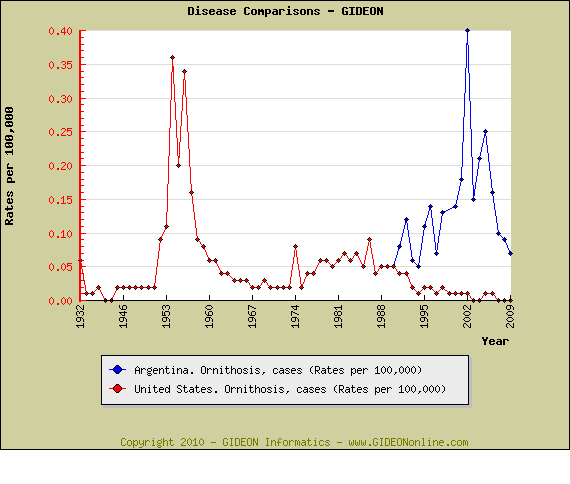
Regarding a recent outbreak in Jujuy, recent rates of ornithoisis in Argentina are strikingly similar to those reported in the United States during the 1950’s. [1-3]

References:
1. Berger SA. Infectious Diseases of Argentina, 2010. 410 pp. Gideon e-book series. https://www.gideononline.com/ebooks/country/infectious-diseases-of-argentina/
2. Berger SA. Infectious Diseases of the United States, 2010. 996 pp. https://www.gideononline.com/ebooks/country/infectious-diseases-of-the-united-states/
3. Berger SA. Ornithosis: Global Status, 2010. 36 pp. Gideon e-book series. https://www.gideononline.com/ebooks/disease/ornithosis-global-status/

Trichinosis in Mexico

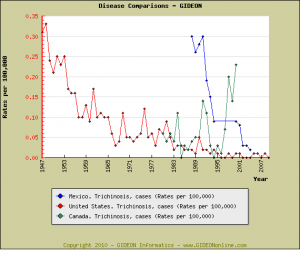
In recent years, reported rates of trichinosis in Mexico have decreased to levels which are comparable to those of the United States. In fact, Canada now reports the highest rates for North America (see graph). [1,2]

Chronology of trichinosis outbreaks in Mexico (primary reference available on request) [1,2]

Notable outbreaks:
1979 (publication year) – An outbreak was reported among family members in Naucalpan.
1981 (publication year) – An outbreak was reported in Villanueva, Zacatecas.
1984 (publication year) – Outbreaks were reported in Zacatecas.
1985 (publication year) – An outbreak was reported in Zacatecas.
1985 – An outbreak was reported in a government office in Federal District.
1986 (publication year) – An outbreak was reported in Durango.
1990 (publication year) – An outbreak (4 cases) among family members in Iztapalapa was caused by raw sausage.
1992 (publication year) – An outbreak (166 cases) in Delicias City, Chihuaha was caused by contaminated pork sausage.
1992 (publication year) – An outbreak (3 cases) among members of a family in Zapopan was related to consumption of raw pork.
1994 – An outbreak (7 cases) in France was associated with horsemeat imported from Mexico.
2001 (publication year) – An outbreak (5 symptomatic and 17 asymptomatic cases) was reported in Mexico State.

References:
1. Berger SA. Infectious Diseases of Mexico, 2010. 439 pp. Gideon e-books. https://www.gideononline.com/ebooks/country/infectious-diseases-of-mexico/
2. Berger SA. Trichinosis: Global Status, 2010. 81 pp. Gideon e-books. https://www.gideononline.com/ebooks/disease/trichinosis-global-status/

Tick-borne Encephalitis in Croatia

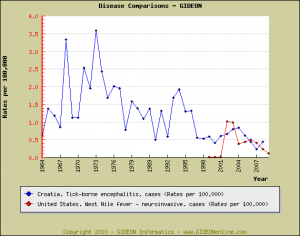
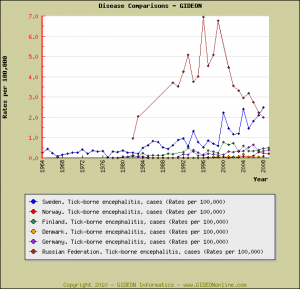
Although recent reports of Tick-borne encephalitis (TBE) in Croatia belie the fact that this disease has been steadily declining for five decades, the impact of TBE in Croatia is comparable to that of the main form of arthropod-borne encephalitis in the United States. See graph

TBE was first reported in Croatia in 1953, and mandatory reporting was instituted in 1987. There is only one natural focus in the northern part of the country, between the Sava and Drava Rivers. Alleged cases in Zadar and Pula, have not been certified. 75% of cases occur from May to July.

Approximately 20 cases per year are reported in Koprivnica-Krizevci County, characterized by a relatively mild illness without neurological residua.

References:
1. Berger SA. Infectious Diseases of Croatia, 2010. 356 pp. Gideon e-book series. https://www.gideononline.com/ebooks/country/infectious-diseases-of-croatia/
2. Berger SA. Tick-borne Encephalitis: Global Status, 2010. 52 pp. Gideon e-book series. https://www.gideononline.com/ebooks/disease/tick-borne-encephalitis-global-status/

Borreliosis: Lyme or Ljubljana

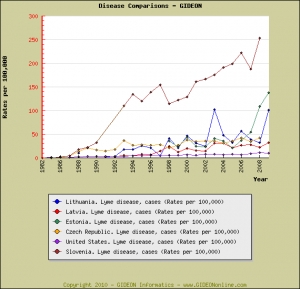
The first cases of Lyme disease (LD) were recognized in Lyme, Connecticut in 1975. Although many assume that the condition is largely limited to the United States, LD has been reported in 63 countries as of 2010, with cases in Latin America, Asia, Europe and North Africa. Surprisingly, the world’s highest LD rates are reported in Slovenia, followed by the Baltic countries and Czech Republic (see graph). [1,2]

Borrelia burgdorferi was first isolated from patients in Slovenia in 1988, and from ticks in 1993.

Prevalence surveys:
7.7% to 46% of febrile illness following tick bite
45.5% of ticks in the Italy/Slovenia transborder territory (2008 publication)

Seroprevalence surveys:
15.4% of children and young adults in Slovenia (2000 publication)
23.8% of forestry workers (ELISA, 2002)

Infecting species:
– Borrelia burgdorferi, B. afzelii and B. garinii are encountered.
– B. afzelii accounts for the majority of isolates; however, B. garinii predominates among strains cultured from cerebrospinal fluid.
– B. bissettii has been isolated from humans with Lyme disease in Slovenia.
– Borrelia spielmanii (Borrelia A14S) has been implicated in cases of erythema chronicum migrans in Slovenia.

References:
1. Berger SA. Infectious Diseases of Slovenia, 2010, 373 pp. Gideon e-book series. https://www.gideononline.com/ebooks/country/infectious-diseases-of-slovenia/
2. Berger SA. Lyme disease: Global Status, 2010, 66 pp. Gideon e-book series. https://www.gideononline.com/ebooks/disease/lyme-disease-global-status/

Hepatitis E in the United States

Although less-recognized that other forms of viral hepatitis, several studies have suggested that Hepatitis E infection is common in the United States. [1,2]

Seroprevalence surveys:
21.0% of non-institutionalized Americans – with highest rates among US-born individuals, males, non-Hispanic whites, and individuals residing in the Midwest and/or in metropolitan areas (1988 to 1994)
13.6% of destitute and 15% of homeless persons in Los Angeles (2000)
2.1% of blood donors (1992 publication)
29.3% of patients with chronic liver disease (Cincinnati, Ohio, 1995 to 2006)
23% to 26% of veterinarians treating swine, compared to 18% of a control group of blood donors (1999)
10.9% of swine workers in North Carolina (2002 publication)
77% of wild rats in Maryland (1997)
73.5% of Norway rats in Baltimore (2005 to 2006)
90% of Norway rats in Hawaii (1986)
44% of Norway rats in Louisiana (1995)

References:
1. Berger SA. Infectious Diseases of the United States, 996 pp. 2010, Gideon e-books https://www.gideononline.com/ebooks/country/infectious-diseases-of-the-united-states/
2. Berger SA. Hepatitis D, E and G: Global Status, 92 pp. 2010, Gideon e-books https://www.gideononline.com/ebooks/disease/hepatitis-d-e-and-g-global-status/

Update: Posted in ProMED

Tick-borne Encephalitis in Sweden

Recent reports highlight the fact that Sweden has the highest rate of Tick-borne encephalitis (TBE) in Scandinavia, exceding even those of Russia in 2008. [1,2]

The following background data on TBE in Sweden are abstracted from Gideon. Primary references are available on request.

Time and Place:
Disease rates peak during July to August.
– Natural foci are found throughout the southern and middle parts of Sweden up to the counties of Varmland and Dalarna and further north along the Baltic sea.
– Cases are identified on the Stockholm archipelago, the middle and eastern parts of lake Malaren close to Stockholm, the coastal area of the Baltic sea from Stockholm further south to the city of Kalmar and the islands of Oland and Gotland.
– Highest incidence is found on the East Coast, (particularly on the Stockholm archipelago), the eastern region of Lake Malaren and the Gotland Island region.
– The first cases in Skane were reported in 2001. Six cases were reported in the region to 2006.
– 65.3% of cases reported during 1992 to 1996 were acquired in Stockholm, 15.2% in Sodermanland, 6% from Ostergotland or Gotland, and 4.9% from other countries (primarily Finland).
– 402 cases of TBE were registered during 1955 to 1993, with a case/fatality rate of 0.5%. During this period, the disease rate in Stockholm County was 3.4 per 100,000 per year.
– 71% of cases in 2001 were reported from Stockholm, Uppsala and Sodermanland.
– 56% of cases in 2003 were from Stockholm, 15% from Sodermanland and 6% from Uppsala.
– In 2007, TBE virus was the most common agent of viral meningitis in Sweden, accounting for 37.4% of cases.

The male/female ratio among TBE patients is is 2.1/1; and the median patient age is 41.5 years.

Exported cases:
Tick-borne encephalitis was documented in a Swedish national in England (1991 publication).
An American traveler acquired Tick-borne encephalitis in Sweden in 2006.

Prevalence surveys:
21% of adult aseptic meningitis in Northern Stockholm (1999 and 2004)

Seroprevalence surveys:
4% to 22% in endemic areas, and 5% Stockholm
3.5% on the island of Asp (Southeast Sweden) in 1991; 12% in 2002
0.8% of persons in northeastern Skane are seropositive.

Tick-borne encephalitis virus has been identified in Ixodes ricinus found on migrating passerine birds.

References:

1. Berger SA. Infectious Diseases of Sweden, 2010, 417 pp. Gideon e-book series https://www.gideononline.com/ebooks/country/infectious-diseases-of-sweden/

2. Berger SA. Tick-borne Encephalitis: Global Status, 2010, 52 pp. Gideon e-book series https://www.gideononline.com/ebooks/disease/tick-borne-encephalitis-global-status/

Japanese Encephalitis in Vietnam

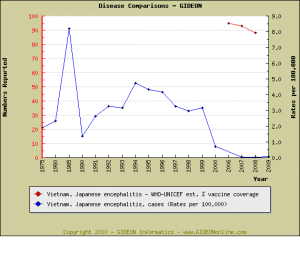
Recent reports of Japanese encephalitis (JE) activity belie the fact that disease rates in Vietnam have decreased in recent years. [1,2]

Time and Place:
– Japanese encephalitis was first reported in Vietnam in 1960.
– Most cases of Japanese encephalitis in Vietnam occur in the South during the rainy and early dry season; and in the north during late summer and autumn.
– 61,729,000 persons (73% of the population) live in areas of risk.

Vaccine Schedule:
BCG – birth
DTwP – 2, 3, 4 months
HepB – birth; 2, 4 months; [since 2003]
Japanese encephalitis – 12, 13, 25 months; Part of country [selected HRD]
Measles (monovalent) – 9 months
OPV – 2, 3, 4 months
TT – pregnant women; CBAW (15-35) in some areas
Typhoid – 3-10 years; Part of country [selected HRD]
Vitamin A – 6-11, 12-17, 18-24, 31-36 months

WHO estimates for vaccine coverage decreased slightly from 95% in 2006, to 88% in 2008 (see graph).

The incidence of Japanese encephalitis has decreased dramatically during the past three decades – from a peak of 4,935 cases in 1985, to only 558 cases in 2000.
– 9,574 cases were reported during 1986 to 1990; 6,981 during 1991 to 1996.
– 68 cases were officially reported in 2009.
– Annual mortality from the disease has varied from 60 to 150 cases.

Incidence and Prevalence:
– Japanese encephalitis accounted for 67% of acute childhood encephalitis in Hanoi during the summer of 1995.
– The annual incidence among children in Southern Vietnam is 4.6% (2007 publication)
– A recent outbreak was centered in Ha Bac and Hai Hung.
– Eight children died of presumed Japanese encephalitis in Kien Giang Province in 1999.
– 200 cases were reported in the northern region during May to June, 2005.

Exported cases
– An Australian soldier acquired Japanese encephalitis in Vietnam (reported in 1975).
– In 2006, an Italian traveler developed Japanese encephalitis (nonfatal) after returning from Vietnam.
– In 2008, an American tourist contracted Japanese encephalitis (nonfatal) while in Vietnam and Cambodia.

Related diseases:
– A new arbovirus, tentatively named “Nam Dinh virus,” was implicated in several cases of encephalitis in Ha Noi and Ha Tay in 2003, and in Bac Giang Province in 2004.

References:
1. Berger SA. Infectious Diseases of Vietnam, 2010, 382 pp. Gideon e-book series, https://www.gideononline.com/ebooks/country/infectious-diseases-of-vietnam/
2. Berger SA. Japanese Encephalitis: Global Status, 2010, 51 pp. Gideon e-book series, https://www.gideononline.com/ebooks/disease/japanese-encephalitis-global-status/

Update: Posted in ProMED

Legionellosis in Spain

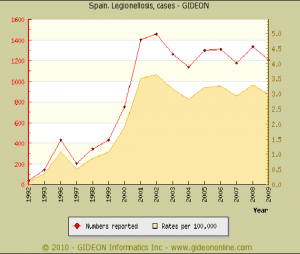
A recent outbreak in Alcoy reminds us that rates of legionellosis have been increasing in Spain. The following background data are abstracted from the GIDEON e-book series. [1,2]

Graph 1 summarizes disease incidence and rates per 100,000 population.

Graph Notes:
1. 47 cases were reported in the Balearic Islands during 2001 to 2003.
2. 460 cases were reported among Spanish tourists during 2002 to 2006; 30 in 2005; 73 in 2006.
Individual years:
1993 – Included 57 cases in Cataluna
2003 – 5.82 per 100,000 in the Balearic Islands

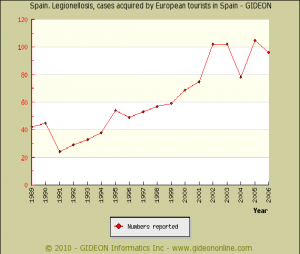
As seen in Graph 2, this increase has also affected tourists in Spain.
Graph Notes:
1. 281 cases were acquired by foreign tourists in Spain during 1987 to 1995 – 67% of these from Great Britain. 37% of these were acquired in the Balearic Islands.
2. 627 cases were acquired by foreign tourists in Spain during 1989 to 2001.
3. 6,411 cases of legionellosis were reported during 1999 to 2004 – 565 (9%) involving Spanish travelers, and 426 involving foreign travelers in Spain.
4. 73 travel-associated cases were reported in 2006; 68 in 2007.
Individual years:
2003 – Included nine Spanish citizens touring within Spain.

Legionellosis accounts for 3% of community-acquired pneumonia in Palma de Mallorca (1992 to 1994)

Outbreaks – an overview:
– 1989 to 1998 – 55 outbreaks of legionellosis were reported – 36 of these associated with tourism, 11 nosocomial and 8 community-acquired.
– A single hotel in Benidorm was implicated in the infection of 3 tourists in 1989, 1 in 1990, 2 in 1995, 1 in 1996; 3 in 1997; 8 (1 fatal) in 1998.
– 1990 to 1991 – 54 outbreaks involving 805 cases (and additional 1,358 sporadic cases) were reported.
– 1990 to 2004 – 118 outbreaks involving 690 patients were reported in Catalonia – 35.6% involving water towers, and 14.4% involving water distribution systems in public buildings.
– 1999 to 2001 – Four outbreaks affected over 160 people in Alcoy.
– 2000 – Seven outbreaks were reported – 4 of these nosocomial. An additional 4 clusters were reported among tourists to Spain.
– 2000 – Girona reported 32 cases (3 fatal); Barcelona 48 (1 fatal); Vigo 30 (4 fatal) and Alcala de Henares 249 (11 fatal).
– 2001 to 2003 – 135 cases (10 fatal) in 46 clusters were acquired by European travelers to Spain, including 85 in 2002
– 1999 to 2003 – Eight outbreaks (approximately 300 cases) were reported in Alcoy, Alicante.
– 2003 – 55 outbreaks (247 cases) were reported.

Notable outbreaks:
1973 – An outbreak (89 cases, 3 fatal) was associated with a hotel in Benidorm.
1978 (publication year) – An outbreak (2 fatal cases) was associated with a hotel in Benidorm.
1983 – An outbreak (35 cases) in Valencia was related to contaminated shower heads and toilet tanks.
1984 (publication year) – An outbreak was reported in Los Castillejos.
1984 – An outbreak (32 cases) was reported among Dutch tourists at a hotel in Pineda de Mar (Barcelona region, Spain).
1988 – An outbreak (56 cases) was reported in Barcelona.
1992 (publication year) – An outbreak (6 cases) in a private apartment building in Zaragoza was associated with potable water.
1992 (publication year) – An outbreak was reported in a hospital in Badalona.
1993 – An outbreak (4 British tourists and 1 French tourist) was reported at a hotel in Spain.
1994 – An outbreak (20 cases) was reported in L’Espluga de Francoli, Tarragona.
1996 – An outbreak (260 cases, 197 hospitalized, 14 fatal) was reported in Madrid region (Alcala de Henares). This was the largest outbreak reported in Europe to date.
1996 – An outbreak (4 cases) was reported among British tourists at a hotel in Minorca.
1998 – An outbreak (3 cases, all fatal) was reported in a hospital in Zaragoza.
1999 – An outbreak (6 cases) was reported among foreign tourists to a spa in Cestona (Guipuzcoa Province).
1999 – An outbreak (7 cases, 1 fatal) was associated with a hotel outbreak in Benidorm.
2000 – An outbreak (70 cases, 2 fatal) was reported in Alcoy (Valencia region).
2000 – An outbreak (28 cases) was associated with a cooling tower in the region of a hospital in Vigo (Galicia).
2000 – An outbreak (54 cases, 17 hospitalized, 3 fatal) was reported in the “La Barceloneta” district of Barcelona.
2001 (publication year) – An outbreak (2 cases, both fatal) was reported among mechanics working on a cargo ship in the port of Barcelona.
2001 – An outbreak of 751 clinical cases (449 confirmed, 2 fatal) was reported in Santa Maria de Gracia (Murcia) – the world’s largest recorded outbreak to that time. The source of infection was an outdoor hospital cooling tower.
2001 – An outbreak (18 cases, 3 fatal) was reported from a hospital in Pamplona. A contaminated hot water system was implicated.
2002 – An outbreak (124 cases, 2 fatal) in Matara, Catalonia was related to a local cooling tower.
2003 – Outbreaks (25 total cases, 1 fatal) were reported in Valencia.
2003 – An outbreak (4 cases) was reported at a spa on Tenerife. An additional suspect case was reported in a Venezuelan visitor to the spa.
2004 – An outbreak (28 confirmed cases, 1 fatal) was reported at a hospital in Zaragoza. Contaminated cooling towers were implicated.
2004 – An outbreak (33 cases, 2 fatal) in Vallarca, Barcelona was caused by a contaminated air conditioning system at a private clinic.
2005 – An outbreak (19 cases, 3 fatal) was reported in Barcelona.
2005 – An outbreak (28 cases, including 21 foreigners – 0 fatal) was associated with a shopping center in Torrevieja.
2005 – An outbreak (55 cases, 3 fatal) was associated with a cooling tower in Catalonia.
2006 – An outbreak (146 cases, 0 fatal) in Pamplona was ascribed to contaminated cooling towers.
2006 – An outbreak (5 cases) was reported among ceramic workers in Castellon.
2006 – An outbreak (12 cases) in Catalonia was related to a contaminated mist machine.
2007 (publication year) – An outbreak of Legionnaires’ disease was reported among immunosuppressed patients at a cancer centre in Barcelona.
2007 to 2008 – An outbreak (3 cases) on a hospital surgical ward was associated with a contaminated oxygen humidifier.

References:
1. Berger SA. Infectious Diseases of Spain, 516 pp. Gideon Informatics, Inc. 2010, https://www.gideononline.com/ebooks/country/infectious-diseases-of-spain/
2. Berger SA. Legionellosis: Global Status, 84 pp. Gideon Informatics, Inc. 2010, https://www.gideononline.com/ebooks/disease/legionellosis-global-status/

GIDEON Sign In