GIDEON blog

Free Demo ► Latest Updates ► Video Tutorials ►
Subscribe , j x

Legionellosis in Spain

A recent outbreak in Madrid reminds us that Spain may well have the highest rate of legionellosis in the World. In the following graph, I’ve compared reported cases per 100,000 population for Spain and other regional countries with those of the United States.
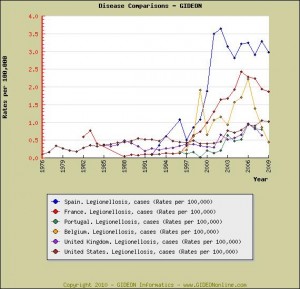
67 specific outbreaks have been described in the World’s literature for the United States, as compared to 37 for Spain; however, the number of outbreaks per million population in Spain (0.80) is over 3.6-fold that for the United States (0.22).

The following chronology of legionellosis outbreaks in Spain is abstracted from the Gideon e-book series. [1,2] (primary references available on request)

1973 – An outbreak (89 cases, 3 fatal) was associated with a hotel in Benidorm.
1978 (publication year) – An outbreak (2 fatal cases) was associated with a hotel in Benidorm.
1983 – An outbreak (35 cases) in Valencia was related to contaminated shower heads and toilet tanks.
1984 (publication year) – An outbreak was reported in Los Castillejos.
1984 – An outbreak (32 cases) was reported among Dutch tourists at a hotel in Pineda de Mar (Barcelona region, Spain).
1988 – An outbreak (56 cases) was reported in Barcelona.
1992 (publication year) – An outbreak (6 cases) in a private apartment building in Zaragoza was associated with potable water.
1992 (publication year) – An outbreak was reported in a hospital in Badalona.
1993 – An outbreak (4 British tourists and 1 French tourist) was reported at a hotel in Spain.
1994 – An outbreak (20 cases) was reported in L’Espluga de Francoli, Tarragona.
1996 – An outbreak (260 cases, 197 hospitalized, 14 fatal) was reported in Madrid region (Alcala de Henares). This was the largest outbreak reported in Europe to date.
1996 – An outbreak (4 cases) was reported among British tourists at a hotel in Minorca.
1998 – An outbreak (3 cases, all fatal) was reported in a hospital in Zaragoza.
1999 – An outbreak (6 cases) was reported among foreign tourists to a spa in Cestona (Guipuzcoa Province).
1999 – An outbreak (7 cases, 1 fatal) was associated with a hotel outbreak in Benidorm.
2000 – An outbreak (70 cases, 2 fatal) was reported in Alcoy (Valencia region).
2000 – An outbreak (28 cases) was associated with a cooling tower in the region of a hospital in Vigo (Galicia).
2000 – An outbreak (54 cases, 17 hospitalized, 3 fatal) was reported in the “La Barceloneta” district of Barcelona.
2001 (publication year) – An outbreak (2 cases, both fatal) was reported among mechanics working on a cargo ship in the port of Barcelona.
2001 – An outbreak of 751 clinical cases (449 confirmed, 2 fatal) was reported in Santa Maria de Gracia (Murcia) – the world’s largest recorded outbreak to that time. The source of infection was an outdoor hospital cooling tower.
2001 – An outbreak (18 cases, 3 fatal) was reported from a hospital in Pamplona. A contaminated hot water system was implicated.
2002 – An outbreak (124 cases, 2 fatal) in Matara, Catalonia was related to a local cooling tower. 43 44 45
2003 – Outbreaks (25 total cases, 1 fatal) were reported in Valencia.
2003 – An outbreak (4 cases) was reported at a spa on Tenerife. An additional suspect case was reported in a Venezuelan visitor to the spa.
2004 – An outbreak (28 confirmed cases, 1 fatal) was reported at a hospital in Zaragoza. Contaminated cooling towers were implicated.
2004 – An outbreak (33 cases, 2 fatal) in Vallarca, Barcelona was caused by a contaminated air conditioning system at a private clinic.
2005 – An outbreak (19 cases, 3 fatal) was reported in Barcelona.
2005 – An outbreak (28 cases, including 21 foreigners – 0 fatal) was associated with a shopping center in Torrevieja.
2005 – An outbreak (55 cases, 3 fatal) was associated with a cooling tower in Catalonia.
2006 – An outbreak (146 cases, 0 fatal) in Pamplona was ascribed to contaminated cooling towers.
2006 – An outbreak (5 cases) was reported among ceramic workers in Castellon.
2006 – An outbreak (12 cases) in Catalonia was related to a contaminated mist machine.
2007 (publication year) – An outbreak of Legionnaires’ disease was reported among immunosuppressed patients at a cancer centre in Barcelona.
2007 to 2008 – An outbreak (3 cases) on a hospital surgical ward was associated with a contaminated oxygen humidifier.
2010 – An outbreak (16 cases) in Alcoy was related to a car-washing machine. This was the 16th outbreak in Alcoy since 1999.
2010 – An outbreak (43 cases) of Pontiac fever was reported in Barcelona.
2009 – An outbreak (11 cases, 1 fatal) in Alcoy was related to exposure to the water tank of a milling machine used in street asphalt repaving.

References:
1. Berger SA. Infectious Diseases of Spain, 511 pp, 2,036 refs. 2010, Gideon e-book series. www.gideononline.com/ebooks/country/infectious-diseases-of-spain/
2. Berger SA. Legionellosis: Global Status, 82 pp, 751 refs. 2010, Gideon e-book series. www.gideononline.com/ebooks/disease/legionellosis-global-status/
GIDEON ebook series discount

We are very excited to officially launch the GIDEON ebook Infectious Diseases series.

Building on the success of the free ebook, Infectious Diseases of Haiti, with over 10,000 downloads, the GIDEON selection has expanded to over 400 ebooks.

To celebrate, we are offering a coupon for a 25% discount on all the ebooks valid until the end of November. Coupon code is “welcome”.

Click on “Add a coupon” after adding books to your cart and press Update. Then continue checkout and the discount will be reflected in your shopping cart.

Choose the ebooks by country or by disease.

The ebooks will be available in multiple book stores, including Amazon, Barnes and Nobles and Apple app store thanks to our relationship with O’Reilly Media.

GIDEON AND O’Reilly Media announce partnership to distribute 411 Infectious Disease Ebooks

— Features up-to-date information on 347 infectious diseases and 200 countries —
— Available for Kindle, iPad, mobile devices and computers in PDF, mobi and ePub formats —

LOS ANGELES, Calif., November 1, 2010 – GIDEON Informatics Inc (https://www.gideononline.com/) today announced a partnership with O’Reilly Media, Inc. to distribute a new series of 411 GIDEON ebooks on infectious diseases ($49 each) that can be read on Amazon Kindle, Apple iPad, mobile devices and personal computers. The GIDEON ebook series makes it easier for medical professionals to stay up to date on developments in the field of Infectious Diseases and provides the first comprehensive compilation of disease data for every country in the world.

The new GIDEON ebook collection features one series of ebooks dedicated to infectious disease data by country, and another series that details the “global status” of each disease. The GIDEON ebook series encompasses over 95,000 pages of text, supplemented by 30,000 graphs and 200,000 clickable linked references.

“Keeping up with new information on infectious diseases is a significant challenge for medical professionals, and these new ebooks now make all of the world’s data more accessible,” said Dr. Stephen Berger, Chief Medical Officer of GIDEON. “The ebooks in this series retail at $49 each, making them affordable and ideal for medical professionals, public health departments, students, educators, researchers and pharmaceutical companies.”

The country series of GIDEON ebooks includes a complete and comprehensive review of the status of every infectious disease – for each of 200 countries, from Afghanistan to Zimbabwe. The “global status” GIDEON ebook series summarizes the clinical features and epidemiology of every individual disease, with an entire book dedicated to each condition – from Acanthocephalan worms to Yersiniosis. The GIDEON ebook series even includes entire ebooks for lesser-studied countries, such as Andorra, Djibouti and Kiribati; and diseases such as Acanthocephalan worms, Coltiviruses, Dicrocoeliasis and Australo-Pacific Arboviruses.

Additional titles in the GIDEON ebook series include: Infectious Diseases and Bioterrorism and Infectious Diseases of the World. GIDEON Online also offers a free ebook on Infectious Diseases of Haiti (314 pages, 36 graphs), which has already been downloaded over 10,000 times. It is available for free download or on Amazon.com for $1, for the US: Kindle version.

In addition to all diseases which are endemic to a given country, each book includes all published data regarding imported diseases and infection among expatriates. The entire series will be updated annually.

“We are excited to distribute the GIDEON series of ebooks through O’Reilly’s new Digital Distribution Services,” said Pascal Honscher, General Manager Digital Distribution of O’Reilly Media, Inc. “These quality infectious disease titles from GIDEON will now be easily available through a large number of resellers.”

O’Reilly Media’s Digital Distribution Service provides ebooks in multiple formats to leading online book retailers and channels, including: Amazon, Apple iTunes, Book Glutton, eBookPie, Barnes & Noble, PaperC, Dawson, Scribd, Follet, Diesel eBooks, Entourage eDGe, Kobo, Examville, Immateriel, Woodslane, Bookshare and Android market. The GIDEON ebook series is available through these channels and directly on the GIDEON Online website at www.gideononline.com/ebooks.

“We are thrilled to partner with O’Reilly Media, a market leader in ebooks digital distribution with an extensive distribution network,” said Uri Blackman, CEO of GIDEON Informatics, Inc. “This new ebooks series on infectious diseases makes this vital information easily available in a variety of formats.”

The data in these ebooks are based on the GIDEON Online database (www.gideononline.com), which incorporates all relevant information from text books, peer-review journals, Health Ministry reports and ProMed, supplemented by an ongoing electronic search of the medical literature. GIDEON’s ebooks complement its web application by expanding easy access to GIDEON’s vast content without a subscription or internet access.

About GIDEON Informatics
GIDEON Informatics Inc develops and markets point-of-care medical-decision support applications that help reduce diagnostic errors. Founded in 1992 by Uri Blackman and Stephen Berger, MD, one of the foremost experts on Infectious Disease, GIDEON Informatics is managed by an expert executive team and medical advisory board. Its comprehensive, easy-to-use, interactive Web-based infectious disease knowledge management tool helps medical personnel worldwide diagnose and treat infectious diseases, and identify microorganisms, including bioterrorism agents. GIDEON is in use by hundreds of medical institutions, universities and public health departments worldwide including Children’s Hospital Oakland, Palo Alto Medical Foundation, World Health Organization (WHO), Center for Disease Control (CDC), Yale University, Hong Kong University and the Los Angeles county health department. For additional information on GIDEON Informatics, visit www.gideononline.com or call 888-664-3366.

About O’Reilly
O’Reilly Media spreads the knowledge of innovators through its books, online services, magazines, and conferences. Since 1978, O’Reilly Media has been a chronicler and catalyst of cutting-edge development, homing in on the technology trends that really matter and spurring their adoption by amplifying “faint signals” from the alpha geeks who are creating the future. An active participant in the technology community, the company has a long history of advocacy, meme-making, and evangelism.

# # #

Media Contact:

Lisa Hendrickson
LCH Communications for GIDEON Online
516-767-8390
[email protected]

Available on:
Marketwire

Hepatitis E in England

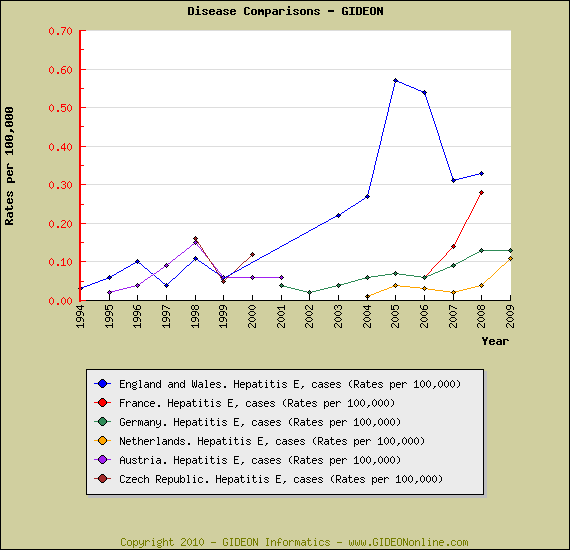
Recent reports from Cornwall remind us that autothonous cases of Hepatitis E are increasingly reported in Europe. In fact, reported rates in England and Wales are somewhat higher than those of other regional countries.

The following background data on Hepatitis E in the United Kingdom are abstracted from the Gideon e-book series. [1,2] Primary references are availale on request.

Only one autochthonous case (in 1999) of Hepatitis E was reported during 1994 to 2000 – all others were either imported or source unknown.
– 10 autochthonous cases had been reported as of 2006.
– 186 cases were reported during 1996 to 2003 – including 17 autochthonous cases.
– 100 confirmed and presumed indigenous infections were reported in 2005 (30.4% of total cases, 70% above age 55 years).
– 181 cases were confirmed during January to June, including 25 autochthonous cases.

21 autochthonous cases were documented in southwestern England during a 7-year period (2007 publication). 5 ; 28 in Cornwall and Devon during 2005 to 2006.
– A series of 24 cases of non-travel associated Hepatitis E infection was treated at a hospital in south Wales during a 25-month period (2010 publication)
– 13 cases were confirmed in South Hampshire during a 13-month period (2005 to 2006)

Prevalence surveys:
5% to 35% of pigs on farms in the Yorkshire Humberside area (2008 publication)

Seroprevalence surveys:
16% of blood donors, 13% of patients with chronic liver disease and 25% in individuals over 60 years (southwestern England, 2008 publication)
13% of persons in England (1991 to 2004)
3.9% (native-born) to 8.8% (foreign-born) of persons in inner city London (1996 publication)
2.4% of farming industry workers (2009 publication) 13

Human infection by a porcine strain of Hepatitis E virus has been documented.

Notable outbreaks:
2008 – An outbreak (33 cases) was reported among passengers on a British round-the-world cruise ship.

References:
1. Berger SA. Infectious Diseases of the United Kingdom, 956 pp, 2010. Gideon e-book series. https://www.gideononline.com/ebooks/country/infectious-diseases-of-the-united-kingdom/
2. Berger SA. Hepatitis D, E and G: Global Status, 89 pp, 2010. https://www.gideononline.com/ebooks/disease/hepatitis-d-e-and-g-global-status/

Update: Posted in ProMED

Malaria in Spain

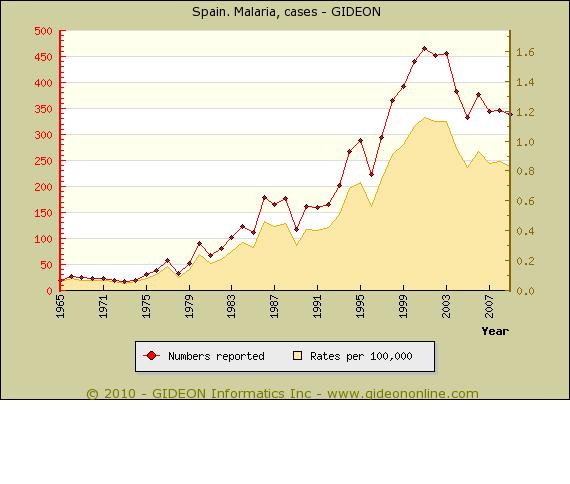
A recent case of autochthonous infection in Huesca Province highlights the fact that malaria rates in Spain have increased dramatically since the 1960’s. See graph

Graph notes:
1. 461 cases were reported during 1973 to 1982; 1,707 during 1985 to 1994.
2. Plasmodium falciparum accounted for 59.6% of cases reported during 1989 to 1995, with a case/fatality rate of 1.91% among patients infected with this species.
3. P. falciparum accounted for 62.6% of cases reported during 1996 to 1999.
4. No cases of ‘airport malaria’ were reported during 1994 to 1995.
Individual years:
1994 – 69.02% imported from Africa. 115 of these reported from Madrid and 74 from Cataluna.
1995 – 228 from Africa. 89 were from Equatorial Guinea).
1996 – 117 from Madrid and Cataluna. 143 from Africa (51 from Equatorial Guinea).
1997 – 181 from Madrid and Cataluna. 208 from Africa (61 from Equatorial Guinea).
1998 – 219 from Madrid and Cataluna. 271 from Africa (104 from Equatorial Guinea).
1999 – 219 from Madrid and Cataluna. 229 from Africa (65 from Equatorial Guinea).

The following background data are abstracted from references 1 and 2.

Malaria was extremely common in Spain during the first decades of the twentieth century, with 293,000 cases and 1,278 deaths reported during the late 1930’s to early 1940’s. The last confirmed indigenous cases were reported during the 1950’s, and Spain was certified “malaria-free” by WHO in September 1964.

Autochthonous or Introduced malaria:
1978 – A case of introduced malaria was reported (a nurse who had been in contact with a malaria patient).
1984 – An outbreak of 4 cases was reported among injecting drug users in Madrid in 1984. A similar outbreak (2 IDU in Cataluna) was reported in 1986.
1987 – A case of transfusion-related malaria was reported in Valencia.
1991 – An outbreak (43 cases from transfused blood and 11 from plasma) of ‘introduced malaria’ was reported.
1998 – Spain’s last case of introduced malaria (from Mauritania) was reported in the Canary Islands in 1998.

Prevalence surveys:
3.8% of asymptomatic immigrants referred to a tropical medical unit (Madrid, 1989 to 2008)

Vectors:
The local potential vectors are Anopheles atroparvus (throughout) and An. messeae (in the north).
– An. labranchiae, once a common vector, is not longer found in Spain.

References:
1. Berger SA. Infectious Diseases of Spain, 511 pp, 2,036 refs. Gideon e-book series, 2010.
2. Berger SA. Malaria: Global Status, 370 pp, 1,609 refs. Gideon e-book series, 2010.

Salmonellosis – U.K. and International Outbreaks

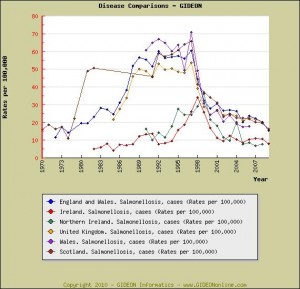
Recent cross-border oubreaks belie the fact that salmonellosis activity in the United Kingdom has actually declined in recent years. In fact, since 1997, reporting rates for England, Scotland and Wales have been similar to the lower figures which had existed in Ireland and Northern Ireland. The following data are extracted from the Gideon e-book series. [1-3]

The following chronlogy of earlier international salmonellosis outbreaks (not including clusters among tourists) is extracted from reference [4]:

Outbreaks involving two or more countries (primary references available on request)
1973 (publication year) – An international outbreak of Salmonella agona infection was reported.
1973 to 1974 – An outbreak (80 cases in the U.S. and 39 in Canada) of Salmonella Eastborne infection was caused by contaminated chocolate.
1982 – An outbreak (245 cases) of Salmonella napoli infection in England and Wales was caused by contaminated chocolate bars imported from Italy.
1991 – An outbreak (400 cases or more) of Salmonella poona infection in the United States and Canada was caused by contaminated American and Central American cantaloupe.
1995 – An outbreak (27 cases in the U.K.) of Salmonella agona infection was caused by a savoury snack imported from Israel.
1995 – An outbreak ( 242 cases, approximate) in the United States and Finland of Salmonella serotype Stanley infection was traced to Alfalfa sprouts.
1996 to 1997 – An outbreak (22 cases) of S. enterica serotype Anatum infection was caused by contaminated dried formula milk – resulting in 13 cases in England, 4 Scotland, 4 France and 1 Belgium.
1997 – An outbreak of S. livingstone infection was reported in Western Europe – several of the cases were acquired abroad, notably in Tunisia.
1997 – An outbreak (24 cases) of Salmonella serogroup Saphra infection in California was associated with imported Mexican cantaloupe.
1997 to 1998 – An outbreak of Salmonella Newport infection associated with contaminated cured ham was reported in the United Kingdom and Finland.
1998 – Outbreaks of Salmonella blockley infection were reported in Germany, Austria, Belgium, Sweden, Finland and the United Kingdom – smoked eel implicated in some countries.
1999 – An outbreak (275 cases) of Salmonella paratyphi B infection was reported among European tourists who visited Turkey during the summer of 1999.
1999 – An outbreak (400 cases or more, 21 hospitalized) of Salmonella muenchen infection from orange juice affected 25 U.S. states and two Canadian provinces (22 cases).
2000 – Outbreaks of Salmonella typhimurium DT204b infection (total 396 cases) which may have been related occurred in Iceland, England and Wales, the Netherlands, Scotland and Germany. Contaminated lettuce was implicated.
2000 to 2001 – An outbreak (168 cases, total) of S. enteritidis phage type 30 infection (157 cases in Canada, 11 in the United States) was caused by contaminated raw almonds.
2000 to 2002 – Outbreaks (148 cases, total) of Salmonella poona infection (47 cases in 2000, 50 in 2001, 58 in 2002) from imported Mexican cantaloupe were reported in multiple American states and Canada.
2001 – Outbreaks of Salmonella typhimurium DT 104 infection caused by a batch of imported Turkish halvah were reported in Australia and Sweden. Contaminated halvah was also identified in Germany, Norway and the United Kingdom.
2001 – An outbreak (99 total cases) of Salmonella Stanley infection in Australia (60 cases) and Canada (33 cases) was associated with contaminated peanuts imported from China.
2001 – An outbreak of Salmonella oranienburg due to contaminated German chocolate affected several European countries.
2001 – An outbreak (303 cases) of Salmonella enteritidis anaerogenic PT 14b infection was reported among Norwegian, Finish and Swedish tourists returning from Crete and Karpathos. The probable source was contaminated poultry.
2001 – An outbreak of Salmonella Schwarzenground infections in Denmark and the United States was traced to contaminated chickens in Thailand.
2003 – Outbreaks of Salmonella Montevideo infection in Australia and New Zealand were caused by contaminated sesame seed products (Tahini and Halva) imported from Egypt and Lebanon.
2004 – Raw almonds contaminated with Salmonella enteritidis were recalled by the manufacturer from China, Taiwan, Democratic Republic of Korea, France, Italy, Japan, Malaysia, Mexico and the United Kingdom.
2004 – Ruccola lettuce contaminated with Salmonella Thompson was identified in Norway, Sweden and the United Kingdom.
2005 – An outbreak (5 cases, total) of Salomonella enterica serotype Thompson infection (3 cases in Canada and 2 in United States) was caused by handling contaminated pet treats.
2005 – An outbreak (48 cases, total) of Salmonella stoubridge infection in Sweden (6 cases), Switzerland (3), Germany (2), Austria (5), United Kingdom (3) and France (27) was caused by unpasteurized French soft cheese.
2005 – An outbreak (178 cases) of Salmonella Goldcoast infection in Majorca affected tourists from Scotland (37), Ireland (6), Sweden (6), Norway (8), Denmark (3), Germany (20) and Finland (4).
2005 – An outbreak (22 cases) of Salmonella typhimurum DT 104 infection in Denmark was caused by raw beef carpacio imported from Italy.
2006 – An outbreak (13 cases) of Salmonella typhimurium infection in Sweden was caused by contaminated salami imported from Italy.
2007 – An outbreak (10 cases) of Salmonella typhimurium infection in Denmark (6 cases) and Norway (4 cases) was caused by imported Spanish sausage.
2007 – An outbreak (63 cases) of Salmonella senftenberg infection in England and Wales (51 cases), Denmark (11) and the Netherlands (2) was ascribed to contaminated basil imported from Israel. Subsequent testing of local batches of basil failed to demonstrate the organism.
2007 – An outbreak (45 cases, total) of Salmonella Weltevreden infections in Norway (19 cases), Denmark (19 cases) and Finland (7 cases) was associated with alfalfa sprouts distributed from Denmark. 2007 – An outbreak (354 cases) of Salmonella paratyphi B variant Java (Salmonella Java) infection in Netherlands (12 cases), Sweden (172), Norway (25), Ireland (9), Hungary (3), Finland (9), Denmark (40) and Austria (2) was ascribed to contaminated baby spinach.
2008 – An outbreak (59 cases) of Salmonella Litchfield infection in 16 American states (50 cases) and Canada (9 cases) was caused by contaminated melon from Honduras.
2008 – An outbreak (141 cases) of Salmonella serotype Agona infection in England (80 cases), Wales (10), Ireland (11) , Northern Ireland (1) , Scotland (31) Sweden (2), France (1) and Finland (1) was ascribed to contaminated commercial sandwiches.
2008 – An outbreak (74 cases) of Salmonella enterica serotype poona infection included 26 cases in Canada and 48 in the United States.
2008 – An outbreak (49 cases) of Salmonella enterica serotype typhimurium U288 infection from contaminated pork products included 37 cases (4 fatal) in Denmark, 10 in Norway and 2 in Sweden.
2008 to 2010 – An outbreak (400 cases) of Salmonella typhimurium DT 191a infections in England, Wales, Northern Ireland and Ireland was related to pet reptiles which were fed with contaminated frozen mice. Subsequent outbreak cases (34) were reported in multiple American states in 2010.
2009 – An outbreak (137 cases) of Salmonella oranienburg infection included 38 cases in the United Kingdom, 85 in the United States, 7 in Canada and 7 in Scotland.
2009 – An outbreak (124 cases in the United States and 12 in Canada) of Salmonella enterica serotype typhimurium infections was ascribed to possible contamination of shredded lettuce.
2010 – An outbreak (14 cases) of Salmonella urbana infection included cases in in Finland, the Czech Republic and Latvia.

1. Berger SA. Infectious Diseases of the United Kingdom, 956 pp. 2010. Gideon e-book series. https://www.gideononline.com/ebooks/country/infectious-diseases-of-the-united-kingdom/
2. Berger SA. Infectious Diseases of Ireland and Northern Ireland, 433 pp. 2010. Gideon e-book series. https://www.gideononline.com/ebooks/country/infectious-diseases-of-ireland-and-northern-ireland/
3. Berger SA. Salmonellosis: Global Status, 237 pp. 2010. Gideon e-book series. https://www.gideononline.com/ebooks/disease/salmonellosis-global-status/
4. Berger SA. Infectious Diseases of the World, 929 pp. 2010. Gideon e-book series. https://www.gideononline.com/ebooks/country/infectious-diseases-of-the-world/

Shigellosis Outbreaks Among Travelers

Although sporadic cases of shigellosis are common among travelers and expatriates, overt outbreaks are relatively uncommon. The following chronology was abstracted from reference [1]. Primary references are available on request.

1969 (publication year) – An outbreak of shigellosis was reported among Australian soldiers in Vietnam.
1976 – An outbreak (386 cases) of diarrhea due to Salmonella, Vibrio, Shigella, ETEC and EIEC was reported among passengers of a cruise ship following a visit to Haiti.
1987 – An outbreak (15 cases) of Shigella dysenteriae infection was reported among American tourists in Mexico.
1988 – An outbreak (240 cases) of shigellosis was reported among domestic and international passengers aboard an airline based in the United States.
1989 – An outbreak (84 cases) of Shigella flexneri infection aboard an American cruise ship was caused by contaminated potato salad.
1991 (publication year) – An outbreak (11 cases) of Shigella sonnei infection was reported among children from a Danish day-care institution on tour in Sweden.
1992 – An outbreak of shigellosis was reported among passengers on a cruise ship following a restaurant meal in Saint Lucia.
1994 – An outbreak (610 cases, 1 fatal) of Shigella flexneri infection occurred on a cruise ship sailing between California and Mexico.
1994 – An outbreak (1,062 cases) was reported among Rwandan refugees in Dem. Rep. Congo. A parallel outbreak (77 cases) involved Dutch military personnel who had eaten at an on-site hotel.
1996 – An outbreak (350 cases) was reported on a cruise ship en route from Venice to Crete.
2001 – Outbreaks (30 cases) were reported among travelers returning to New Zealand from Samoa.
2002 – An outbreak (78 cases) of food-borne Shigella sonnei infection was reported among tourists at a hotel resort in the Turks and Caicos Islands.
2003 – An outbreak (99 cases) was reported among Taiwanese tourists on tour in Indonesia.
2004 – An outbreak (45 cases) of Shigella sonnei infection in the United States, Japan, Australia and American Samoa was associated with food served on air flights serviced by a supplier in Hawaii.
2005 – An outbreak (71 cases) was reported among Irish tourists in Egypt.
2005 – An outbreak (6 cases) was reported among Japanese students and family members traveling to Malaysia and Singapore.
2005 (publication year) – An outbreak (14 cases) was reported among tourists at a rural hotel in the Canary Islands.
2006 – An outbreak (23 cases) of Shigella sonnei infection was reported among passengers on a bus from Norway to the Russian Federation.
2008 – Outbreaks (18 cases) were reported among tourists from Hong Kong in Cambodia (11 cases) and Egypt (7 cases).

1. Berger SA. Shigellosis: Global Status. 150 pp., 891 refs. 2010, Gideon e-book series https://www.gideononline.com/ebooks/disease/shigellosis-global-status/

Update: Posted in ProMED

Crimean-Congo Hemorrhagic Fever in Iran

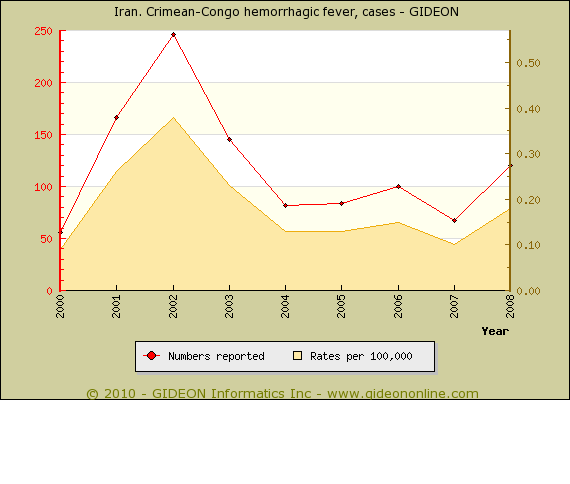
The following background data were abstracted from Gideon e-books on Iran and Crimean-Congo hemorrhagic fever. [1,2] Primary references are available on request.

Crimean-Congo hemorrhagic fever was first reported in Iran (Khorassan Province) in 1978, when infected cattle entered the country from Pakistan and Afghanistan.

Several deaths were ascribed to this disease in Eastern Iran during 1999.

Graph notes:
1. Data include suspect cases.
2. 255 cases were reported in southeastern Iran during June 1999 to February 2004.
3. 169 cases were reported in Sistan-Baluchestan during 2000 to 2004.
4. 45 cases (16 confirmed, 3 fatal) were reported in Fars Province during 2001 to 2004.
5. 91 cases were reported from a single hospital in Zahedan during 1999 to 2003; 32 during 2005 to 2007.
6. 47 fatal cases were reported during 2000 to 2007; 19 in 2008.
Individual years:
2005 – Highest incidence in Sistan-Baluchestan.
2006 – Included 46 confirmed cases, most in Sistan-Baluchestan.
2009 – 71 cases (8 fatal) were reported during January to August.

Prevalence surveys:
28% of ticks in Ardabil Province (2004 to 2005)

Seroprevalence surveys:
0.24% in Sistan-Baluchestan Province, following the period 2000 to 2004
3.87% of exposed health care workers in Sistan-Baluchestan Province (2003)
1.8% of first-degree relatives of confirmed CCHF cases in Sistan-va-Baluchestan province (2008 publication)
13% of humans, sheep 38%, goats 36%, cattle 36%, camels 18% (1975)
39% of livestock in Ardabil Province (2004 to 2005)
33.4% of sheep tested during 2000 to 2001; with evidence of recent infection in 1.5%

Notable outbreaks:
1999 – An outbreak (3 cases) involved infection of two physicians from an index patient.
2001 – An outbreak (100 cases or more) of presumed CCHF was reported in Isfahan, Siustan, Baluchestan, Lorestan and West Azerbaijan.
2002 – An outbreak (5 cases) of suspected CCHF (3 fatal) was reported in Iran among Afghan refugees from Nimroz Province.
2002 – An outbreak (80 cases) was confirmed in Sistan-Baluchistan, with additional cases in Isfahan, Fars, Tehran, Khuzistan, Yazd, Chaharmahal-Bakhtiyari, and Hormozgan.
2009 – An outbreak (6 cases) was reported among abattoir workers in Mashad.
2009 – An outbreak (4 cases) was reported among hospital workers following contact wih an index case.

References:
1. Berger SA. Infectious Diseases of Iran, 356 pp, 1,222 refs. 2010. GIDEON e-books. https://www.gideononline.com/ebooks/country/infectious-diseases-of-iran/
2. Berger SA. Crimean-Congo Hemorrhagic Fever: Global Status, 31 pp, 385 refs. 2010. GIDEON e-books. https://www.gideononline.com/ebooks/disease/crimean-congo-hemorrhagic-fever-global-status/

Anaplasmosis in China

Anaplasmosis has been documented in both humans and animals in China. [1,2] The following background data are abstracted from GIDEON (primary reference available on request).

Time and Place:
– Seropositive ruminants have been documented in Xinjiang Uygur Autonomous Region area.
– Seropositive rodents have been documented in Jilin Province: Japanese field mouse (Apodemus peninsulae), Black-striped field mouse (A. agrarius) and Siberian chipmunk (Tamias sibirica).
– Ehrlichial DNA (Anaplasma phagocytophilum) has been detected in Ixodes persulcatus ticks from the Northeastern (ie, Lyme disease) region – Inner Mongolia and Heilongjiang Province.
– Infected rodents, sheep and ticks (I. persulcatus and Dermacentor silvarum) have been detected in Jilin Province.

Prevalence surveys:
8.82% of forest rodents in Jilin Province, 1.64% in Helongjiang Province and 0% in Inner Mongolia autonomous region (2007 publication)
14.1% of rodents captured from a mountainous area in southeastern China (Zhejiang Province, 2008 publication)
5.5% of rodents from Heilongjiang Province, Inner Mongolia Autonomous Region, Jilin Province, Zhejiang Province, Guizhou Province, and Xinjiang Autonomous Region (2004 to 2006)
1.9% of rabbits captured in southeastern China (2009 publication)
4.6% to 6.8% of I. persulcatus in Jilin Province (2003 to 2005 publications)
7.34% of small mammals in the forest area of Hengduan Mountains, southwestern China (2009 publication)
6.7% of livestock and 14.5% of small rodents (2010 publication)

Seroprevalence surveys:
8.8% of farm workers near Tianjin (2006)
19.8% of persons with animal or tick exposure in central and southeastern China (2007)

Notable outbreaks:
2006 – An outbreak (9 cases) of transmission through blood or secretions was reported in Anhui Province among hospital staff who had treated an index patient.
2008 – An outbreak (5 cases, 3 fatal) was reported in Wanjiakou village in Shandong Province.

References:
1. Berger SA. Infectious Diseases of China, 614 pp. Gideon e-books, 2010. https://www.gideononline.com/ebooks/country/infectious-diseases-of-china/
2. Berger SA. Anaplasmosis: Global Status, 23 pp. Gideon e-books, 2010. https://www.gideononline.com/ebooks/disease/anaplasmosis-global-status/

Update: Quoted in ProMED

Imported West Nile Virus

Regarding a recent case in the Netherlands posted in ProMED, several instances of imported West Nile fever have been reported in recent years.

Published reports are summarized below. (primary references are available on request)

2001 – A patient in the Netherlands developed West Nile fever following a trip to Israel.
2002 – Cases acquired in the United States were reported in France, Denmark (2 cases), Mexico; Czech Republic
2003 – Cases acquired in the United States were reported in Germany (2 cases); Canada; the Netherlands.
2003 (publication year) – Cases acquired in Israel and Canada were reported in Denmark.
2003 – A case acquired in Canada was reported in the Netherlands.
2003 – Cases acquired in the United States were reported in France (3 cases), the Netherlands (3 cases), and Germany (2 cases).
2004 – Cases acquired in the United States were reported in Germany 36; Netherlands; and Uruguay.
2004 – 2 cases of West Nile Virus infection were confirmed in Ireland. In both instances, the patients had recently visited Portugal.
2005 – Cases acquired in the United States were reported in Japan.
2005 – An Irish traveler acquired West Nile fever in the United States.
2005 – 4 cases reported in France had been acquired in Djibouti.
2006 – A Spanish missionary acquired West Nile fever in Nicaragua.
2007 – 2 British travelers developed West Nile fever while visiting Canada.

Reference
Berger SA. West Nile fever: Global Status, 2010. GIDEON e-book series

Posted in ProMED

GIDEON Sign In