GIDEON blog

Free Demo ► Latest Updates ► Video Tutorials ►
Subscribe , j x

Tick-borne diseases in the USA in perspective

An interesting piece by Steve in ProMED, regarding tick borne diseases in the US:

Although Rocky Mountain spotted fever and Lyme disease are better known to the lay public, the list of additional tick-borne diseases has grown in recent years. The incidence of Lyme disease in the United States is greater than 5-fold that of all other tick-borne infections combined:
Graph: Tick borne diseases in the US

If we eliminate Lyme disease, we find that tularemia was the most common disease in this group until 1965, but has since been superseded by Rocky Mountain spotted fever — and more recently Ehrlichiosis:
Graph: Tick borne diseases, besides Lyme disease, in the US

Most significantly, although deaths due to other tick-borne diseases have declined in recent years, the number dying from tularemia has remained surprisingly constant for over 4 decades:
Graph: Tularemia deaths in the US

ISSN numbers assigned to GIDEON publications

An ISSN is an identity number for a serial publication. It is mainly used by librarians, but also for vendors that deal with publications. GIDEON is categorized as a serial publication updated weekly (online) or quarterly (CD). For reference here are the ISSN numbers:
GIDEON (ONLINE) ISSN 1938-6508
GIDEON (CD-ROM) ISSN 1938-6516

GIDEON helped save a life with a correct differential diagnosis

In 2005 an agricultural expert from Israel went for 6 days to India to participate in a farming project. He returned to Israel, and the following morning developed fever, headache, vomiting and muscle pain.

Read the latest case of the month, Agriculture Expert in India, about how GIDEON helped save this person’s life.

Salmonellosis rates in Romania and surroundings

Following up on the latest outbreak of salmonellosis in Constanta, Romania, using the GIDEON graph function, Steve analyzes the reported rates of salmonellosis in Romania and surrounding countries. As reported by ProMED:

The recent outbreak in Constanta belies the fact that Romania has consistently reported the lowest rates of salmonellosis in this region of Europe for at least 20 years. See graph.

Measles outbreak in Switzerland and regional vaccine coverage

Following the latest outbreak of measles in Switzerland, Steve graphs vaccine coverage in the neighboring countries in this ProMED post:

This latest outbreak in Lucerne reminds us that the goal of 95 percent measles coverage continues to elude this region of Europe. See graph.

Zika disease characteristics

A new infectious disease, Zika, mentioned in ProMED with a quote from Steve:

Zika, Dengue and Chikungunya share many epidemiological, clinical and geographic features. (See maps). An etiological diagnosis for febrile rash in these regions will increasingly depend upon viral studies.

Lyme disease in the Baltic region

Steve is quoted in ProMED again:

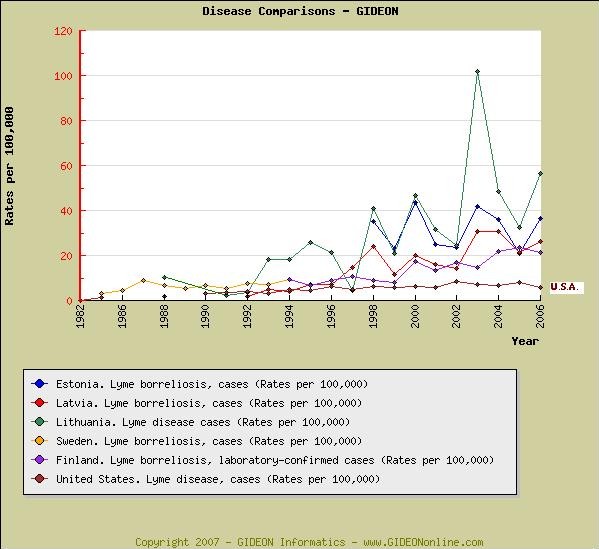
A recent ProMED-mail posting is a reminder that Lyme disease is extremely common in the Baltic region. In fact, disease rates are several fold higher in this area than in the USA.

Additional background data abstracted from GIDEON (primary references available on request):

The 1st cases (3) of Lyme borreliosis in Lithuania were diagnosed in 1987; and Estonia reported its 1st cases in 1988.
Endemic foci exist in the western, eastern, and southern regions of Estonia. The areas of highest risk are concentrated along the Finnish Gulf coast in Harjumaa and Western Virumaa, in Parnumaa and Eastern Virumaa counties, and on the island of Saaremaa.
In Latvia, 2.7 per cent of workers in high-risk occupations and 3 per cent of healthy persons in the Karksi Nuia region (south) of Estonia are seropositive.
_Ixodes ricinus_ is abundant in Estonia, and _Ixodes persulcatus_ is found in the east and south of the country; 3 per cent of _I. ricinus_ adults and 5 per cent of the _I. persulcatus_ adults are infected with _Borrelia burgdorferi_; 31 per cent in Narva-Joesuu, 12 per cent in Western Virumaa, and 14 per cent in Tartumaa. Borreliae are found in 15 per cent of ticks (_I. ricinus_) on Vormsi Island. Tick infection by _B. afzelii_ and _B. garinii_ has also been demonstrated.
_B. afzelii_ is the dominant species among _I. ricinus_ and _I. persulcatus_ in Latvia, followed by _B. garinii_ and _B. burgdorferi_ (1993 to 2002). In Lithuania, 11 per cent of adults and 1 per cent of nymphal _I. ricinus_ ticks are infected with Borrelia (1988 to 1991).

Taiwan, Russia and measles

In another discussion on measles on the ProMED mailing list – this time in Taiwan – a great reference to the information available in GIDEON, which complements the information available from Taiwan’s CDC:

… according to the Global Infectious Disease & Epidemiology Network – GIDEON, the numbers of clinical cases of measles reported annually in Taiwan were: 1386 in 1988; 44 in 1990; 303 in 1992; 71 in 1993; 101 in 1994; 40 in 1995; 49 in 1996; 63 in 1997; 49 in 1998; 23 in 1999; 48 in 2000; 59 in 2003; 36 in 2004; 39 in 2005; 24 in 2006 — available at https://www.gideononline.com) Taiwan has undertaken the goal of measles elimination by 2010. Data available at the website review a vaccination coverage of the cohort born in 2002 of 95 percent with MMR 1st dose. No information was available on 2nd dose coverages.

A note about Russia and measles also references GIDEON.

Linking between modules

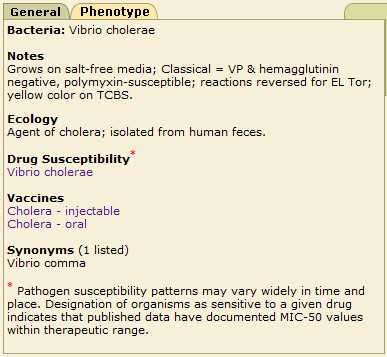
We’re continuing our progress in making it easier to find the information you’re looking for in GIDEON with minimal effort. We have added a new feature in the Microbiology module that link relevant organisms to their drug susceptibility and appropriate vaccines as demonstrated by the highlighted links in this screen shot of the Vibrio Cholerae general tab:
Microbiology Vibrio Cholerae information
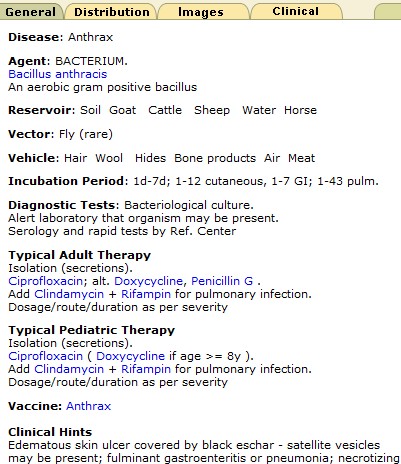
These new links are in addition to links added in the past connecting between disease organisms to microbiology and typical therapy to drugs, vaccines and pathogens.
For example see the links from the Anthrax disease general information tab screen shot below, to the Microbiology organism (Bacillus anthracis), Therapy (eg: Ciprofloxacin) and Anthrax vaccine:
Anthrax general disease information

Background on Measles in Congo

Steve is quoted once again in ProMED:

The latest outbreak of Measles – Democratic Republic of the Congo (Katanga) highlights the fact that measles rates in this area have changed little during the past 2 decades.
The relevant data extracted from the GIDEON database can be viewed in graphic form via the following link.
There is little doubt that such outbreaks are related to continued suboptimal and erratic vaccination coverage.

GIDEON Sign In