GIDEON blog

Free Demo ► Latest Updates ► Video Tutorials ►
Subscribe , j x

Yersiniosis in Norway

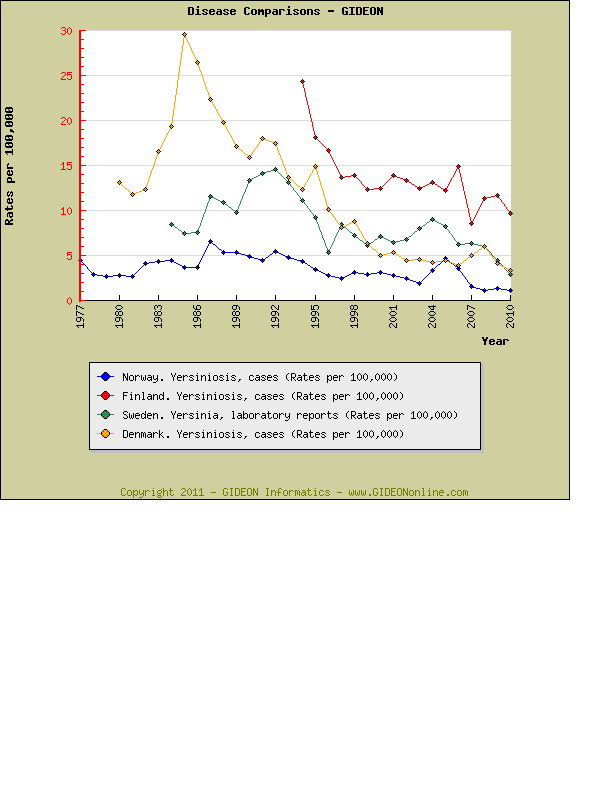
A recent outbreak related to contaminated lettuce belies the fact that yersiniosis rates in Scandinavia have been decreasing since 1992, and are lowest in Norway. [1,2] see graph

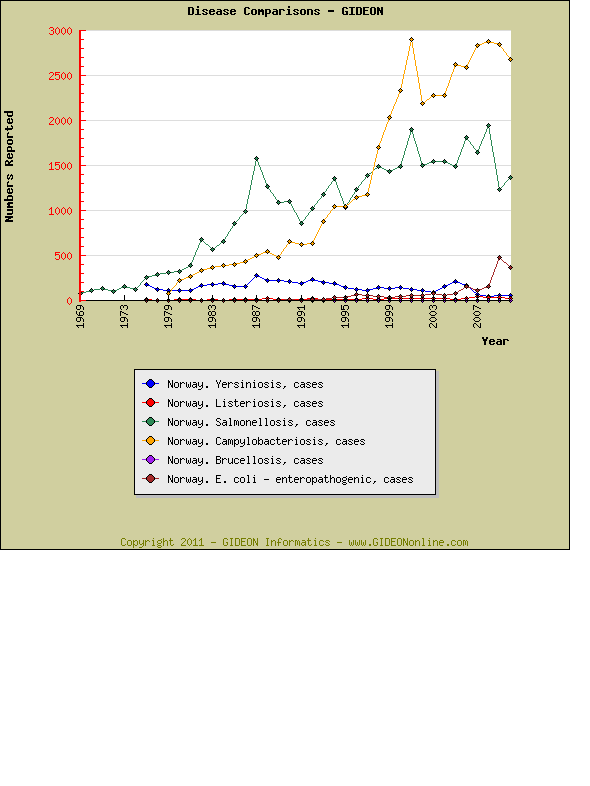
Even within Norway, the incidence of yersiniosis is lower than that reported for other foodborne bacterial zoonoses. see graph

References:
1. Berger SA. Infectious Diseases of Norway, 2011. 411 pp, 133 graphs. Gideon Ebooks, https://www.gideononline.com/ebooks/country/infectious-diseases-of-norway/
2. Berger SA. Yersiniosis: Global Status, 2011. 55 pp, 57 graphs. Gideon E-books, https://www.gideononline.com/ebooks/disease/yersiniosis-global-status/

Spotted Fever in Brazil

The following background data on spotted fever in Brazil are abstracted from the Gideon e-book series. [1,2] (Primary references are available on request)

Time and Place:
Rickettsial spotted fever is known locally as Brazilian spotted fever, Sao Paulo fever and Febre maculosa brasileira.
– Rickettsial spotted fever was first reported in Brazil in 1920.
– Cases are reported in Minas Gerais, Bahia, Goias, Rio Grande do Sul and Espirito Santo.
– The disease has re-emerged in Rio de Janeiro in recent years.

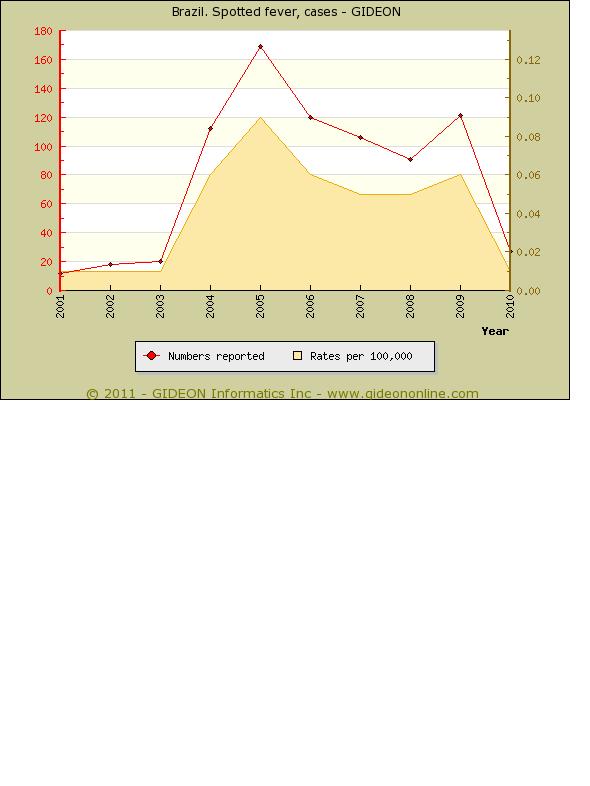
Disease incidence and rates per 100,000 are depicted in the following graph. Between 6 and 27 fatal cases per year were registered during 2007 to 2010.
Geographical notes:
Outbreaks were reported in Minas Gerais during 1929 to 1944, but not during 1945 to 1980.
– Subsequent outbreaks were reported in Minas Gerais in 1981, 1984, 1992, 1995 and 2000.
– 92 cases (40% fatal) were confirmed in Minas Gerais during 1981 to 1989; 78 during 1992 to 1997 (including 3 fatal cases in 1996, and 2 in 1997).
67 cases were reported in Sao Paulo during 1985 to 2000; 224 (including 6 case-clusters) during 2001 to 2008 5 ; 5,949 suspected cases (206 confirmed) during 2003 to 2006.
– 17 cases (8 fatal) were reported in Pedreira county, Sao Paulo during 1985 to 1995.
– Five fatal cases were reported in Sao Paulo State in 2003.
– Eight outbreaks were reported in Sao Paulo State during 2005.
– A case of eschar-associated spotted fever rickettsiosis (species not determined) was reported in Bahia in 2007.

Prevalence surveys:
1.3% of Rhipicephalus sanguineus ticks in metropolitan Sao Paulo are infected by Rickettsia rickettsii (2009 publication)
1.3% of Amblyomma cajennense in Minas Gerais (1997 publication)
Rickettsia parkeri was identified in 9.7% of Amblyomma triste (a non-human biting tick) in Pauliceia County, Sao Paulo (2005).

Seroprevalence surveys:
10.6% of healthy students and 4.11% of dogs in the endemic areas of Minas Gerais (1998)
38.4% of humans, 7.6% of dogs and 25.9% of horses (Espirito Santo, Rickettsia spp., 2010 publication)
77.3% of horses and 31.3% of dogs in Pedreira Municipality, Sao Paulo State (2001)
1.6% of healthy persons in Minas Gerais (2005 publication)
25.7% of dogs in southern Brazil (Rickettsia parkeri, 2002 to 2003)
69.6% of dogs in metropolitan Sao Paulo (2009 publication)
4.4% of dogs from Sao Jose dos Pinhais, Parana State (2006 to 2007)

Reservoirs:
– The principal reservoir hosts are capybara (Hydrochaeris hydrochaeris) , horses and occasionally dogs.
– Natural infection has been identified in dogs in Sao Paulo.
– R. parkeri antibodies have been documented in dogs from urban areas in the western Brazilian Amazon. (Monte Negro, Rondonia)

Vectors:
The principal vectors are Amblyomma aureolatum (areas of Sao Paulo) and Amblyomma cajennense.
– Amblyomma cooperi has also been implicated (in Sao Paulo).
– Spotted fever-group rickettsiae have been found in Rhipicephalus sanguineus in Rio de Janeiro state.

Notable outbreaks:
1993 (publication year) – An outbreak (6 cases, 4 confirmed) was reported in Espirito Santo.
2004 (publication year) – An outbreak was reported in Campinas.
2004 – An outbreak (3 fatal cases) was reported in Maua (Grande Sao Paulo).
2005 – An outbreak (7 cases, 2 fatal) was reported in a mountain resort near Rio de Janeiro.
2008 – An outbreak (3 fatal cases) was reported in Sao Paulo State.

References:
1. Berger SA. Infectious Diseases of Brazil, 2011. 530 pp. Gideon e-book series, https://www.gideononline.com/ebooks/country/infectious-diseases-of-brazil/
2. Berger SA. Rocky Mountain Spotted Fever: Global Status, 2011. 18 pp. Gideon e-book series, https://www.gideononline.com/ebooks/disease/rocky-mountain-spotted-fever-global-status/
Q-fever in Australia

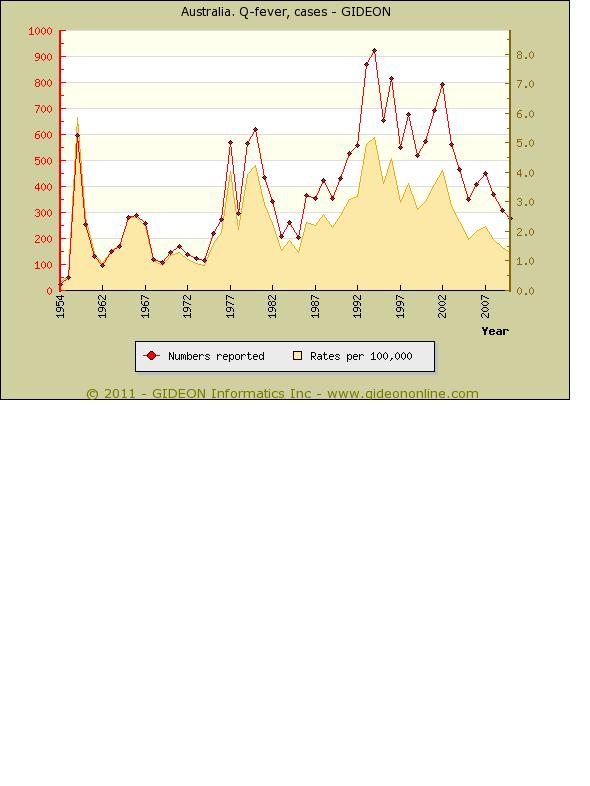
A recent cluster of cases on Coff’s Coast reminds us that Q-fever continues to be a common disease in Australia. The following backgroud data are abstracted from the Gideon e-book series. [1,2] Primary references are available on request.

Time and Place:
– Q-fever was first characterized in Australia, in 1939.
– Queensland and New South Wales account for over 90% of cases.
– Over 50% of cases are directly, or indirectly related to meat processing.
– The male/female ratio for reported cases is approximately 5-to-1.

Disease rates have gradually increased over the past six decades – see graph:

Travel and Q-fever:
2002 (publication year) – Three Japanese workers acquired Q-fever while in Australia and New Zealand. 7
2005 – An American tourist acquired Q-fever in Australia. 8

Seroprevalence surveys:
18.5% of non-vaccinated meat workers in central Queensland (2001 publication)
6.5% of persons below age 25 years in South West Queensland (2010 publication)
66% of persons in Kimberly have evidence for prior exposure (2002)
7% of persons in the Hunter New England region of New South Wales (2006 to 2009)

The average rate among abattoir workers in Victoria is 6,600 per 100,000 during the first 10 years of exposure.
– As of 1996, vaccination programs were identified in one-third of abattoirs.
– Routine immunization of abattoir workers in endemic areas was introduced in 2002.
– As of 2009, vaccine update is 100% among abattoir workers and 43% among farmers.

The standard vaccine (‘Q-vax’) is prepared from Inactivated phase I whole Coxiella burnetii. A dose of 0.5 ml s.c. (deltoid region) is indicated for high-risk populations (eg, occupational exposure), and confers immunity for five years. Few sides effects are reported, and are limited to fever and headache.

A variety of local mammals serve as reservoirs, including the bandicoot (Isoodon torosus).
– Amblyomma triguttatum triguttatum ticks are implicated in the epidemiology of Q fever in Queensland.

Notable outbreaks:
1959 (publication year) – An outbreak of Q-fever in Queensland was associated with sheep contact.
1962 (publication year) – An outbreak was reported in a meat-works in South Australia.
1969 – An outbreak in a Brisbane ‘meat works’ affected 7.9% of workers.
1979 – An outbreak (110 cases) was reported at an abattoir in Victoria.
1998 – An outbreak (29 confirmed and 8 suspect cases) was reported at an abattoir in New South Wales.
2004 – An outbreak (9 confirmed and 6 suspect cases) was reported among farmers in South Australia.
2005 – An outbreak (5 cases) was reported among persons involved in calving activities, in New South Wales.
2006 (publication year) – An outbreak (4 cases) was reported among workers at a cosmetics factory.
2006 (publication year) – An outbreak (27 cases) was reported in rural South Australia.
2007 – An outbreak (5 cases confirmed, 1 possible fatal case) was associated with an abattoir in South Australia.

References:
1. Berger SA. Infectious Diseases of Australia, 2011. 503 pp., 158 graphs. Gideon e-book series, https://www.gideononline.com/ebooks/country/infectious-diseases-of-australia/
2. Berger SA. Q-fever: Global Status, 2011. 73 pp, 57 graphs. Gideon e-book series, https://www.gideononline.com/ebooks/disease/q-fever-global-status/

Update: Reported in ProMED

Legionellosis in Scotland

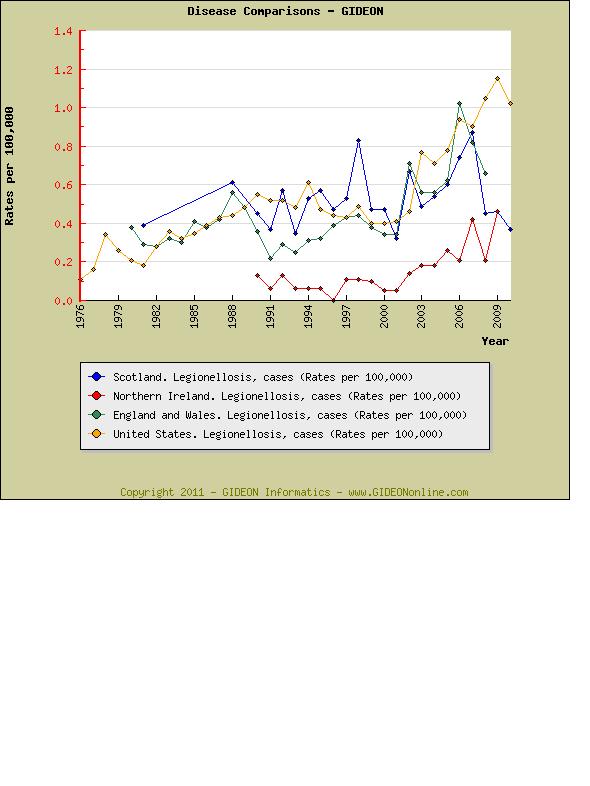
Notwithstanding a recent outbreak in Dundee, rates of legionellosis in Scotland have changed little during the past three decades, and continue to be similar to those reported in the United States [see graph]

The following background data regarding Legionnaire’s disease in Scotland are abstracted from the Gideon e-book series. [1,2] (primary references available on request)

Notable outbreaks:
1984 – An outbreak (33 cases, 1 fatal) in Glasgow was ascribed to a contaminated cooling tower.
1985 – An outbreak (16 cases) at a hospital in Glasgow was ascribed to a contaminated cooling tower.
1989 (publication year) – An outbreak (187 cases) of Pontiac fever due to Legionella micdadei was associated with use of a whirlpool in Lochgoilhead.
1994 (publication year) – An outbreak (3 cases) in a hospital was related to a contaminated water main.
1998 – An outbreak (2 cases) was reported among passengers on a Scottish cruise ship.
2004 – An outbreak in West Fife was associated with proximity to sullage tanks.
2008 to 2009 – An outbreak (3 cases) of Legionella longbeachae infection was associated with handling potting soil.

References:
1. Berger SA. Infectious Diseases of Scotland, 2011. 403 pp, 140 graphs. Gideon e-books, https://www.gideononline.com/ebooks/country/infectious-diseases-of-scotland/
2. Berger SA. Legionellosis: Global Status, 2011. 90 pp, 106 graphs. Gideon e-books, https://www.gideononline.com/ebooks/disease/legionellosis-global-status/

Update: Reported in ProMED

Botulism in Canada

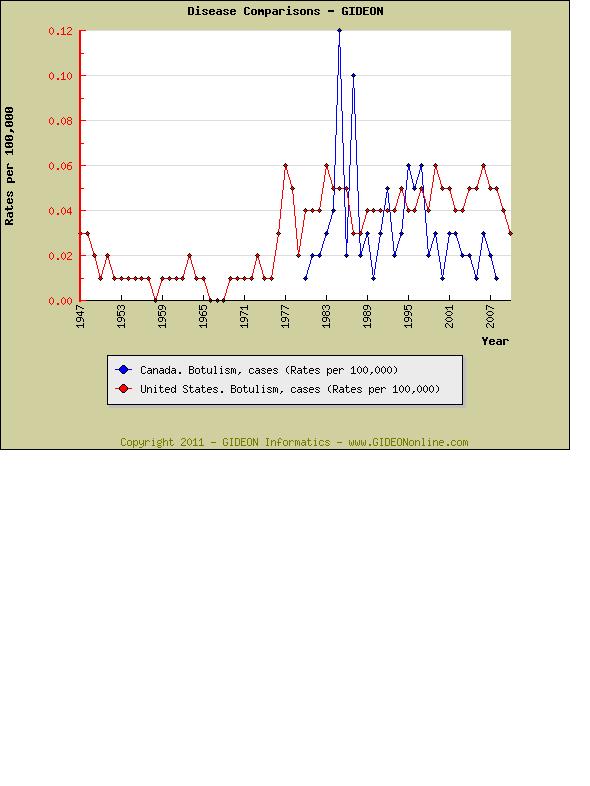
A recent episode involving contaminated jelly belies the fact that current botulism rates in Canada are only half those reported in the United States [see graph]

The following background data on botulism in Canada are abstracted from the Gideon e-book series. [1,2] Primary references are available on request.

Historical background:
The first outbreak of botulism in Canada was recorded in 1919.
– A total of 100 outbreaks involving over 230 cases had been reported to 2005.
– Botulism is primarily encountered among the First Nations and Inuit people.
– Rates of 30 per 100,000 per year are reported among the Inuit.
– Most cases in recent years have been caused by fermented salmon roe (‘stink eggs’ or ‘gink’) in British Columbia; and fermented sea mammal meat among the Inuit.
– 14 outbreaks (63 cases, 35 fatal) were reported during 1919 to 1954.
– 61 outbreaks (122 cases, 21 fatal) were reported during 1971 to 1984 – Inuit people accounted for 92.6% of the patients, and 59% of the cases caused by raw, parboiled or “fermented” meats from marine mammals. Fermented salmon eggs or fish accounted for 23% of the outbreaks.

Canada’s first case of infant botulism was reported in 1971.
– 27 cases of infant botulism were reported during 1979 to 2006 – including 22 type A and 5 type B.
– As of 2008, infant botulism had been reported in 26 countries – with highest numbers in United States – followed by Argentina, Australia, Canada, Italy, and Japan.

Food recalls:
2006 – Lots of imported Italian olives, American carrot juice, chili sauce and pasteurized canned crab were recalled due to contamination with botulism toxin.
2007 – A recall was issued for clams and cod liver sold in mason jars.
2010 – A recall was issued for peperoni products sold in British Columbia.
2011 – A case of botulism on Vancouver Island let to the recall of watermellon jelly.

Notable outbreaks:
1974 – Outbreaks (10 cases in 4 outbreaks, 4 fatal) of type E botulism were reported among indigenous peoples. Walrus, Arctic char, seal and fermented salmon eggs were implicated.
1977 (publication year) – Outbreaks (12 cases in 2 outbreaks) of type A and B botulism were reported among Inuit peoples.
1985 – An outbreak (36 cases) in the United States and Canada was associated with chopped garlic in soybean oil served in a restaurant in Vancouver, Canada.
1991 – An outbreak of type A botulism was reported in Ottawa.
1995 – Outbreaks (16 cases in 7 outbreaks, 0 fatal) and one case of infant botulism were reported – implicated foods included muktuk, micerak (fermented fat of marine mammals), seal, walrus and marinated/smoked fish.
1996 – Outbreaks (10 cases in 5 outbreaks, 0 fatal) of foodborne botulism were reported – implicated foods included seal, fermented fish, beluga whale and micerak.
1997 – Outbreaks (18 cases in 7 outbreaks, 1 fatal) were reported – including 9 cases in Quebec acquired from seal igunaq and 4 cases in the Northwest Territories acquired from beluga whale and caribou fat.
1999 – An outbreak (3 cases) of type B botulism in Ontario was ascribed to home-canned tomatoes.
2001 – Outbreaks (4 cases in 2 outbreaks, 1 fatal) in British Columbia were ascribed to fermented salmon roe.
2006 – An outbreak (4 cases) in the United States was associated with commercially-canned carrot juice. Three additional cases in Toronto were associated with the same product.
2009 – An outbreak (3 cases) of type E botulism in France was related to vacuum packed hot-smoked Canadian whitefish purchased in Finland.

References:
1. Berger SA. Infectious Diseases of Canada, 2011. 475 pp. Gideon e-book series, https://www.gideononline.com/ebooks/country/infectious-diseases-of-canada/
2. Berger SA. Botulism: Global Status, 2011. 80 pp. Gideon e-book series, https://www.gideononline.com/ebooks/disease/botulism-global-status/

Lassa Fever among Travelers and Expatriates

The following background data on Lassa fever among travelers and expatriates are abstracted from the Gideon e-book series. [1]

Twelve cases of Lassa fever were imported into Europe and North America during 1970 to 2000, with no secondary cases among medical staff or patients.
– Four cases were imported into Europe in 2000.
– Six cases were imported in the United Kingdom during 1976 to 2003 – none resulting in secondary cases.

Chronology:
1969 – The first reported case of Lassa fever was that of an American nurse working in Lassa, Nigeria.
1971 – A nurse and physician from United Kingdom developed nonfatal Lassa fever in Sierra Leone.
1972 – A nurse from United Kingdom developed nonfatal Lassa fever in Sierra Leone.
1974 – A German physician contracted Lassa fever (nonfatal) in Nigeria.
1975 – An American aid worker developed nonfatal Lassa fever in Sierra Leone.
1976 – A Peace Corps worker returned to the United States from Sierra Leone with Lassa fever.
1980 – A case of Lassa fever (nonfatal) acquired in Burkina Faso was reported in the Netherlands.
1984 – A British geologist developed nonfatal Lassa fever in Sierra Leone.
1985 – A British nurse developed nonfatal Lassa fever in Sierra Leone.
1987 – A case of Lassa fever (nonfatal) was reported in Israel – an engineer who had been in Liberia and Sierra Leone.
1987 – A traveler developed Lassa fever in 1987 after returning to Japan.
1989 – A Canadian agricultural specialist developed Lassa fever (nonfatal) in Nigeria.
1999 – A woman died of Lassa fever after returning to Germany from the Ivory Coast.
2000 – A Nigerian national died of Lassa fever after transfer to Germany for treatment.
2000 – A case of Lassa fever (fatal) from Sierra Leone was reported in the Netherlands.
2000 – A student died of Lassa fever in Germany after traveling through Burkina Faso, Ivory Coast and Ghana.
2000 – A British national acquired Lassa fever in Sierra Leone, and died while under treatment in England.
2000 to 2001 – Four Ghanaian soldiers serving in Sierra Leone contracted Lassa fever.
2003 – A British national acquired Lassa fever in Sierra Leone, and was treated successfully in the U.K.
2004 – A man died of Lassa fever in the United States following a trip to Liberia and Sierra Leone.
2005 – Two Pakistani soldiers died of Lassa fever in Liberia.
2006 – A man was hospitalized with Lassa fever in Germany, following travel to Sierra Leone.
2008 – An outbreak (5 cases, 4 fatal) of Lujo virus (a related agent) infection in South Africa followed hospitalization of an index patient from Zambia. 2009 – Two men died of Lassa fever in England – one following travel to Nigeria, and one following travel to Mali.
2010 – An American traveler acquired Lassa fever in Liberia; and a South African civil engineer died of Lassa Fever in Sierra Leone.
2011 – A Swedish woman acquired Lassa fever in West Africa.

Reference:
1. Berger SA. Lassa fever: Global Status, 2011. Gideon e-book series, https://www.gideononline.com/ebooks/disease/lassa-fever-global-status/

Update: Quoted in ProMED

Trichinellosis in Spain

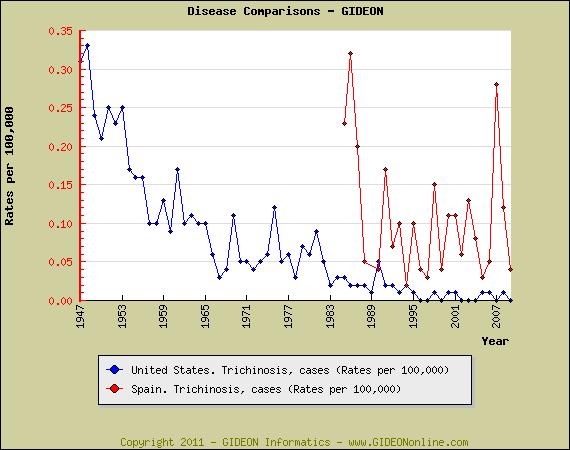
Trichinellosis outbreaks are common in Spain, with disease rates comparable to those reported in the United States during the mid-twentieth century. [1,2] See graph:

Prevalence surveys:
0.3% of red foxes (Vulpes vulpes) in Catalonia (Trichinella britovi, 1998 to 2007)
8.9% of red foxes in Guadelajara (2000 publication)
3% of red foxes and 0.48% of wild boar (Sus scrofa ferus) in Extremadura (2000 publication)
12.8% of wolves (Canis lupus) in the northwestern region (Trichinella britovi, 1993 to 1999)

Outbreaks:
1. 51 outbreaks were reported during 1981 to 1987 – 24 (294 cases) due to wild boar, 18 (659 cases) due to domestic pork, and 12 unknown source.
2. 18 outbreaks were reported during 1988 to 1992.
3. 49 outbreaks were reported during 1990 to 2001 (75.5% due to wild boar, 14.3% domestic pork. Trichinella britovi was identified in 61.5%, and T. spiralis in 38.5%.
4. 32 outbreaks were reported during 1994 to 2003 – including 3 outbreaks (40 cases) in 2003.
5. Five outbreaks involving 86 cases were reported in Andalucia during 1984 to 1987 – including 4 from infected pork and one by from wild boar meat.

Notable outbreaks:
1982 to 1983 – An outbreak (452 cases) was caused by infested sausage prepared in Bdajoz.
1987 (publication year) – An outbreak was reported in Rioja Baja.
1992 to 1993 – An outbreak (19 cases) in Huerta del Marquesado was caused by contaminated pork.
1993 to 1994 – Outbreaks (2) in Cuenca and Teruel Provinces were associated with Trichinella britovi from wild boar sausages.
1995 (publication year) – An outbreak in Navarre was associated with consumption of home-prepared pork products.
1996 – An outbreak (42 cases) of Trichinella spiralis infection was traced to wild boar products in Iruela (Jaen).
1998 – An outbreak (140 cases) of infection by T. britovi from wild boar was reported in Grenada.
1998 – An outbreak (61 cases) was reported in Zaragoza.
1998 to 1999 – An outbreak (43 cases) in Germany was associated with raw sausage (“Mettwurst”) made from fresh pork imported from Spain.
2000 – An outbreak (38 cases, 0 fatal) of Trichinella britovi infection in Granada was ascribed to uninspected sausages.
2001 to 2002 – An outbreak (26 cases) of Trichinella britovi infection was reported in Caceres. Salami sausages were suspected as the reservoir.
2003 – An outbreak (33 cases) was reported in Burgos.
2007 – An outbreak (21 cases) of Trichinella britovi infection among persons in Spain and Sweden was related to Spanish wild boar sausage.
2009 (publication year) – An outbreak of trichinosis was reported in Salamanca Province.

References:
1. Berger SA. Infectious Diseases of Spain, 2011. 528 pp. Gideon e-book series, https://www.gideononline.com/ebooks/country/infectious-diseases-of-spain/
2. Berger SA. Infectious Diseases of the United States, 2011. 1,030 pp. Gideon e-book series, https://www.gideononline.com/ebooks/country/infectious-diseases-of-the-united-states/
3. Berger SA. Trichinosis: Global Status, 2011. 82 pp. Gideon e-book series, https://www.gideononline.com/ebooks/disease/trichinosis-global-status/

Tularemia in Norway

Tularemia in Norway is most common in the northern region. [1,2]
– 54% of patients are in the age group 30 to 54, and most infections are acquired by handling hares and other game.

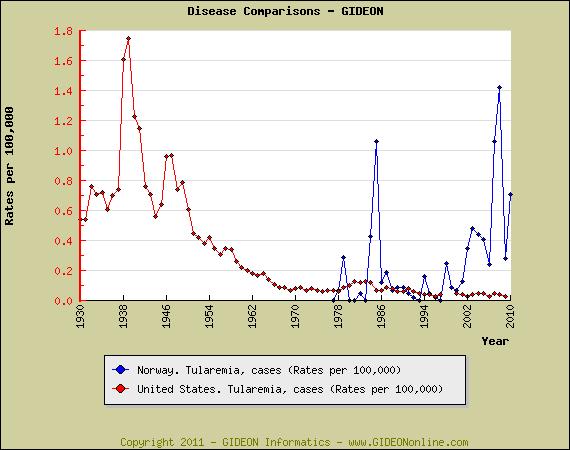
Reports of tularemia in Norway have increased somewhat since 2000, and are currently similar to rates reported in the United States during the 1930’s and 1940’s. See graph:

Seroprevalence surveys:
As many as 4.7% of school children are seropositive (1996 publication)

Notable outbreaks:
1983 – An outbreak of tularemia was reported among hares (Lepus timidus) on the island of Stora Karlso.
1984 to 1985 – An outbreak (57 cases) was reported in Sor and Nord-Trondelag counties. Smaller outbreaks were reported in Norland and Troms counties in 1979; and in Troms county in 1998.
2006 to 2007 – An outbreak (9 cases) was reported in the northern region.

References:
1. Berger SA. Infectious Diseases of Norway, 2011. 411 pp. Gideon e-book series, https://www.gideononline.com/ebooks/country/infectious-diseases-of-norway/
2. Berger SA. Tularemia: Global Status, 2011. 45 pp. Gideon e-book series, https://www.gideononline.com/ebooks/disease/tularemia-global-status/

Measles Outbreak in Turkey

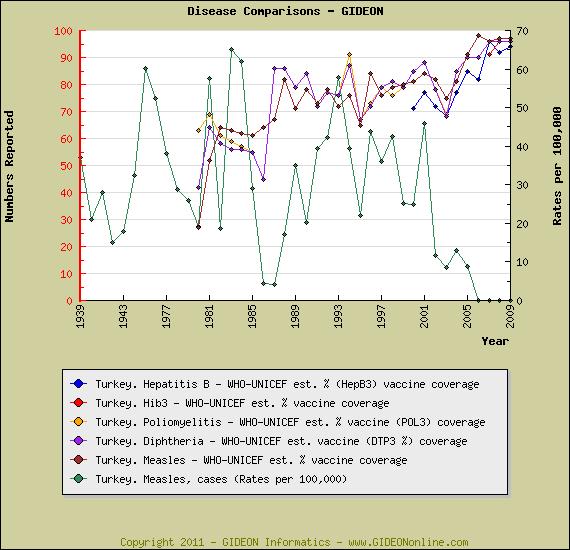
An ongoing outbreak in Istanbul reminds us that measles rates in Turkey have decreased significantly only during the past five years, in parallel with achievement of >90 vaccination coverage in the country (WHO estimates) [1,2] In the attached graph, measles rates (green line) are contrasted with vaccination coverage estimates.

References:
1. Berger SA. Infectious Diseases of Turkey, 2011. 420 pp. Gideon e-books, https://www.gideononline.com/ebooks/country/infectious-diseases-of-turkey/
2. Berger SA. Measles: Global Status, 2011. 386 pp. Gideon e-books, https://www.gideononline.com/ebooks/disease/measles-global-status/

Update: Posted in ProMED

Q-fever in Germany

The following review of Q-fever in Germany is abstracted from the Gideon e-book series. [1,2] (Primary references available on request).
Time and Place:
Q-fever was first recognized in Germany in 1947.
– Reporting was instituted in West Germany in 1962, and in East Germany in 1979. The two systems were combined in 1991.
– Most cases are reported in Bavaria, Baden-Wurttemberg, Rhineland-Palatinate, Hesse, Northrhine-Westphalia, and Thuringia.
– Hesse has experienced the greatest increase in incidence since 1990.

Outbreaks peak during spring to summer, and may be related to urbanization.
– 40 outbreaks were reported during 1947 to 1999. Sheep were implicated in 24 of the outbreaks, and cattle in six.
– Two laboratory outbreaks (in 1947 and 1948) were reported during 1947 to 1999.

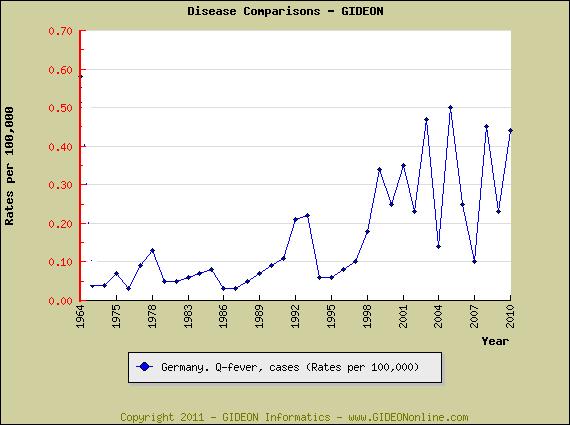
Reported rates of Q-fever in Germany are summarized in the following graph:

Additional notes:
1. The mean rate was 0.08 per 100,000 during 1979 to 1989; 0.14 per 100,000 during 1990 to 1999 (0.31 in Baden Wurttemberg).
2. Three cases of travel-associated Q-fever were reported in Germany – acquired in Sri Lanka, Sudan and the Sahara desert (2007 publication).

Prevalence surveys:
0% of rodents and Ixodes ricinus ticks in Stuttgart (2008 publication)
1.9% of Ixodes ricinus in central Germany, often in association with Borrelia, Babesia or spotted fever-group rickettsiae (2006 to 2007)

Seroprevalence surveys:
22% of blood donors are seropositive (nationwide, 1983 to 1986)
22% of military personnel (1985 to 1987)
0% of Vietnamese refugees in Germany (1980 publication)
12% of cattle in the southern Bavarian foothills
0.9% of 10.2% of sheep in Baden-Wuerttemberg (2004 publication)

The average number of cattle reported herds infected with Q-fever was 71 per year during 1971 to 1979; 328 during 1980 to 1989; 303 during 1990 to 1998.

Notable outbreaks:
1947 (publication year) – An outbreak of presumed Q-fever was reported in Munich.
1947 to 1948 – An outbreak (326 cases, 7 fatal) was reported among members of a farming community in Remmingsheim.
1948 – Outbreaks (1,500 cases, estimated) were reported in villages near Tubingen.
1949 to 1950 – An outbreak (100 cases) was reported in Stuttgart.
1951 (publication year) – An outbreak was reported in Zuzenhausen.
1951 – An outbreak (6 cases) was reported among members of a single household in Munich.
1966 – An outbreak was associated with a slaughterhouse in Hamburg.
1973 – An outbreak was reported in Simmerath/Eifel.
1982 (publication year) – An outbreak (12 cases) was reported at a Pathology Institute in Tubingen.
1989 – An outbreak (16 cases) in Vorderpfalz was associated with sheep contact.
1992 – An outbreak (80 cases) was reported among staff from a veterinary institute in Berlin.
1993 – An outbreak (121 cases) was reported in Hessen.
1994 – An outbreak was reported in Dusseldorf.
1996 – An outbreak (60 cases) in the Rollshausen area (Lohra, Hessen) was associated with infected sheep.
1997 – An outbreak (105 confirmed cases) at a university was associated with proximity to sheep.
1999 – An outbreak (81 cases) in Dortmund was associated with proximity to sheep.
2000 to 2001 – An outbreak (68 clinical cases) was reported in Hochsauerland and Nordhessen.
2002 – An outbreak (72 cases, 1 fatal) was reported in Hesse.
2003 – An outbreak (299 cases) was associated with a contaminated ewe in farmer’s market in Soest (North Rhine-Westphalia).
2005 – An outbreak (331 cases, 188 laboratory-confirmed) in Jenna was related to proximity to sheep.
2009 (publication year) – An outbreak (5 cases) was reported among researchers working with sheep.

References:
1. Berger SA. Infectious Diseases of Germany, 2011. 488 pp. Gideon E-books, https://www.gideononline.com/ebooks/country/infectious-diseases-of-germany/
2. Berger SA. Q-fever: Global Status, 2011. 73 pp. Gideon E-books, https://www.gideononline.com/ebooks/disease/q-fever-global-status/

Update: Posted in ProMED

GIDEON Sign In