GIDEON blog

Free Demo ► Latest Updates ► Video Tutorials ►
Subscribe , j x

Scarlet Fever in The United Kingdom

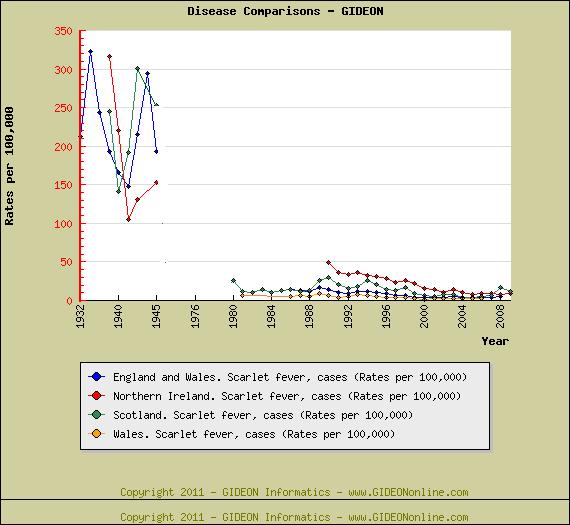
Of historic interest, rates of scarlet fever in the United Kingdom decreased by a factor of 3 to 20 following the advent of antibiotics [1,2] See graph

References:
1. Berger SA. Infectious Diseases of the United Kingdom, 2011, 992 pp. Gideon e-book series, https://www.gideononline.com/ebooks/country/infectious-diseases-of-the-united-kingdom/
2. Berger SA. Rheumatic Fever and Scarlet Fever: Global Status, 2011, 96 pp. Gideon e-book series, https://www.gideononline.com/ebooks/disease/rheumatic-fever-and-scarlet-fever-global-status/

Salmonellosis in Australia

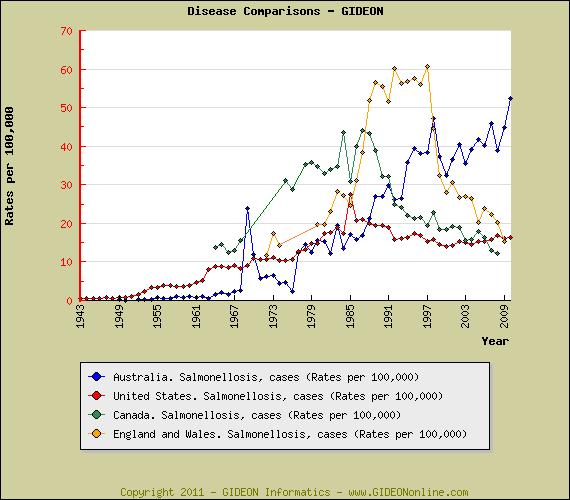
A recent outbreak in Adelaide reminds us that the salmonellosis rates in Australia have been increasing for more than five decades. In contrast, the incidence of this disease in other English-speaking countries has leveled off, or even decreased, since the 1990’s. 1,2 [see graph]

References:
1. Berger S. Infectious Diseases of Australia, 2011, 503 pp. Gideon e-book series, https://www.gideononline.com/ebooks/country/infectious-diseases-of-australia/
2. Berger S. Salmonellosis: Global Status, 2011, 245 pp. Gideon e-book series, https://www.gideononline.com/ebooks/disease/salmonellosis-global-status/

Legionellosis in Australia

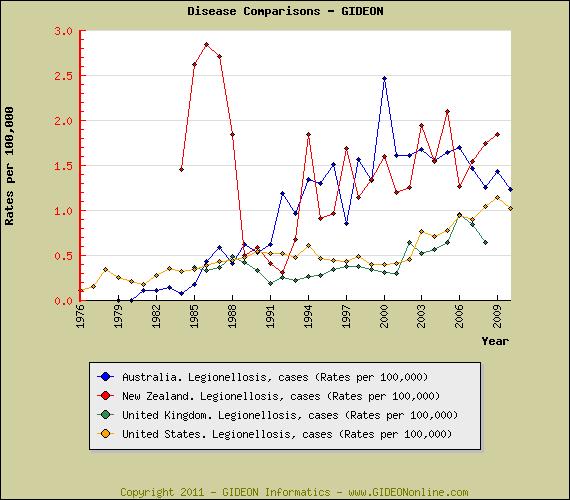
Rates of legionellosis in Australia and New Zealand have changed little since 2000, but remain somewhat higher than those of the United States and the U.K. – see graph:

The following background data are abstracted from the Gideon e-book series. 1,2 [primary references available on request]

Time and Place:
In Australia, highest legionellosis rates are reported during March to May.
– Legionella pneumophila infection peaks in summer and autumn, and L. longbeachae in spring.
– 69% of patients are males (1991 to 2000), and 71% of patients are above age 49 (1996).
– 2,170 cases of legionellosis were reported during 1991 to 2000.

L. longbeachae accounts for 22% of isolates nationwide, and is the predominant species in Western Australia (apparently associated with potting soils in South Australia).

22 outbreaks were reported during 1992 to 2000.

Notable outbreaks:
1986 – An outbreak of legionellosis was reported in South Australia.
1987 (publication year) – An outbreak of legionellosis was reported in Wollongong, New South Wales.
1987 – An outbreak (53 cases, 13 fatal) was reported in Illawarra, Southeast Sydney.
1992 – An outbreak (26 cases, 6 fatal) was associated with the Fairfield business district in Sydney.
1996 (publication year) – An outbreak (33 cases) was associated with a hotel car park in Sydney.
1998 (publication year) – An outbreak (11 cases) of community-acquired legionellosis was reported in Western Sydney.
1998 – An outbreak (58 cases, 7 fatal) was reported in Victoria. Of these, a cluster of 18 cases was linked to a contaminated cooling tower in a northern Melbourne suburb.
1998 – Two cases were reported among travelers returning from Bali.
2000 – An outbreak (125 confirmed cases; 2 fatal) was traced to a water cooling tower at the Melbourne Aquarium.
2002 (publication year) – An outbreak (5 cases) of Legionella longbeachae was reported in an intensive care unit.
2005 – An outbreak (12 cases) in the business district of Wollongong, New South Wales was ascribed to a contaminated cooling tower.

References:
1. Berger SA. Infectious Diseases of Australia, 2011. 503 pp. Gideon e-book series, https://www.gideononline.com/ebooks/country/infectious-diseases-of-australia/
2. Berger SA. Legionellosis: Global Status, 2011. 90 pp. Gideon e-book series. https://www.gideononline.com/ebooks/disease/legionellosis-global-status/

GIDEON at IMED 2011 in Vienna, Austria

Dr. Steve Berger will be presenting GIDEON at the International Meeting on Emerging Diseases and Surveillance (IMED 2011) in Vienna, Austria on Saturday, February 5, 2011 at 7am.

See the program for the full schedule.

This will be a good chance to hear about both the GIDEON web application and the GIDEON ebook series.

As a bonus access to a free ebook ($49 value) will be provided.

Rickettsia felis Infection in Australia

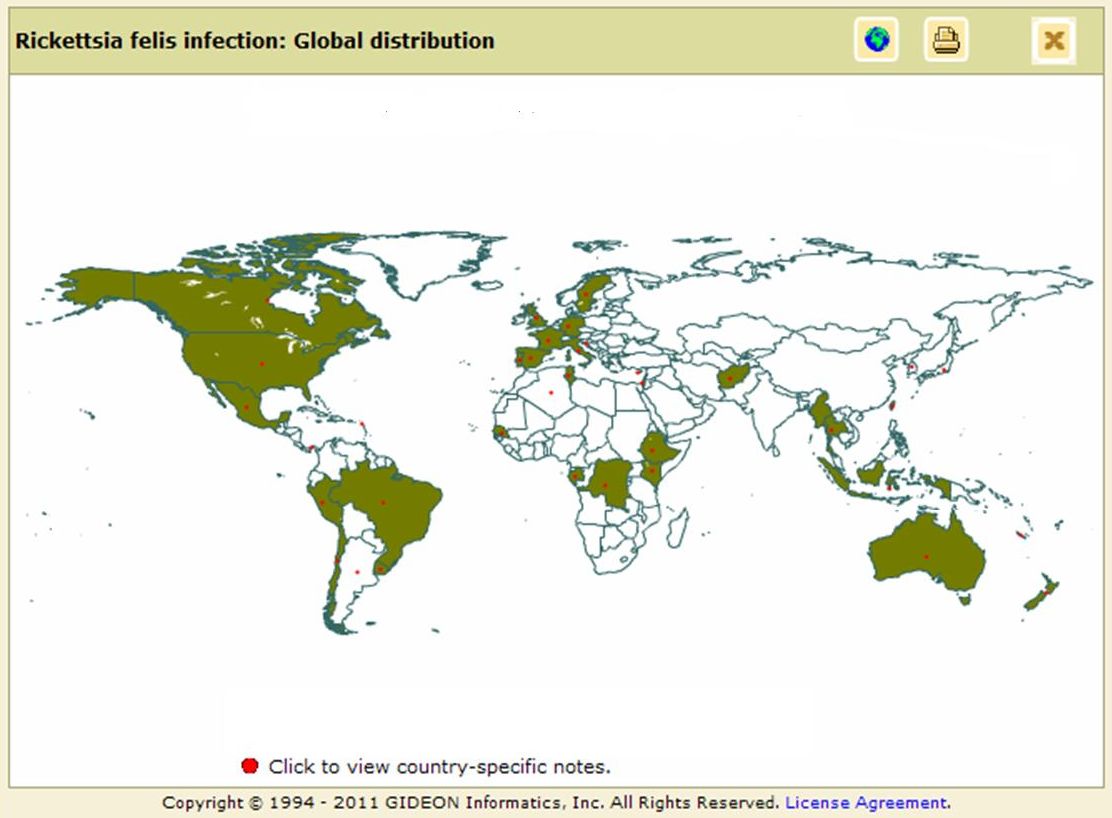
The report of a cluster of cases in Melbourne have added Australia to a growing list of countries endemic for Rickettsia felis infection. As of 2011, zoonotic and / or human disease has been reported in 32 countries. See map:

Crimean-Congo Hemorrhagic Fever in South Africa

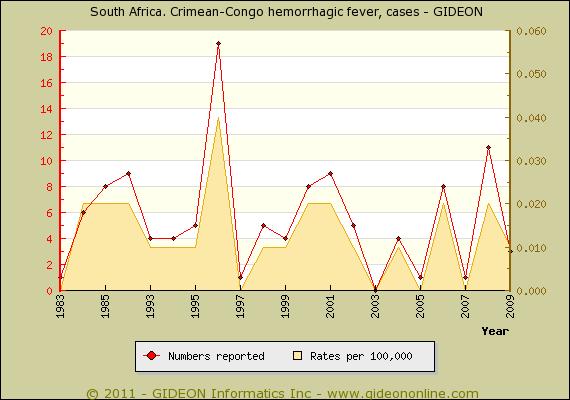
A report of recent cases in Northern Cape reminds us that the rate of Crimean Congo hemorrhagic fever in South Africa has changed little during the past 25 years. See graph:
The following background information is abstracted from the Gideon e-book series. 1,2 Primary references are available on request.

Time and Place:
The first indigenous case of CCHF in South Africa was reported in 1981 – fatal infection acquired in Transvaal. At the time of the report, 7% of persons in the area were found to be seropositive.
– Most cases are reported in the Karoo, the Western Free State, the Northern Cape and North West Province; and most are farmers, farm laborers, hunters or abattoir workers.
– Twenty-seven fatal cases were reported during 1983 to 2009.
– 16 outbreaks were reported among animals during 1981 to 1986.

Seroprevalence surveys:
100% of giraffe (Giraffa camelopardalis), 54% of rhinoceros (Ceratotherium simium) and Diceros bicornis), 46% of eland (Taurotragus oryx), 19.5% of buffalo (Syncerus caffer), 22% of kudu (Tragelaphus strepsiceros), 17% of zebra (Equus burchelli), 6.0% of domestic dogs, 13.7% of hares, 1.7% of rodents and 0% of primates (South Africa and Zimbabwe, 1987 publication)
28% of cattle (1987 publication)

Subclinical infection is common among cattle, hares and sheep.

Vectors:
– The principal vector is Hyalomma truncatum.
– H. marginatum rufipes and H. m. turanicum have also been incriminated.

Notable outbreaks:
1984 – An outbreak (5 cases, 1 fatal) of Crimean-Congo hemorrhagic fever was reported in Orange Free State.
1985 – An outbreak (6 cases, 1 fatal) was reported at a hospital near Cape Town, among health-care workers who had contact with an index patient or his secretions.
1996 – An outbreak (32 suspect cases, 17 confirmed; one fatal) was reported at an ostrich abattoir in Oudtshoorn (Western Cape).

1. Berger SA. Infectious Diseases of South Africa, 2010, 411. pp. Gideon e-book series https://www.gideononline.com/ebooks/country/infectious-diseases-of-south-africa/
2. Berger SA. Crimean-Congo Hemorrhagic Fever: Global Status, 2010, 31. pp. Gideon e-book series https://www.gideononline.com/ebooks/disease/crimean-congo-hemorrhagic-fever-global-status/
Cryptosporidiosis in Sweden

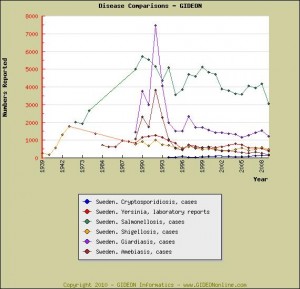
Prior to a recent outbreak in Jamtland, Cryptosporidium had been the least common reported cause of diarrhea in Sweden – see graph

The following background data are abstracted from the Gideon e-book series. 1,2

Prevalence surveys:
2% of adult patients with diarrhea (2000 publication)
24% of untreated surface water supplies in 1996; 40% in 1997
52% of calves, 29% of young stock and 5.6% of cows in dairy herds (2005 to 2007)

One waterborne outbreak was reported during 1986 to 1996.

Notable outbreaks:
2002 – An outbreak (800 to 1,000 cases) was reported among visitors to a public swimming pool.
2007 – An outbreak was reported at a daycare center in the Stockholm area.
2007 – An outbreak (25 cases) was reported among Swedish guests at a hotel in Norway.
2008 – An outbreak (21 cases) was reported among guests at a wedding reception in a hotel in Stockholm.

References:
1. Berger SA. Infectious Diseases of Sweden, 2010, 414 pp., 1,219 references. Gideon e-book series, https://www.gideononline.com/ebooks/country/infectious-diseases-of-sweden/
2. Berger SA. Cryptosporidiosis: Global Status, 2010, 66 pp., 843 references. Gideon e-book series, https://www.gideononline.com/ebooks/disease/cryptosporidiosis-global-status/

Update: Reported in ProMED

Rabies in the Philippines

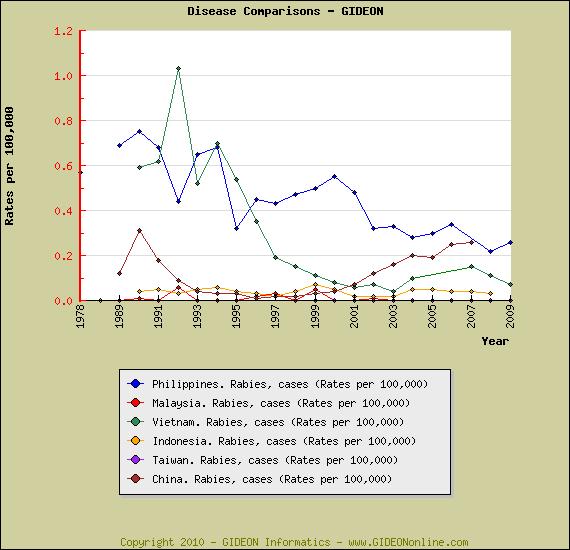
Although the incidence of rabies has declined somewhat in recent years, disease rates per 100,000 continue to be higher in the Philippines than those of neighboring countries. [1,2] See graph

References:
1. Berger SA. Infectious Diseases of the Philippines, 2010, 1,131 pp. Gideon e-book series. https://www.gideononline.com/ebooks/country/infectious-diseases-of-the-philippines/
2. Berger SA. Rabies: Global Status, 2010, 353 pp. Gideon e-book series.  https://www.gideononline.com/ebooks/disease/rabies-global-status/

Cholera – Not Just Haiti

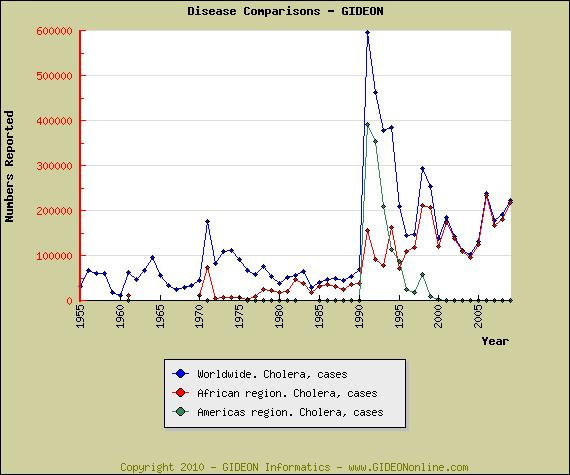
Although the world is currently focused on a serious outbreak of cholera in Haiti, the disease continues to be active in several other areas of the world. The following outbreaks were posted during November, concurrent to the events in Haiti:

  • Benin – An outbreak (846 cases, 7 fatal) was reported.
  • Cameroon – An outbreak (10,000 cases, 597 fatal)
  • Chad – An outbreak (4,000 cases, 135 fatal) was reported.
  • China – Outbreaks were reported in Jiangsu and Anhui
  • Ghana – An outbreak was reported in the Eastern region
  • Haiti – 16,799 cases, 1,034 fatal
  • India – Outbreaks were reported in Jammu and Kashmir, Maharashtra, Assam, Orissa, Tamil Nadu and Gujarat.
  • Nigeria – Outbreaks (38,173 cases, 1,555 fatal) involved 11 states.
  • Pakistan – Large outbreaks have followed local flooding.
  • Papua New Guinea – Outbreaks (2,000 cases, 40 fatal) were reported in East Sepik, Madang and Morobe Provinces.
  • Zambia – An outbreak (70 cases) was reported in Copperbelt.
  • Zimbabwe – Multiple outbreaks, over 100,000 cases (4,500 fatal) total since 2008.

Ebooks review in Clinical Infectious Diseases

GIDEON ebooks series review by Dr. Mary Wilson, Associate Professor of Global Health and Population, Harvard School of Public Health has appeared in the journal Clinical Infectious Diseases (CID 2010; 51(10):1227–1228).

Some excerpts:

[GIDEON] has now developed the GIDEON e-books system. This massive database, 411 books with 95,000 pages, presents material in 2 formats, by country and by infectious disease. Data are culled from papers published in journals, textbooks, Health Ministry publications, and materials from the Centers for Disease Control and Prevention and the World Health Organization.

…

The advantages of the system are many. It is an extraordinary database. It assembles a vast amount of material and makes it available in a consistent format.

GIDEON Sign In